


CMS released the CY 2027 Medicare Physician Fee Schedule final rule (CMS-1848-F) on November 4, 2026. It takes effect on January 1, 2027, and is scheduled for publication in the Federal Register on November 9 (CMS fact sheet; final rule, public inspection copy). For most practices, three changes matter first: a lower conversion factor, a modifier in place of G2211, and a payment cut for some same-day visits billed with modifier 25.
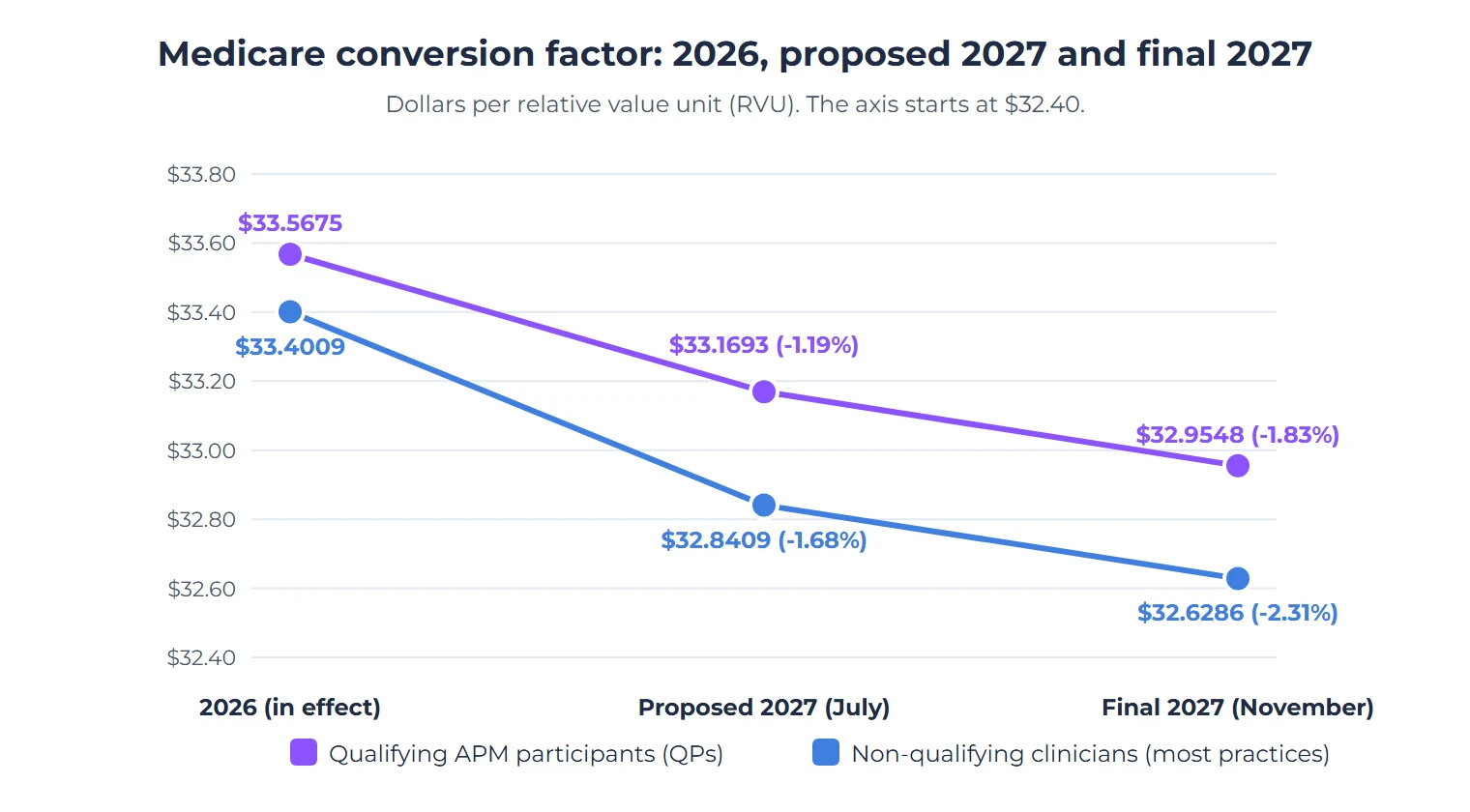
The cut is deeper than CMS proposed in July. The conversion factor for most clinicians falls 2.31%, to $32.6286, against a proposed 1.68%. This guide covers what CMS finalized, what it means in dollars, and what to change in your fee schedule, superbills and payer contracts before January 1.
Key Takeaways
- The 2027 conversion factor is $32.6286 for most clinicians, down 2.31% from $33.4009. Qualifying APM participants get $32.9548, down 1.83%. Both are lower than the July proposal.
- The cut comes from the end of the one-year 2.5% increase that applied only to 2026, partly offset by a 0.25% statutory update.
- G2211 is replaced by modifier B1 on the E/M line itself, described by CMS as a 16% increase to the visit. Clinicians in a Shared Savings Program or LEAD Model ACO can use modifier B2, at 32%.
- An office visit billed with modifier 25 on the same day as a 0-day global procedure now pays 20% less on the lower-valued service. CMS dropped 10- and 90-day globals from the policy.
- CMS’s own documents disagree on how B1 is calculated, so wait for your Medicare contractor’s 2027 fee schedule before you load B1 rates.
What did CMS finalize in the 2027 physician fee schedule?
CMS kept most of its July proposals. Its biggest retreat was on modifier 25, and it also delayed one remote monitoring rule by two years. The final rule runs 2,468 pages, and CMS says it received about 43,100 comments on the proposed rule. This table shows how the main payment items moved between the proposed rule and the final rule.
| Item | Proposed (July 2026) | Final (November 2026) |
|---|---|---|
| Conversion factor, non-qualifying clinicians | $32.8409 (down 1.68%) | $32.6286 (down 2.31%) |
| Conversion factor, qualifying APM participants | $33.1693 (down 1.19%) | $32.9548 (down 1.83%) |
| Budget neutrality adjustment | +0.53% | -0.12% |
| G2211 complexity add-on | Replace with modifiers MOD1 (16%) and MOD2 (32%) | Finalized as modifiers B1 and B2 |
| Same-day E/M billed with modifier 25 | 50% cut, with 0-, 10- and 90-day globals | 20% cut, with 0-day globals only |
| Indirect practice cost index | Phase out over 2 years | Finalized as proposed |
| Practice expense stabilization cap | 5% a year | Finalized as proposed |
| Maternity care | New CPT codes, plus a request for comment on 15 HCPCS G-codes | New CPT codes adopted, no G-codes |
These payment changes apply to traditional Medicare Part B. Medicare Advantage plans and commercial payers follow it only as far as their contracts tie them to it.
How much will the 2027 conversion factor cut Medicare payments?
For most practices, the conversion factor alone cuts every service by 2.31% before any code-level change. CMS builds the number in three steps (final rule, Table D-B2):
- Remove the one-year 2.5% increase from the 2026 rate: $33.4009 becomes $32.5863.
- Apply the 0.25% statutory update for clinicians who are not qualifying APM participants.
- Apply the -0.12% budget neutrality adjustment. The result is $32.6286.
Qualifying APM participants (QPs) get a 0.75% update instead, which gives $32.9548. QPs are clinicians who meet CMS’s participation thresholds in an Advanced Alternative Payment Model, so a practice outside an Advanced APM bills at the non-qualifying rate. The anesthesia conversion factors are $20.1056 and $20.3068.
The 2.5% came from Public Law 119-21, and CMS’s fact sheet says it “will no longer be in effect for CY 2027.” On its own, that expiry lowers the rate 2.44%. The 0.25% update gives a little back, and the budget neutrality adjustment takes a little more. The final rate came in below the proposal for a different reason: CMS proposed a positive budget neutrality adjustment of 0.53% and finalized a negative one of 0.12%. That swing is 0.65%, which is the entire gap between the proposed and final conversion factors. The rule’s conversion factor tables do not break that swing down by policy.
In dollars, CMS’s own examples (national amounts, before geographic adjustment) show what this does to common codes (CMS-1848-F downloads, “Impact of Payment for Selected Procedures”):
- 99213, office visit: $95.19 in 2026, $92.01 in 2027 (non-facility).
- 99214: $135.61, then $131.17.
- 99203, new patient: $117.57, then $113.55.
- 27130 total hip arthroplasty and 27447 total knee arthroplasty: down 18% each, to $955.04 and $953.08 (facility).
If a payer contract pays “a percentage of the current Medicare fee schedule,” those rates drop on January 1 without anyone signing anything. A contract tied to a fixed year’s fee schedule does not move. Check which wording each of your contracts uses.
What replaces G2211 in 2027?
Modifier B1. CMS finalized replacing the G2211 add-on code with a modifier that goes on the E/M line itself, so the complexity payment no longer needs its own claim line. G2211 is not in the 2027 relative value file (Addendum B). The billing rules carry over from G2211, as our G2211 billing guide describes:
- Which visits: office and outpatient E/M visits (99202 to 99215) and home or residence visits (99341 to 99350).
- Which relationship: you are the continuing focal point for all of the patient’s needed care, or you provide ongoing care for a single serious or complex condition.
- Telehealth: allowed when the visit itself is billed as telehealth and all other rules are met.
- Not allowed: in other settings, such as skilled nursing facilities, rural health clinics, federally qualified health centers and critical access hospitals.
- Modifier 25: B1 and B2 still do not pay on a visit billed with modifier 25, except when the same-day service is an annual wellness visit, a vaccine administration or another Part B preventive service.
Modifier B2 is the ACO version, valued at 32%. Only clinicians participating in a Shared Savings Program ACO, or Participant Providers in a LEAD Model ACO, can use it. CMS’s fact sheet says B2 is voluntary and can go on visits for any patient those clinicians see, not only patients assigned or aligned to the ACO.
If your billing system holds only four modifiers per line, CMS points to the overflow rule in the Medicare Claims Processing Manual: put modifier 99 in the fourth position and list the rest in the claim’s narrative field.
How much will modifier B1 pay?
CMS has published two different methods, and they give different answers. The fact sheet says B1 will “increase the payment of the associated E/M code by 16%,” and the rule’s impact analysis describes it as 16% of the visit’s total RVUs. But the B1 and B2 crosswalk file CMS posted with the rule adds 16% to the work RVUs only. Its footnote says so, and its numbers follow it: a 99213 goes from 2.82 total RVUs to 3.03, not to 3.27.
The difference is real money. These examples use national non-facility amounts and the non-qualifying conversion factor. The 2026 column adds G2211 (0.52 RVUs) to the visit, using CMS’s RVU26D file.
| Visit | 2026: E/M plus G2211 | 2027: E/M plus B1 at 16% of the visit | 2027: E/M plus B1 per CMS’s crosswalk file |
|---|---|---|---|
| 99213 | $112.56 | $106.73 | $98.86 |
| 99214 | $152.98 | $152.15 | $141.28 |
| 99215 | $209.76 | $212.71 | $198.06 |
Under either method, a 99213 with the complexity payment pays less in 2027 than it did in 2026. That matters because, as one commenter quoted in the rule pointed out, 99213 and 99214 visits make up most primary care. CMS acknowledged the trade-off and kept the percentage approach. Until your Medicare Administrative Contractor (MAC) publishes its 2027 fee schedule, treat any B1 amount as an estimate.
The rule also does not bind Medicare Advantage plans. CMS said it “does not directly govern” how they pay contracted providers. Ask each plan, in writing, whether it will accept B1 and B2 in 2027 and how it will price them.
How does the modifier 25 payment cut work?
When an office or outpatient E/M visit (99202 to 99205 or 99211 to 99215) is billed with modifier 25 on the same day as a procedure with a 0-day global period, Medicare now pays the highest-valued service in full and the other services 20% less. The rule applies when the same practitioner, or a practitioner of the same specialty in the same group practice, bills both.
CMS proposed a 50% cut that would have covered 0-, 10- and 90-day global procedures. After comments, it finalized 20% and limited the policy to 0-day globals. It said overlap on one day of a 10- or 90-day global period is harder to measure. The cut does not apply to emergency department, inpatient or critical care visits.
Whichever service is worth less takes the cut, so sometimes it is the visit. These examples use 2027 Addendum B values at national non-facility rates:
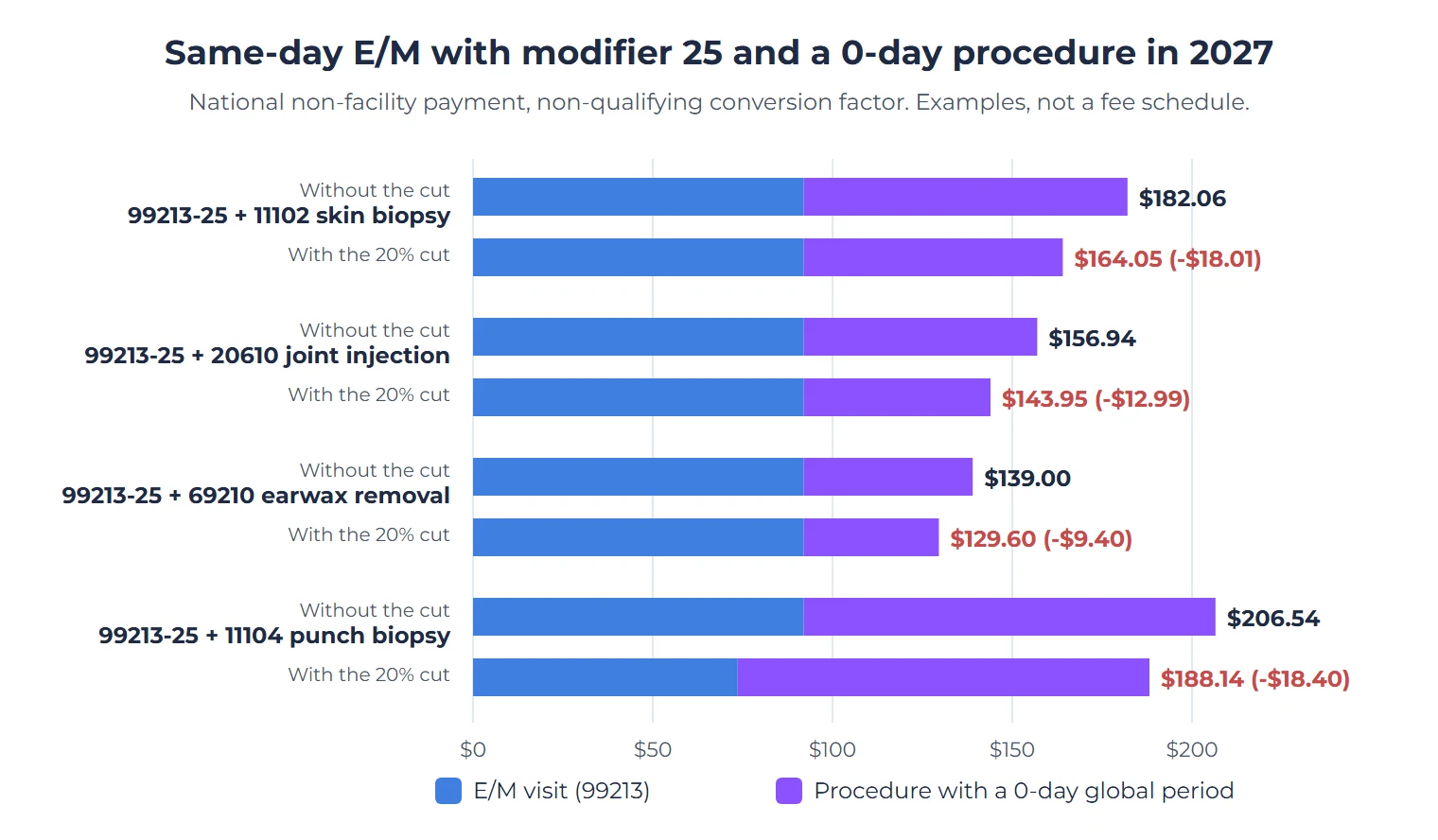
CMS expects the largest effect on dermatology, otolaryngology and podiatry, which bill these combinations most often. The rule is also clear on two points that matter for compliance:
- Same-day procedures are still allowed. CMS called patient letters that implied otherwise “highly concerning.”
- Splitting visits is a red flag. CMS said scheduling services to maximize payment is “problematic.” It plans to watch through claim edits, comparative billing reports and medical review. Bringing a patient back on another day would also raise the patient’s cost-sharing.
Modifier 25 itself has not changed. The visit still has to be significant and separately identifiable from the procedure, and the record has to show it. Our guide to modifier 24 vs modifier 25 covers what that documentation looks like.
Which specialties gain or lose under the 2027 final rule?
Behavioral health and primary care gain, and procedure-heavy specialties lose. CMS’s specialty impact file shows the effect of RVU changes only, so the 2.31% conversion factor cut comes on top of each figure.
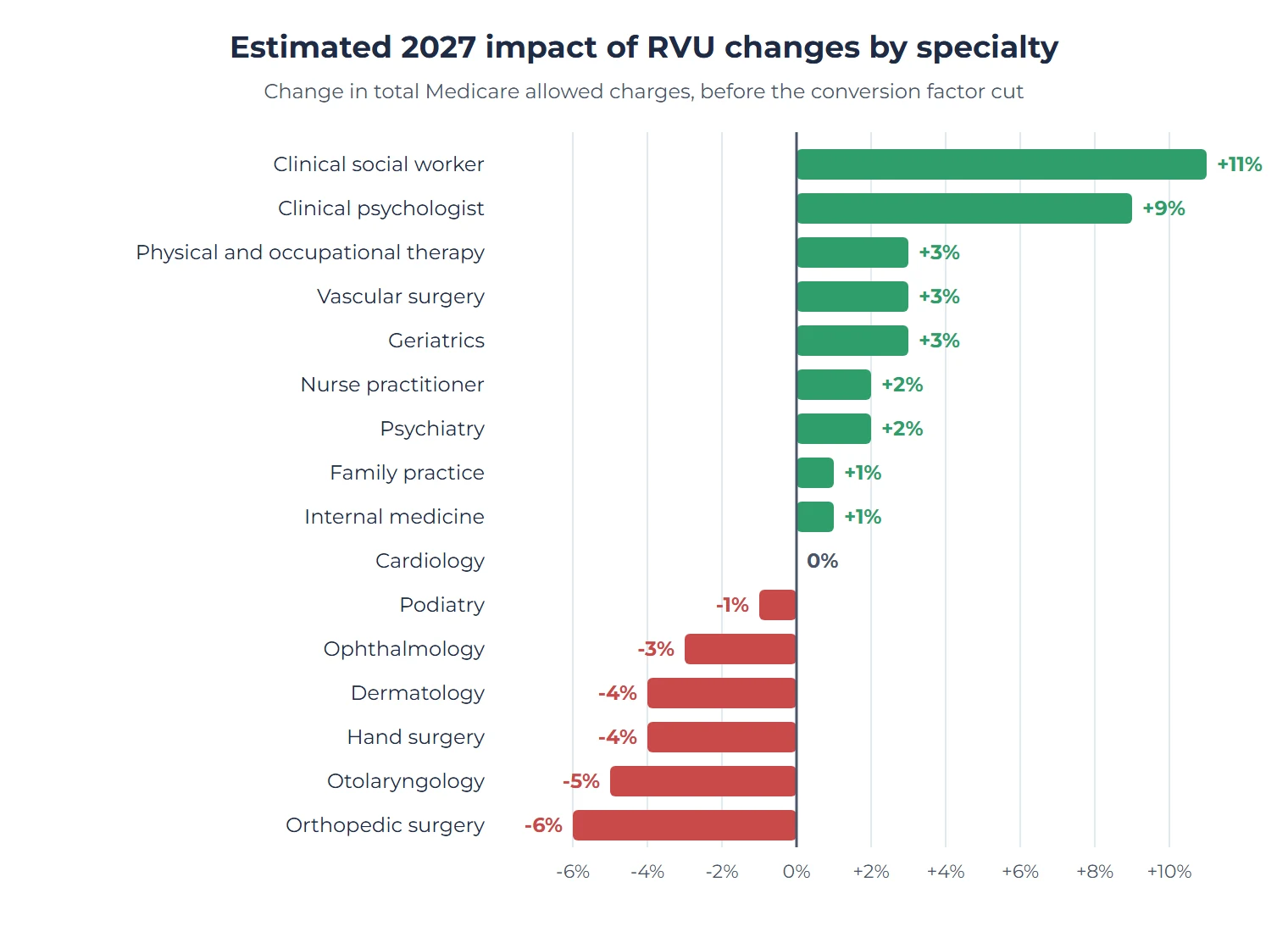
Three practice expense (PE) changes drive much of this:
- The indirect practice cost index is being removed. It anchored each specialty’s PE to survey data from 2007 or earlier. Half of its effect comes out in 2027 and the rest in 2028.
- A 5% stabilizer limits the swings. A code’s PE RVUs cannot rise or fall more than 5% in a year. The cap does not cover new, revised, newly priced or revalued codes.
- Nursing facility visits get a fix. For 99304 to 99310, 99315 and 99316, the facility PE now equals the non-facility PE. That undoes an unintended payment gap that the 2026 site-of-service change created for these visits.
There is no new efficiency adjustment for 2027. CMS applies that cut to work RVUs every 3 years and plans to post the next list of affected codes for CY 2029.
What else changes on January 1, 2027?
Several smaller changes reach the claim form on the same day:
- Telehealth. CMS added G0576, G0572, G0573, G0686, G0687 and G0903 to the Medicare telehealth list. Speech-language and therapy codes 97148, 97149, 97159, 97160, 97173 and 92654 to 92663 replace 92507, 0362T and 0373T. Modifiers BB and BC are required from January 1 and do not change payment. The flexibilities Congress extended stay in place through December 31, 2027, as covered in our Medicare telehealth billing guide.
- Teaching physicians. A teaching physician can now be present by audio and video when either the teaching physician or the resident is in the room with the patient, for services on the telehealth list.
- Maternity. CMS adopted the new CPT maternity codes, which bill prenatal visits separately instead of inside a global package. It raised work RVUs for the new labor and delivery codes about 15% above the AMA RUC’s figures and did not create the G-codes it had asked about. For pregnancies that start in 2026 and end in 2027, CMS is using HIPAA enforcement discretion so covered entities can temporarily keep using the 2026 maternity codes after January 1. Check each payer’s billing instructions.
- Advance care planning. New codes G0572 and G0573 cover advance care planning by clinical staff under direct supervision. CPT 99497 and 99498 now cover only time the billing practitioner spends personally.
- Remote monitoring. Remote therapeutic monitoring is limited to established patients, and both remote physiologic and therapeutic monitoring need a separately reportable initiating visit when the service starts. The rule that only the practice’s own employed staff can furnish these services is delayed to January 1, 2029.
- Shared medical appointments. New codes G0686 and G0687 pay for group visits.
What should your practice change before January 1?
Work through these in order. The first two affect every Medicare claim with a 2027 date of service.
- Load the 2027 fee schedule when your MAC posts it. Use your locality’s amounts, not the national examples above. At the same time, re-price any contract that pays a percentage of current Medicare rates.
- Retire G2211 for 2027 dates of service. Add B1 to the E/M lines in your EHR, superbills and charge rules, and add B2 if you participate in a Shared Savings Program or LEAD Model ACO. Keep G2211 for 2026 visits you bill late.
- Check your modifier slots. If your system holds four modifiers per line, set up the modifier 99 overflow before the first B1 claim goes out.
- Size the modifier 25 cut. Pull a recent quarter of claims with modifier 25 and a 0-day global code on the same day, and apply the 20% reduction to the lower-valued service. That tells you what the change costs you. A medical billing audit can run the same check if you want a second set of eyes.
- Keep scheduling clinical, not financial. Do the procedure on the day it is needed, and document the separately identifiable visit well.
- Update your claim scrubber. Add the BB and BC telehealth modifiers, and agree with your MAC and payers how to bill maternity episodes that cross into 2027.
- Watch for CMS guidance on B1. A CMS MLN Matters article or your MAC’s pricing may settle which calculation applies.
Two things not to do: do not lower your charges to Medicare’s new rates, because other payers may pay from your charges, and do not assume commercial payers will adopt B1 or the modifier 25 cut on January 1.
How Summit Billing Solutions handles fee schedule changes
Summit Billing Solutions was founded in 2023. It is headquartered in Salem, New Hampshire, and serves practices in all 50 states. We work inside your existing EHR and practice management system, in any specialty, and our first-pass claim rate is 95% to 98%. Code and modifier changes like the move from G2211 to B1 are part of our medical coding services.
Want to see where your billing stands before the 2027 changes take effect?
Summit Billing Solutions will look at your clean-claim rate, denial rate, aging A/R and the payers costing you the most in a free account review.
Frequently Asked Questions About the 2027 Medicare Physician Fee Schedule
1. What is the 2027 Medicare conversion factor?
The CY 2027 conversion factor is $32.6286 for clinicians who are not qualifying APM participants, down 2.31% from $33.4009 in 2026. Qualifying APM participants get $32.9548, down 1.83% from $33.5675. The anesthesia conversion factors are $20.1056 and $20.3068.
2. Is G2211 going away in 2027?
Yes. For dates of service from January 1, 2027, CMS replaced the G2211 add-on code with modifier B1, which goes on the office or home E/M line itself. The billing rules stay the same. Clinicians in a Shared Savings Program or LEAD Model ACO can use modifier B2 instead.
3. Does the modifier 25 reduction apply to 10-day and 90-day global procedures?
No. CMS proposed including them but finalized the 20% reduction only for office and outpatient E/M visits billed with modifier 25 on the same day as a 0-day global procedure. The highest-valued service is paid in full, and the others are reduced.
4. When does the 2027 physician fee schedule take effect?
The final rule takes effect on January 1, 2027. CMS released it on November 4, 2026, and it is scheduled for Federal Register publication on November 9. Medicare Administrative Contractors post their local 2027 fee schedules before January.
5. Do Medicare Advantage plans have to follow the 2027 fee schedule changes?
Not directly. The rule sets payment for traditional Medicare, and CMS said it does not govern how Medicare Advantage plans pay contracted providers. Many contracts pay a percentage of current Medicare rates, so check each contract and ask each plan how it will handle modifiers B1 and B2.