


A statement is the last step of a claim, not a separate department, and it is only right if the steps before it were right. The amount on it has to match the patient responsibility that the payer posted, less whatever was collected at the visit, which is why statements at Summit Billing Solutions are released by payment posting, once insurance has paid, and never from the charge. A Medicare patient, for example, owes the Part B deductible, $283 in 2026, and after that usually 20% of the Medicare-approved amount (Medicare.gov, Medicare costs). The patient already holds the summary notice or the explanation of benefits that says so. A statement that agrees with it gets paid; a statement that disagrees with it gets a phone call.
The cycle also has to be built for the patients who receive it. KFF’s February 2024 analysis of federal survey data found that people in the United States owe at least $220 billion in medical debt, and that about 14 million people owe more than $1,000 (KFF, The burden of medical debt in the United States). A statement in plain language, with a clear amount, a due date, an online way to pay and a plan offered before the third notice, is how a small practice gets paid by those patients without becoming one more collection call. Summit Billing Solutions runs that cycle inside your practice management system and through the print, mail or electronic statement service you already use. We are a billing company, not a print house, and the decisions are the service.
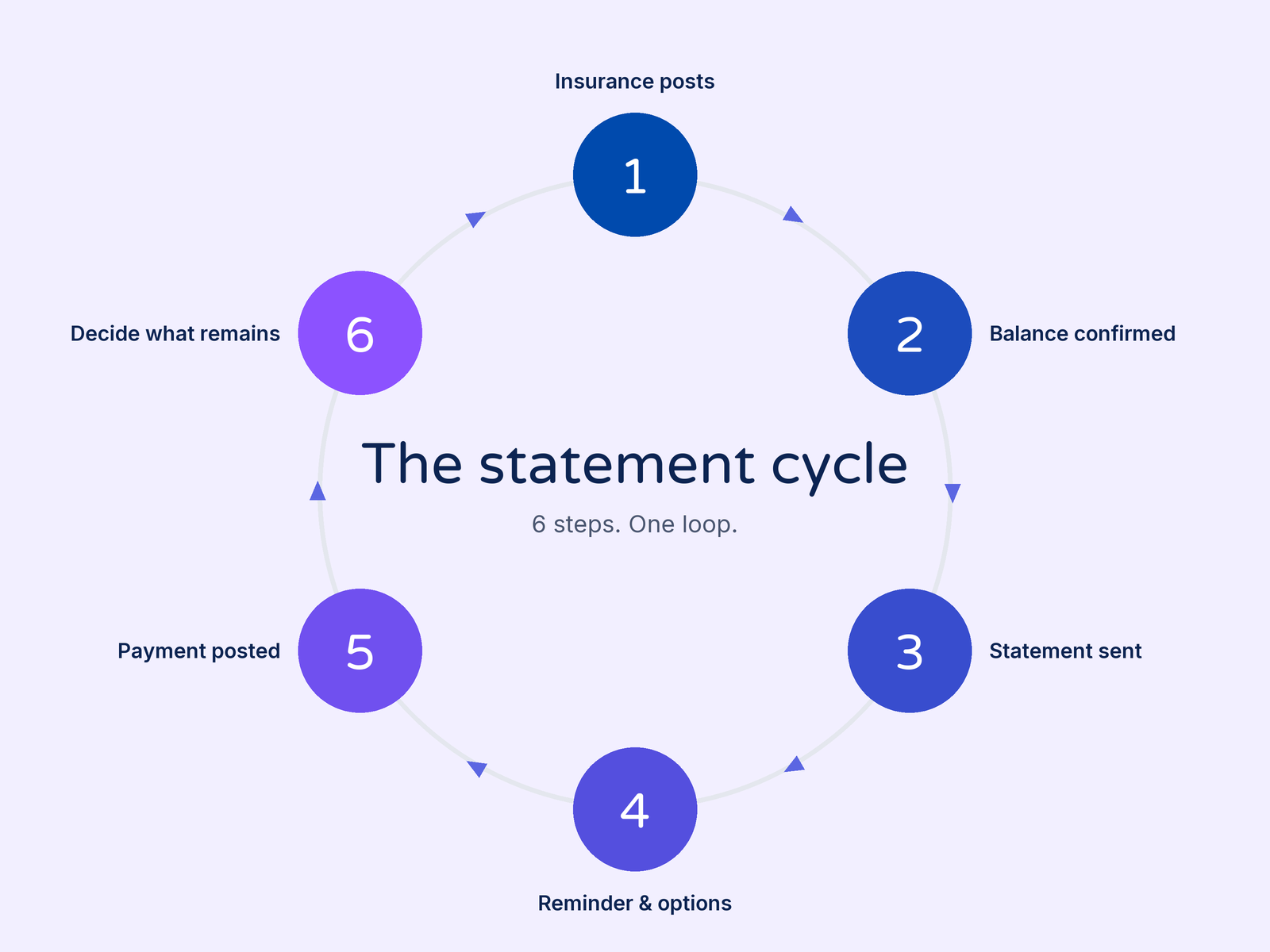
| Number | Decision | What happens | Where it goes wrong, and what we do | Related service |
|---|---|---|---|---|
| 1 | When the balance becomes the patient's | Nothing is statemented until every payer on the claim has posted: primary, secondary and any crossover. The patient responsibility on the remittance, less anything collected at the visit, is the amount the statement shows. | Statements go out before the secondary pays, or for the full charge, and the patient receives a bill that disagrees with their explanation of benefits. We release a balance to statements only after the last payer posts and the copay is applied. | Payment posting |
| 2 | The amount, checked against the remittance | The patient's share is the copay, coinsurance and deductible the plan assigned, nothing more. Those amounts are known before the visit when eligibility is checked, so the front desk collects the copay and the statement covers only what is left. | Contractual adjustments are missed and written to the patient, or a copay paid at check-in is billed again and refunded later. We tie every statement line to the posted remittance and to the payments already taken, before it goes out. | Eligibility verification |
| 3 | What the statement says | Date of service, the provider, a plain description of the service, what was billed, what insurance paid and adjusted, what was paid at the visit, what is due now, the due date, and every way to pay, on one page. | The system's default template prints procedure codes and a running balance with no due date, and the patient calls instead of paying. We set up the statement layout in your system so it can be read without a call, with the online payment link on it. | Medical billing |
| 4 | Cadence and follow-up | Statements run on a fixed schedule, usually every 30 days for up to three cycles, with a reminder by text or email between them where the practice allows it, and a phone call before the last one goes out. | Statements run when someone has time, and a balance is four months old before anyone follows up. We run the cycle on the calendar and follow up before the balance ages, because collectability drops with every month a statement is late. | A/R recovery |
| 5 | Payment options and plans | Online payment from the statement, card on file where the practice offers it, and a payment plan offered in writing on the statement for any balance above a threshold the practice sets. | The only option is a check in the mail, and larger balances are left to fail. We offer the plan before the third statement, set it up in your system with the patient's agreement, and post each installment the day it arrives. | Patient payment tools |
| 6 | Uninsured and self-pay patients | Patients without insurance, or who choose not to use it, must be given a good faith estimate when care is scheduled or when they ask, under the No Surprises Act provider rules in force since January 1, 2022. The statement is then checked against that estimate. | No estimate is given, or the bill runs past it: a bill at least $400 above the estimate can be taken to the federal patient-provider dispute process. We keep the estimate with the account and hold any statement that exceeds it for your review first. | Revenue cycle management |
| 7 | Small balances, write-offs and collections | After the last statement, each unpaid balance gets a decision: a small-balance write-off under the threshold you set, a final notice, or placement with the collection agency you choose. The practice makes the call; we prepare the list and the history. | Balances sit open for years, or accounts go to an agency without a final notice, and a patient hears from a collector about a bill they never understood. We send a monthly decision list with the statement history behind every account on it. | A/R clean-up |
| Compare | Default statement run | Summit Billing Solutions |
|---|---|---|
| Timing | Whenever the statement batch is run, sometimes before the secondary pays. | The week the last payer posts, and never before. |
| Amount | Whatever the account balance says. | Tied to the patient responsibility on the remittance, less what was paid at the visit. |
| What the patient sees | Procedure codes and a running balance, no due date. | A plain description, what insurance paid, what is due, a due date and every way to pay. |
| Ways to pay | A check in the mail. | Online from the statement, card on file where you offer it, and a written plan above your threshold. |
| Follow-up | Another statement, maybe. | A reminder between cycles, a plan on the second statement, a call before the third. |
| Unpaid balances | Sit open, or go to an agency unreviewed. | A monthly decision list: write off, final notice or place, with the history, and you decide. |
We pull your patient balances by age, the balances that were never statemented, the statements sent against the payments received, and the credits created by copays billed twice, and show you what is still collectable, whether or not you go further with us.
We set up the statement layout in your practice management system, agree the rules in writing (cycles, days between them, the plan threshold, the small-balance write-off, the agency you use), add the online payment link and switch on text or email reminders where you allow them. Most practices go live within two weeks.
Balances are released to statements the week the last payer posts. Statements go out through your system or your statement vendor, reminders follow, plans are offered and set up, and every patient payment is posted the day it arrives, online, by card or by check.
Statements sent and paid by cycle, patient balances by age, plans active and in arrears, credits and refunds, and the decision list for balances past the last statement, reviewed with your named contact on the weekly call.


We sign a Business Associate Agreement with every practice before we handle any patient information, as HIPAA requires.
You know who is working your account, and you hear from them every week. A familiar face, not a ticket queue.
If we are not earning the relationship, you can leave. That keeps us honest.
We are in Salem, NH, and we bill for practices nationwide, with the state-by-state payer knowledge that takes.
95-98%
First-pass claim rate
24 hrs
Claims submitted within
28
Average days in A/R

I’ve been in billing for 30+ years and Summit is the best I’ve worked with. They’re knowledgeable, detailed, and persistent to get claims paid instead of writing them off. They take the burden off providers so we can focus on patients.

We billed in-house for decades, but it was time for a change. I couldn’t be happier with Summit. The transition was seamless thanks to their strong systems and clear communication. If you’re considering a switch, talk to Summit.


When Summit Billing Solutions handles your billing, the statement cycle is part of the service, inside the fee of 3% to 9% of monthly collections. Patient balances are a growing share of what a practice collects, so the cycle is never an add-on.
A practice that keeps its billing in house can have the statement cycle alone. That is quoted after the free account review, based on how many statements go out each month, how many cycles you want, and whether you want reminders by text or email and plans set up by us, because those things decide the effort. Printing, postage and any statement vendor’s charge stay with the vendor you use; we do not mark them up. We do not quote a collection percentage; we describe the cycle. How billing companies structure their fees more generally is covered in our guide to medical billing pricing.
50A Northwestern Dr Ste 3, Salem, NH 03079-4827
603-207-3172
(866) 906-3116
info@summitbillingsolutions.com
Mon - Fri @ 9am - 5pm
Summit Billing Solutions has been one of the best decisions for my business. They’re responsive, transparent, and make billing feel organized and manageable. They truly feel like a partner, not a vendor. Highly recommend.