


Denial management in medical billing sits between claim submission and payment. Every remittance carries claim adjustment reason codes, the X12 codes that describe why a claim or service line was paid differently than it was billed, and those codes are where the work starts. Summit Billing Solutions reads them daily, works each denial inside your practice management system, and reports every month on which payers and which reasons cost you the most.
The scale is not small. Among the ACA marketplace plans sold on HealthCare.gov, the one segment where CMS publishes the figures, insurers denied 20% of in-network claims in 2023, fewer than 1% of those denials were appealed, and insurers upheld 56% of the appeals that were filed (KFF, January 2025). Read the other way: more than four in ten of the few appeals that were made changed the decision, and almost nobody appealed.
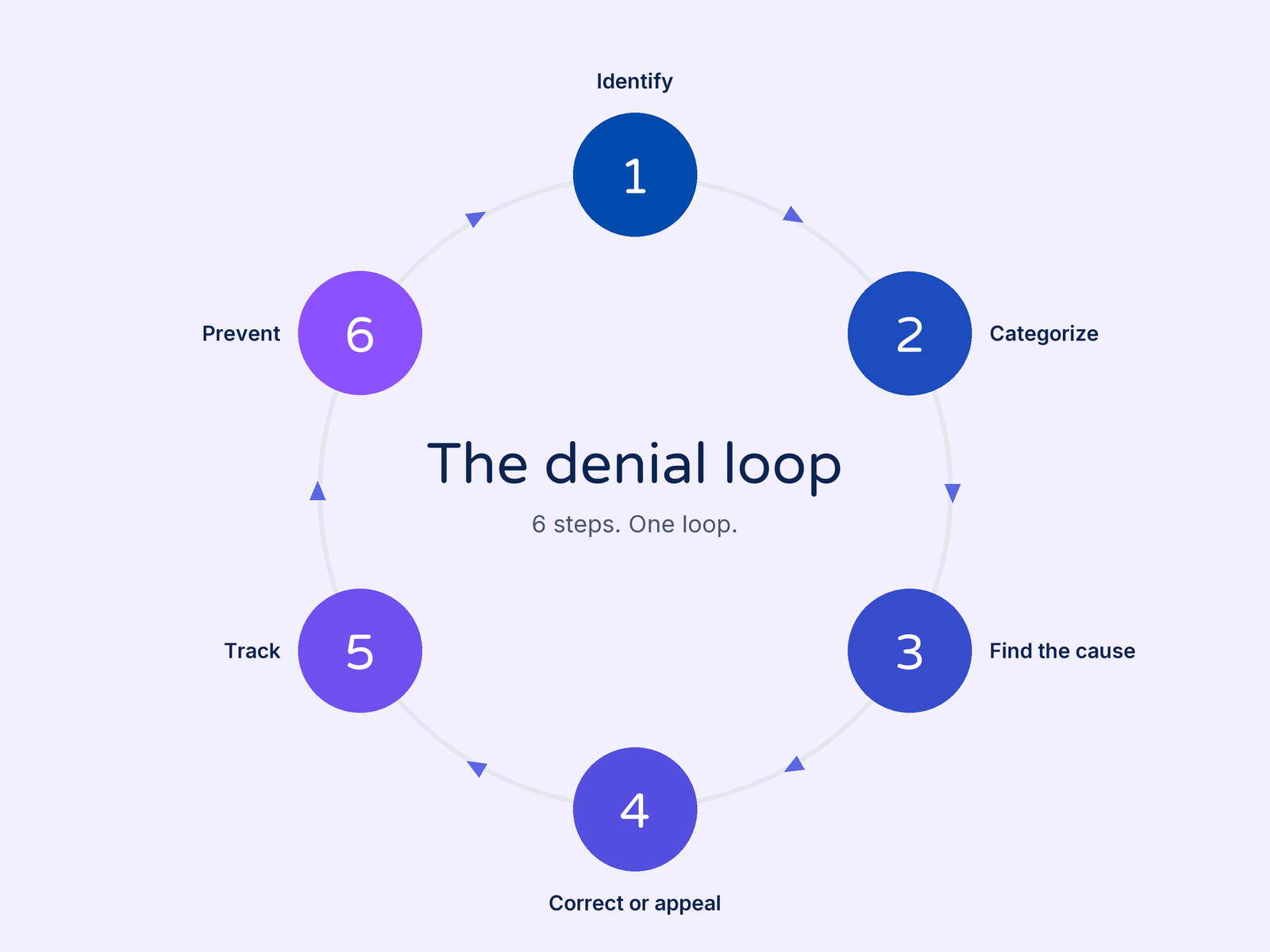
| Number | Denial category | What triggers it | What we do, and how it is prevented | Related service |
|---|---|---|---|---|
| 1 | Eligibility & registration | Coverage was inactive on the date of service, the patient was on a different plan, or the demographics on the claim did not match the payer's record. Typical reason codes: CARC 27, 31 and 140. | We correct the identifier or bill the right plan and resubmit as a corrected claim. Prevention: eligibility is verified before every visit, which is the only stage where this denial is cheap to fix. | Eligibility verification |
| 2 | Authorization & referral | The service needed prior authorization or a referral and none was on file, it had expired, or it did not match the procedure performed. CARC 197 and 198. | If an authorization exists we attach it and resubmit. If it was obtained late, we request a retro-authorization where the payer allows one and appeal with the clinical notes where it does not. Most contracts bar billing the patient for this denial, so prevention is the real fix. | Prior authorization |
| 3 | Coding & medical necessity | The diagnosis does not support the procedure, a modifier is missing or wrong, the service is bundled into another, or the payer's policy calls the service not medically necessary. CARC 4, 11, 50 and 97. | A coder reviews the note against the payer policy. If the code or modifier was wrong, a corrected claim goes out; if the coding was right, we appeal with the documentation and the policy citation. Prevention: coding review before submission, and the policy added to the scrubber. | Medical coding |
| 4 | Timely filing | The claim reached the payer after its filing deadline. CARC 29. Every payer sets its own limit, and some are measured in weeks. | We appeal only when we can prove earlier submission, with the clearinghouse acceptance report. Otherwise this denial is final and the balance cannot be billed to the patient. Prevention alone fixes it: claims out within 24 hours, rejections worked the same day. | Medical billing |
| 5 | Duplicate, bundling & coordination of benefits | The payer thinks it already processed the claim, another payer should have been billed first, or the primary payer's information is missing. CARC 18, 22 and 23. | We confirm which payer is primary, attach the primary remittance and refile in the right order; true duplicates are closed, not re-sent. Prevention: coordination of benefits confirmed at eligibility, and secondary claims filed only after the primary pays. | Secondary claims & COB |
| 6 | Documentation & records requests | The payer needs records before it will pay, or the records sent did not answer the request. CARC 16 and 252, usually with a remark code naming what is missing. | We pull the exact documents the remark code asks for, send them through the payer's channel, and track the claim until it is reprocessed. Prevention: the records payers ask for most are attached at submission for the services that always trigger the request. | Medical billing audit |
| Compare | Resubmit and hope | Summit Billing Solutions |
|---|---|---|
| What gets worked | The denials somebody notices in the remittance, usually the large ones. | Every denied line, read from the reason and remark codes daily, sorted by cause and by dollar. |
| Speed | Whenever there is time, which is often after the appeal window has closed. | Corrected claims out within days of the denial; appeals filed inside the payer's window, with the date tracked. |
| Appeals | Rare, because writing one takes an hour nobody has. | Filed whenever the evidence supports it, with the documentation and the policy citation attached. |
| Recurrence | The same denial returns next month because the cause was never touched. | Each recurring denial is traced to the step that produced it, and that step is changed. |
| Visibility | A vague sense that one payer is difficult. | Denials by payer, by reason and by dollar in the monthly report, reviewed on the weekly call. |
| Write-offs | Decided in a hurry, often for claims that could still have been appealed. | Written off only with a reason, after the appeal options are exhausted, and reported to you. |
We pull your denials for the last 90 days from your practice management system, sort them by payer, reason and dollar, and show you which categories are costing you the most, whether or not you go further with us.
Open denials are sorted by how close they are to a filing or appeal deadline. The ones that can still be corrected or appealed are worked first; the ones past every deadline are listed for you, with a reason, before anything is written off.
New denials are read from the remittances every day, corrected and resubmitted or appealed, and tracked to their decision. Recurring denials are traced to the front-end step that produced them, and that step is changed.
Denials by payer, by reason and by dollar; appeals filed, won and pending; and what changed upstream as a result. Reviewed with your named contact on the weekly call.


We sign a Business Associate Agreement with every practice before we handle any patient information, as HIPAA requires.
You know who is working your account, and you hear from them every week. A familiar face, not a ticket queue.
If we are not earning the relationship, you can leave. That keeps us honest.
We are in Salem, NH, and we bill for practices nationwide, with the state-by-state payer knowledge that takes.
95-98%
First-pass claim rate
24 hrs
Claims submitted within
28
Average days in A/R

I’ve been in billing for 30+ years and Summit is the best I’ve worked with. They’re knowledgeable, detailed, and persistent to get claims paid instead of writing them off. They take the burden off providers so we can focus on patients.

We billed in-house for decades, but it was time for a change. I couldn’t be happier with Summit. The transition was seamless thanks to their strong systems and clear communication. If you’re considering a switch, talk to Summit.


When Summit Billing Solutions handles your billing, denial management is part of the service, inside the fee of 3% to 9% of monthly collections. It is not an add-on, because a denial worked well is the difference between a claim that pays and one that does not.
A practice that keeps its billing in house can hand over a backlog of denied and aging claims as a project. Project work is quoted after the free account review, once we have seen how many claims are open, how old they are and how many are still inside a deadline, because those three things decide the effort. How billing companies structure their fees more generally is covered in our guide to medical billing pricing.
50A Northwestern Dr Ste 3, Salem, NH 03079-4827
603-207-3172
(866) 906-3116
info@summitbillingsolutions.com
Mon - Fri @ 9am - 5pm
Summit Billing Solutions has been one of the best decisions for my business. They’re responsive, transparent, and make billing feel organized and manageable. They truly feel like a partner, not a vendor. Highly recommend.