


Practices are out of network in two ways. Some choose it, most often in behavioral health, where the plan’s contracted rate does not cover the hour. Others land in it, when a patient’s employer changes plans or a new provider was never credentialed with a plan the practice bills every day. Either way the plan pays by its out-of-network benefit, usually a percentage of an allowed amount the plan sets itself, after a separate out-of-network deductible, and the difference between the charge and that allowed amount is the balance. Whether the patient can be billed that balance depends on where the care happened. Since January 1, 2022 the No Surprises Act has protected patients from out-of-network balance bills for emergency room visits, non-emergency care related to a visit to an in-network hospital, hospital outpatient department or ambulatory surgical center, and air ambulance services (CMS, medical bill rights). For those visits the plan pays and the argument over the amount goes to open negotiation and, if needed, federal dispute resolution. Most office-based out-of-network visits fall outside those protections, so the practice’s own financial policy, the notice the patient was given, and state law decide what is billed. Summit Billing Solutions bills out-of-network practices and negotiates single case agreements, and we say plainly where the rules stop and your policy begins.
The dispute process has numbers now. From April 15, 2022 to July 31, 2026, 7,048,593 disputes were initiated in the federal independent dispute resolution process (CMS, IDR reports). In the second half of 2025, providers were the prevailing party in about 85% of payment determinations, and the prevailing offer was above the qualifying payment amount, generally the plan’s median contracted rate, in about 87% of them; emergency department services were 52% of determinations and radiology 15% (CMS, supplemental background on the 2025 public use files). It is a process built around facility-based specialties, and a small office practice uses it rarely, which is why this page treats it as one decision among seven rather than the whole service. The administrative fee is $15 per party per dispute for disputes initiated on or after June 11, 2026, down from $115 (CMS notice, June 3, 2026).
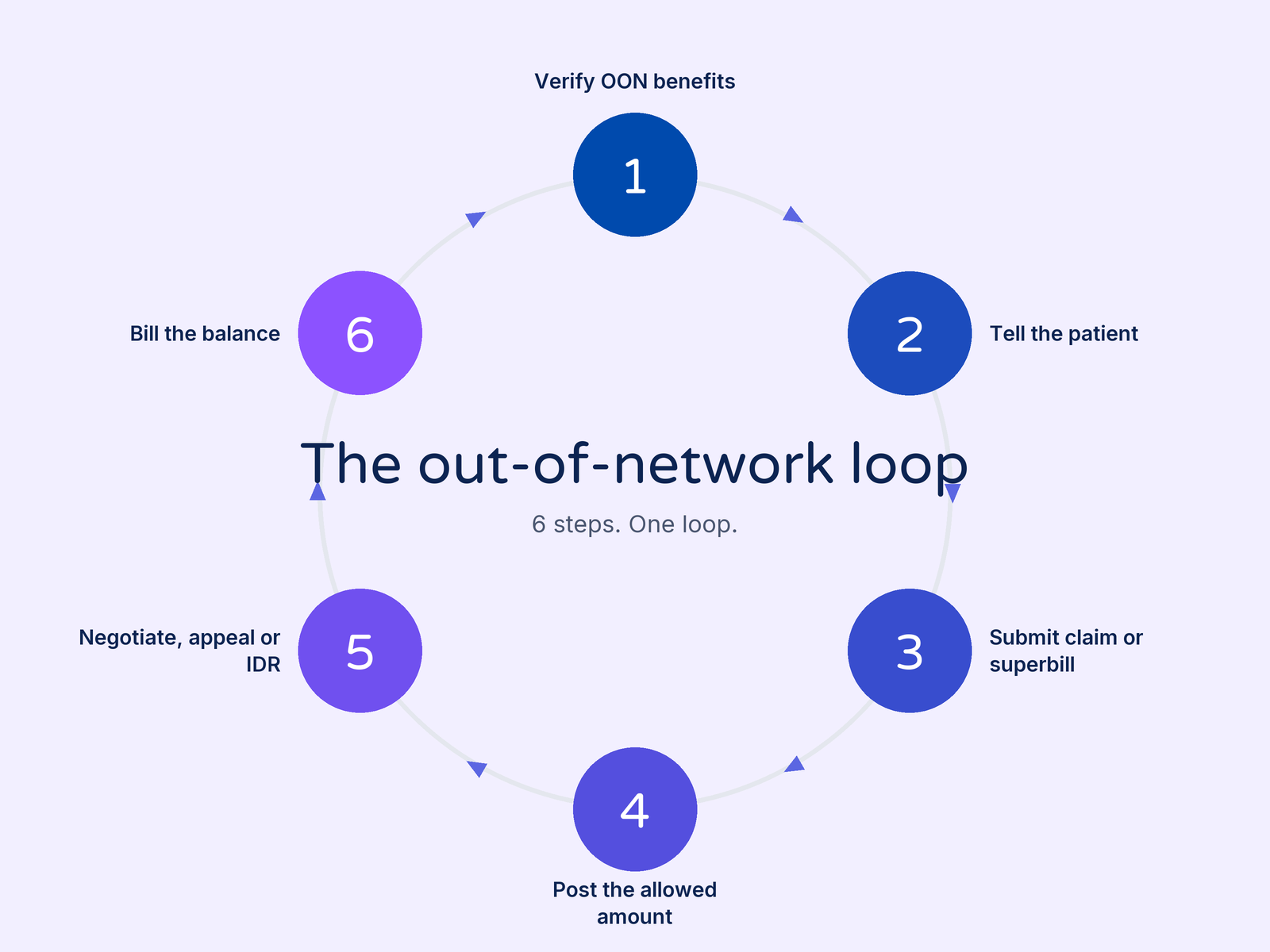
| Number | Decision | What happens | Where it goes wrong, and what we do | Related service |
|---|---|---|---|---|
| 1 | Verify the out-of-network benefit | Before the visit, the plan's out-of-network deductible, coinsurance, allowed-amount basis and any authorization requirement are confirmed, and the patient is told in writing what the plan is likely to pay and what they will owe. | The visit is billed as if the plan paid like an in-network plan, the claim pays a fraction of the charge or nothing, and the patient gets a balance nobody warned them about. We verify the out-of-network benefit for every new patient and every plan change. | Eligibility verification |
| 2 | Assignment of benefits or superbill | With a signed assignment of benefits, the claim goes to the plan and payment comes to the practice. Without one, the patient pays at the visit and receives a superbill, a coded receipt, to claim the plan's reimbursement themselves. | Superbills go out missing codes, place of service or provider identifiers, the patient's claim is rejected, and the practice fields the call. We produce complete superbills, or bill the plan directly with the assignment on file, whichever your policy chooses. | Claim submission |
| 3 | The allowed amount and the patient balance | The plan posts an allowed amount it set itself, pays its share after the out-of-network deductible, and the difference between your charge and that amount is the balance. Where the No Surprises Act does not apply, it is billable under your financial policy and state law. | The balance is written off as a contractual adjustment that never existed, or billed with no explanation and never paid. We post the allowed amount as allowed, not as contract, and statement the balance with what the plan paid shown on the statement. | Patient statements |
| 4 | No Surprises Act visits, notice and consent | For emergency care, non-emergency care at in-network hospitals, outpatient departments and surgery centers, and air ambulance, the patient owes only in-network cost sharing. Billing more needs notice and consent 72 hours ahead, never for anesthesiology, radiology, pathology or emergency care. | A patient at an in-network surgery center is balance billed, or consent is taken the same day without the 3-hour minimum. We flag every protected visit at verification, use the CMS standard notice and consent documents on time or not at all, and bill in-network cost sharing when consent is absent. | Billing compliance |
| 5 | Open negotiation and federal IDR | When a protected claim pays short, either side has 30 business days of open negotiation, then 4 business days to start federal IDR. A certified IDR entity picks one of the two offers and payment follows within 30 calendar days. The fee is $15 per party for disputes started on or after June 11, 2026. | The negotiation window is missed, the offer is filed without the plan's payment data or the qualifying payment amount, or a dispute is filed for a visit the Act does not cover. We calendar both deadlines from the remittance date, file with the evidence, and file only what is eligible. | Denial management |
| 6 | Denials, underpayments and appeals | Out-of-network claims are denied for missing authorization, out-of-network exclusions in the plan, or the allowed amount itself. Outside the No Surprises Act, the routes are the plan's internal appeal and, for state-regulated plans, external review, and they run on the plan's clock. | Denials are accepted because the plan is out of network, and short allowed amounts are never questioned. We appeal with the medical records and the plan's own out-of-network benefit language, and track every appeal to its deadline. | A/R recovery |
| 7 | Going in network instead | For some practices the out-of-network rate is worth the collection risk; for others a contract pays more, sooner. The decision is made per plan, from what the plan actually allowed and paid over the last year against the contracted rate on offer. | The choice is made on a rumor about rates. We put the numbers side by side per plan at the account review, and when a contract wins, credentialing and enrollment start the same week. | Medical credentialing |
| Compare | Billed like in-network | Summit Billing Solutions |
|---|---|---|
| Before the visit | The card is copied. Network status is discovered on the remittance. | Out-of-network benefit verified, and the likely cost given to the patient in writing. |
| The claim | Sent like any other claim, or a superbill scribbled at checkout. | Billed with the assignment of benefits on file, or a complete superbill the same day. |
| The allowed amount | Posted as a contractual write-off. | Posted as allowed, questioned when it is low, appealed with the plan's own benefit language. |
| The patient balance | Billed without explanation, or not at all. | Billed under your written policy and state law, with what the plan paid shown on the statement. |
| No Surprises Act visits | Treated like every other visit. | Flagged at verification; standard notice and consent on time or not at all; in-network cost sharing when consent is absent. |
| When the plan will not pay enough | Accepted. | A single case agreement requested, an appeal filed, or a federal dispute started inside its deadlines. |
We pull a year of your out-of-network claims by plan: charged, allowed and paid, the balances billed to patients and collected, the single case agreements in place, and any No Surprises Act claims that paid short. You see what the out-of-network side is worth, whether or not you go further with us.
We agree your financial policy in writing: assignment of benefits or superbills, how balances are billed, notice and consent for protected visits, and which plans to approach for agreements or contracts. We load each plan's out-of-network rules into verification and connect your system. Most are live within two weeks.
Every new patient and plan change is verified for out-of-network benefits, and the patient told in writing. Claims go out within 24 hours with the assignment on file, or superbills the same day. Allowed amounts post as allowed, short payments are questioned, and negotiation and appeal deadlines are calendared.
Out-of-network collections by plan against charges and allowed amounts, patient balances billed and collected, single case agreements active and expiring, appeals and disputes open with their deadlines, and the plans where a contract would now pay more, reviewed with your named contact on the weekly call.


We sign a Business Associate Agreement with every practice before we handle any patient information, as HIPAA requires.
You know who is working your account, and you hear from them every week. A familiar face, not a ticket queue.
If we are not earning the relationship, you can leave. That keeps us honest.
We are in Salem, NH, and we bill for practices nationwide, with the state-by-state payer knowledge that takes.
95-98%
First-pass claim rate
24 hrs
Claims submitted within
28
Average days in A/R

I’ve been in billing for 30+ years and Summit is the best I’ve worked with. They’re knowledgeable, detailed, and persistent to get claims paid instead of writing them off. They take the burden off providers so we can focus on patients.

We billed in-house for decades, but it was time for a change. I couldn’t be happier with Summit. The transition was seamless thanks to their strong systems and clear communication. If you’re considering a switch, talk to Summit.


When Summit Billing Solutions handles your billing, out-of-network claims, superbills, single case agreement requests and appeals are part of the service, inside the fee of 3% to 9% of monthly collections. A practice that is mostly out of network sits toward the upper end of that range, because every claim carries the verification, the patient conversation and the follow-up that in-network claims do not.
Federal dispute filings are quoted per dispute after the free account review, since a small office practice rarely has one. The federal administrative fee and the certified IDR entity’s fee are paid to those bodies, not to us. We do not quote a revenue increase; we show you a year of your own claims. How billing companies structure their fees more generally is covered in our guide to medical billing pricing.
50A Northwestern Dr Ste 3, Salem, NH 03079-4827
603-207-3172
(866) 906-3116
info@summitbillingsolutions.com
Mon - Fri @ 9am - 5pm
Summit Billing Solutions has been one of the best decisions for my business. They’re responsive, transparent, and make billing feel organized and manageable. They truly feel like a partner, not a vendor. Highly recommend.