


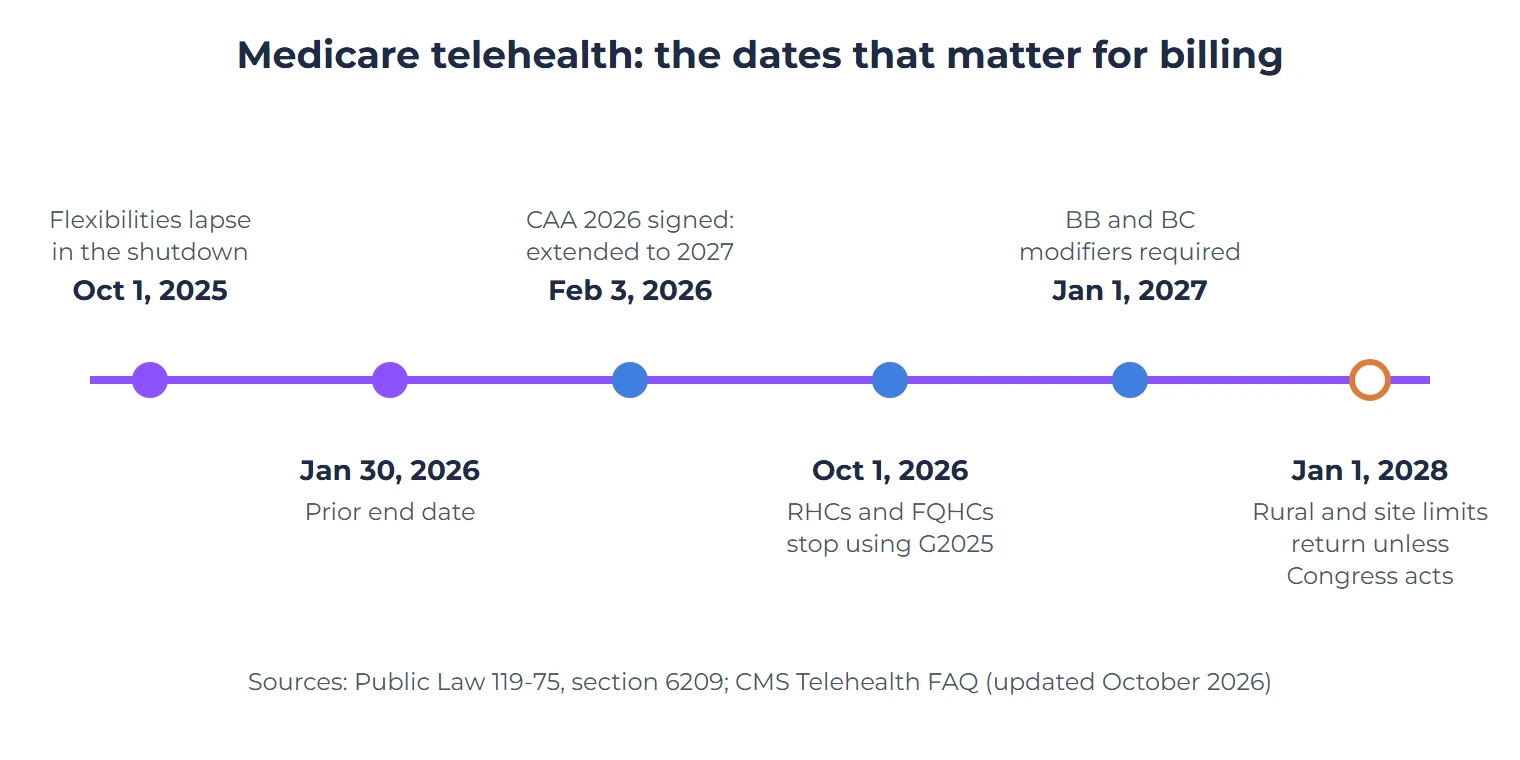
Medicare telehealth billing in 2026 follows the rules practices have used since the pandemic, and those rules now run through December 31, 2027. The Consolidated Appropriations Act, 2026 was signed on February 3, 2026. It moved the end date of Medicare’s telehealth flexibilities from January 30, 2026 to the end of 2027 (Public Law 119-75, section 6209). Until then, patients can be seen at home anywhere in the country. Physical and occupational therapists, speech-language pathologists and audiologists can bill telehealth, and audio-only visits are allowed in the home.
The claim has three parts: the same CPT or HCPCS code you would bill in person, place of service 10 or 02, and modifier 95 or 93. The details are where claims go wrong. Which POS pays more? When is audio-only allowed? What changed for RHCs and FQHCs on October 1, 2026? And what are the two new modifiers that start on January 1, 2027? Telehealth is still a regular part of Medicare care. In the second quarter of 2025, 12.5% of traditional Medicare beneficiaries used a telehealth service, nearly twice the pre-pandemic rate (KFF, March 2026). This guide answers the common billing questions for any specialty, using CMS’s own manuals, its telehealth FAQ (updated October 2026) and the 2026 fee schedule files.
Key Takeaways
- Through December 31, 2027, Medicare pays for telehealth with the patient anywhere in the United States, including at home, and therapists and audiologists can bill it.
- Bill the in-person code with POS 10 (patient at home) or POS 02 (patient elsewhere). Add modifier 95 for audio and video or 93 for audio only.
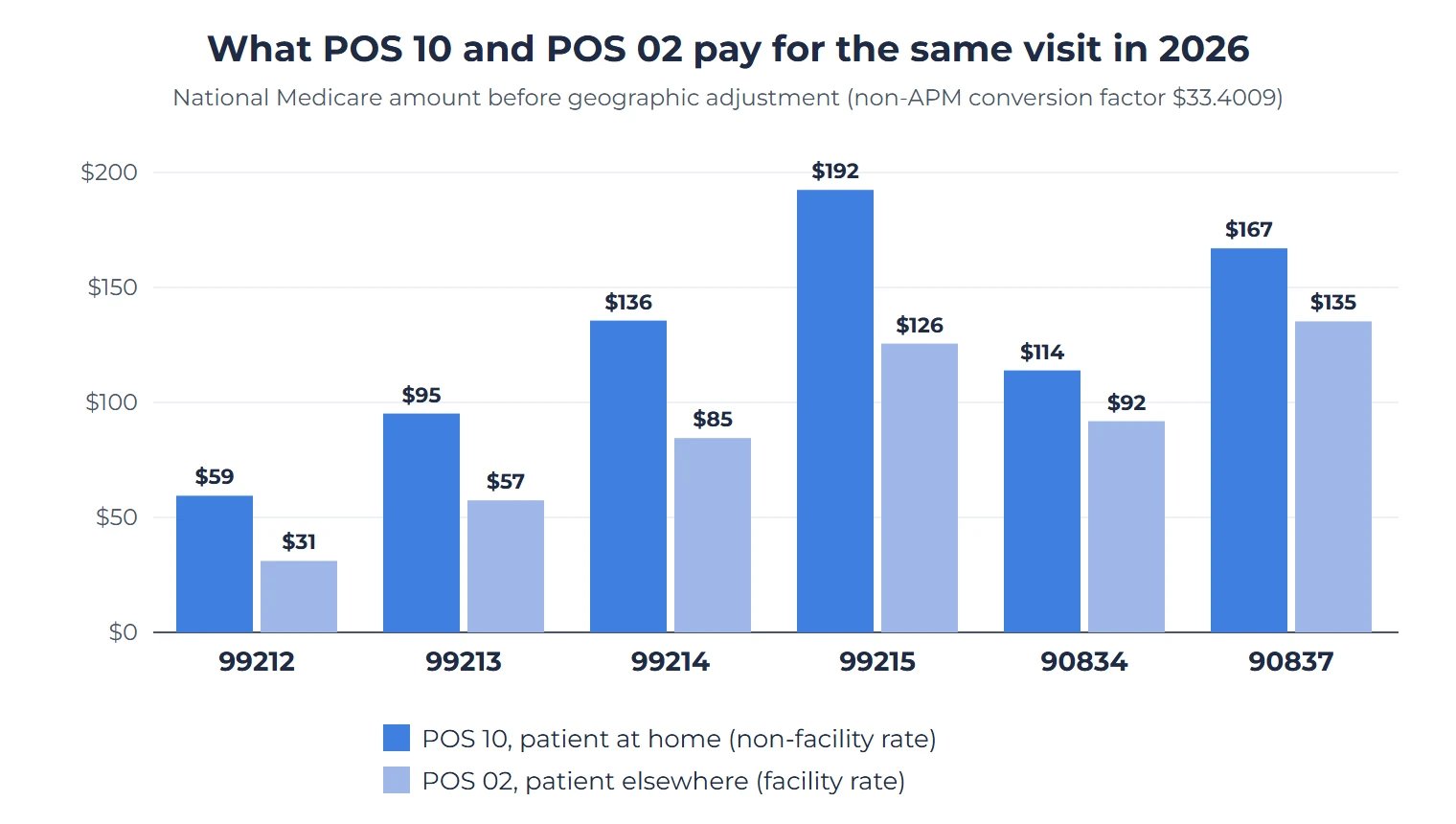
- The POS choice moves real money: a 2026 99214 pays about $135.61 nationally with POS 10 and $84.50 with POS 02.
- From January 1, 2027, CMS requires modifier BB (contracted virtual platform) and BC (incident to) where they apply. Neither changes payment.
- On January 1, 2028, the old rural and facility limits return for non-behavioral telehealth unless Congress acts again.
What did the Consolidated Appropriations Act, 2026 extend?
Section 6209 of the law changed each “January 30, 2026” end date in Medicare’s telehealth rules to “December 31, 2027”. It also delayed the mental health in-person requirement to January 1, 2028. And it told CMS to create new claim modifiers by January 1, 2027 (Public Law 119-75).
| Flexibility | Provision amended | Now runs until |
|---|---|---|
| Patient can be anywhere, including home, with no rural or facility requirement | Section 1834(m)(2)(B)(iii) and (4)(C)(iii) | December 31, 2027 |
| Physical therapists, occupational therapists, speech-language pathologists and audiologists can bill telehealth | Section 1834(m)(4)(E) | December 31, 2027 |
| RHCs and FQHCs can serve as distant sites for non-behavioral services | Section 1834(m)(8)(A) | December 31, 2027 |
| Audio-only telehealth | Section 1834(m)(9) | December 31, 2027 |
| No in-person visit required before mental health telehealth (including RHC and FQHC mental health visits) | Sections 1834(m)(7)(B)(i), 1834(y)(2) and 1834(o)(4)(B) | Delayed to January 1, 2028 |
| Hospice recertification face-to-face encounter by telehealth | Section 1814(a)(7)(D)(i)(II) | December 31, 2027, with new exceptions and a claim modifier from 2027 |
The flexibilities also lapsed earlier, from October 1, 2025, during the federal government shutdown. CMS says it will pay claims from that period as if there had been no lapse (CMS Telehealth FAQ, Q16). If you held claims from that window, they can go out under the normal rules.
Which place of service code do you use for Medicare telehealth?
Use POS 10 when the patient is at home and POS 02 when the patient is anywhere else. These are the only two valid POS codes for Medicare telehealth. The choice sets the payment. POS 10 is paid at the non-facility rate and POS 02 at the facility rate (Medicare Claims Processing Manual, chapter 26, section 10.5).
- POS 10, telehealth provided in patient’s home. “Home” means a private residence, not a hospital or other facility where the patient gets care. Medicare has paid POS 10 at the non-facility rate since January 1, 2024 (CMS Telehealth FAQ, Q8).
- POS 02, telehealth provided other than in patient’s home. Use it when the patient joins from a clinic, a hospital or any other place that isn’t home.
The patient’s location decides between POS 10 and POS 02, not the practitioner’s. A physician who sees a patient at home from the office or from their own home still reports POS 10. Billing POS 02 or 10 also certifies that the patient was at an eligible originating site (Medicare Claims Processing Manual, chapter 12, section 190.6.1). So the note should record where the patient was. When the patient is at an eligible site such as your office, that site can bill the originating site fee. The code is Q3014, and it pays $31.85 in 2026 (CMS Telehealth and Remote Monitoring booklet, MLN901705).
How much does the POS choice matter? We calculated national 2026 amounts from CMS’s October 2026 relative value file for six of the most common telehealth codes (CMS PFS relative value files, RVU26D). The gap is largest on short visits: POS 02 pays about 48% less than POS 10 on a 99212 and about 19% less on psychotherapy.
| Code | POS 10 (non-facility RVUs) | POS 02 (facility RVUs) | POS 10 national amount | POS 02 national amount |
|---|---|---|---|---|
| 99212 | 1.78 | 0.93 | $59.45 | $31.06 |
| 99213 | 2.85 | 1.72 | $95.19 | $57.45 |
| 99214 | 4.06 | 2.53 | $135.61 | $84.50 |
| 99215 | 5.76 | 3.76 | $192.39 | $125.59 |
| 90834 | 3.41 | 2.75 | $113.90 | $91.85 |
| 90837 | 5.00 | 4.05 | $167.00 | $135.27 |
These amounts use the 2026 non-APM conversion factor of $33.4009. They leave out your locality’s geographic adjustment, so treat them as illustrations, not your actual rates.
Which modifiers does Medicare require on telehealth claims?
Pair POS 02 or 10 with modifier 95 for an audio and video visit or modifier 93 for an audio-only visit. CMS’s claims manual says the POS “must be paired with the appropriate telehealth modifier”. The modifier does not change the payment rate. Only the POS does (Medicare Claims Processing Manual, chapter 26). Some Medicare Administrative Contractors publish narrower instructions for particular settings, so check your MAC’s telehealth page as well.
| Modifier | What it means | When Medicare uses it |
|---|---|---|
| 95 | Synchronous telemedicine through real-time audio and video | With POS 02 or 10 on audio-video visits |
| 93 | Synchronous telemedicine through telephone or other real-time audio-only technology | With POS 02 or 10 on audio-only visits that meet the audio-only conditions |
| GT | Via interactive audio and video | Only on institutional claims from critical access hospitals billing under optional payment Method II |
| GQ | Via asynchronous (store and forward) telecommunications | Only for federal telemedicine demonstrations in Alaska and Hawaii |
| BB | Telehealth through a virtual platform owned by an entity the practitioner contracts with, or pays for use of the platform | Required from January 1, 2027 |
| BC | Telehealth furnished incident to a physician’s or practitioner’s professional service | Required from January 1, 2027 |
The GT and GQ rows come from the claims manual’s chapter 12 and the MLN telehealth booklet; most practices will never use them.
What are modifiers BB and BC?
BB and BC are new HCPCS modifiers for Medicare telehealth claims, required from January 1, 2027. CMS says they “do not have payment implications” (CMS Telehealth FAQ, Q17 and Q18). They exist because section 6209 added paragraph (10) to section 1834(m), which requires a code or modifier on two kinds of telehealth claims:
- BB: the visit runs on a telehealth virtual platform. The practitioner either contracts with the platform’s owner or pays an entity to use it.
- BC: the telehealth service is furnished incident to a physician’s or practitioner’s professional service.
The modifiers give CMS a way to track platform-based and incident-to telehealth. Before January, list which clinicians work through a contracted telehealth platform. List which telehealth services you bill incident to. Then add both rules to your claim scrubber.
Should you bill Medicare with the new telemedicine codes 98000 to 98015?
No. CPT added codes 98000 to 98015 for audio-video and audio-only visits in 2025, but Medicare does not pay them. In CMS’s 2026 relative value file, all sixteen codes carry status indicator I. That means “not valid for Medicare purposes” (CMS PFS relative value files, RVU26D). For Medicare, bill the regular office visit code, such as 99202 to 99215, with the telehealth POS and modifier.
Code 98016, a brief communication technology-based service (the virtual check-in), is payable, but it is not a Medicare telehealth service. CMS treats virtual check-ins, remote monitoring and other non-face-to-face services as outside the telehealth rules. They don’t replace an in-person visit (CMS Telehealth FAQ, Q13). Commercial plans and Medicaid programs may want the 98000 series, so follow each payer’s own policy.
Which practitioners can bill Medicare telehealth through 2027?
Every practitioner type on Medicare’s permanent list can keep billing telehealth, and four more can bill it through December 31, 2027 (MLN901705; claims manual, chapter 12, section 190.6).
- Permanent, medical: physicians, nurse practitioners, physician assistants, nurse-midwives, clinical nurse specialists and nurse anesthetists.
- Permanent, behavioral and nutrition: clinical psychologists, clinical social workers, marriage and family therapists, mental health counselors and registered dietitians.
- Through 2027 only: physical therapists, occupational therapists, speech-language pathologists and audiologists (CMS Telehealth FAQ, Q2).
Each practitioner must also be licensed for the service under state law. CMS requires a separate Medicare enrollment for each state where the practitioner provides services. Practitioners can work from home. If they also have a physical practice location, they can enroll and bill from that location as if the visit happened there. A virtual-only practitioner has to enroll the home address. They can mark it as a “home office for administrative/telehealth use only” to hide the street address on Care Compare (CMS Telehealth FAQ, Q15). When enrollment details like these are out of date, telehealth claims can stall. Our medical credentialing and payer enrollment service keeps them current.
Can patients get telehealth at home, and is audio-only allowed?
Yes, through December 31, 2027, for any service on the Medicare telehealth list. Audio-only has conditions. Since January 1, 2025, Medicare has allowed audio-only visits when three things are true. The patient is at home. The practitioner can do video. And the patient can’t use video or doesn’t consent to it (MLN901705). Modifier 93 tells Medicare those conditions were met, so the note should say why the visit was audio-only.
For each telehealth visit, the record should show:
- Where the patient was, at home or another named location, because it drives the POS.
- How the visit happened, audio and video or audio only, and the reason for audio only.
- Where the practitioner was, if your MAC or the payer asks for it.
- The same medical decision making or total time you would document for the in-person code.
- Anyone else on the call, such as a caregiver, interpreter or resident.
What are the rules for mental and behavioral health telehealth?
Behavioral health telehealth has the most permanent rules. Since the Consolidated Appropriations Act, 2021, behavioral health telehealth has no geographic or site limits. Patients can be at home in rural or urban areas, and audio-only is allowed (CMS Telehealth FAQ, Q11).
The open question is the in-person visit. The law requires an in-person visit within six months before the first mental health telehealth service. The 2026 act delayed that rule until January 1, 2028. CMS has said patients who begin mental health telehealth at home before January 1, 2028 will be treated as established. They won’t need the six-month visit, but they will need at least one in-person visit every 12 months after December 31, 2027, with limited exceptions. A practitioner of the same specialty in the same group can furnish that visit if the treating practitioner isn’t available (CMS Telehealth FAQ, Q5).
Mental health practices should start tracking each telehealth patient’s last in-person visit date now, so the 2028 requirement doesn’t become a wave of denials. Our mental health billing and psychiatry billing pages explain how we bill these practices, and our guide to mental health insurance billing covers psychotherapy codes and add-ons.
What changed for RHCs and FQHCs on October 1, 2026?
Rural health clinics and federally qualified health centers stopped billing non-behavioral telehealth with HCPCS G2025. Through September 30, 2026, they reported G2025. From October 1, 2026, they bill the CPT or HCPCS code for the service itself, with the right telehealth modifier (CMS Telehealth FAQ, Q4). They can keep billing non-behavioral telehealth through December 31, 2027.
Behavioral health is different. Virtual mental health visits at an RHC or FQHC are paid under the all-inclusive rate or the FQHC prospective payment system. The in-person visit rule for these visits does not apply until at least January 1, 2028.
Which telehealth rules are now permanent?
The CY 2026 Physician Fee Schedule final rule made several flexibilities permanent, effective January 1, 2026 (CMS Telehealth FAQ, Q7, Q9 and Q10; MLN901705):
- Virtual direct supervision. Real-time audio and video (not audio only) can meet direct supervision. This covers services without a 010 or 090 global surgery indicator, including most incident-to services.
- Teaching physicians. A teaching physician can be present virtually for the key portion of a telehealth service, in any residency training location.
- No frequency limits on telehealth subsequent hospital visits (99231 to 99233), subsequent nursing facility visits (99307 to 99310) and critical care consultations (G0508 and G0509).
- A permanent-only telehealth list. CMS no longer adds “provisional” services. The CY 2026 list has 283 codes. They include five new ones for 2026 (90849, G0473, G0545, 92622 and 92623) and the G2211 add-on code (CMS List of Telehealth Services, CY 2026).
What happens on January 1, 2028?
Unless Congress extends the flexibilities again, most Medicare telehealth returns to its pre-pandemic limits on January 1, 2028 (CMS Telehealth FAQ, Q1 to Q6).
| Rule | Through December 31, 2027 | From January 1, 2028 |
|---|---|---|
| Where the patient can be (non-behavioral services) | Anywhere in the U.S., including home | Generally a medical facility in a rural area |
| Where the patient can be (behavioral health) | Anywhere, including home | Anywhere, including home (permanent) |
| PT, OT, SLP and audiologist telehealth | Allowed | Not allowed |
| Audio-only | Allowed in the home when the conditions are met | Behavioral health in the home only, with the same conditions |
| In-person visit for mental health telehealth | Not required | Required (within 6 months before the first visit for new patients, then every 12 months) |
| RHC and FQHC non-behavioral telehealth | Allowed | Ends |
Two groups keep more flexibility. Clinicians in applicable Shared Savings Program ACOs keep home telehealth for their prospectively assigned patients. That right comes from a 2018 law, not the 2027 extension (Q14). Behavioral health, home dialysis ESRD assessments, acute stroke and substance use disorder treatment already have permanent exceptions to the geographic rules (MLN901705).
How do you prevent Medicare telehealth denials?
Common telehealth denials come from a few mismatches, and each one can be caught before the claim goes out:
- Check the code against the telehealth list for the date of service. A code billed with POS 02 or 10 that isn’t on the list denies with CO-96 and remark code N776 (claims manual, chapter 12, section 190.7).
- Confirm the practitioner can bill it. Telehealth from a practitioner who isn’t eligible or licensed for the service denies with CO-185 (same section).
- Match the POS to the patient’s location, not the practitioner’s, and the modifier to the technology actually used.
- Add BB or BC for dates of service from January 1, 2027 when they apply.
- Follow each payer’s own rules. Medicare Advantage plans, Medicaid and commercial payers set their own telehealth policies. Their POS, modifier and code rules can differ from traditional Medicare.
If telehealth denials are already building up, our denial management team can work the backlog and fix the edit that caused it.
How Summit handles telehealth claims
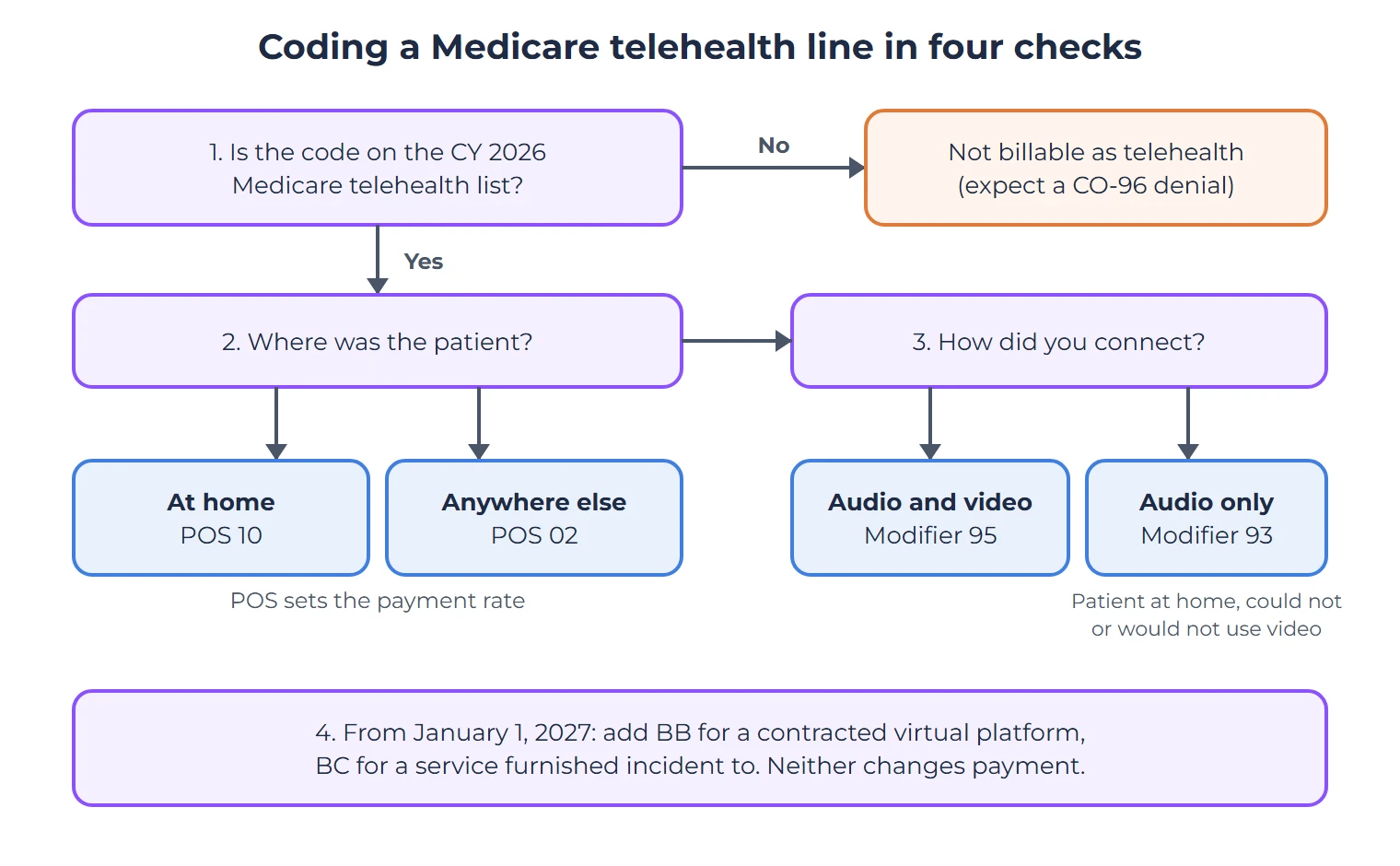
Our coders check each telehealth line against the four points in the flow chart above. That means the telehealth list, the POS, the modifier and, from January 2027, BB and BC. It’s part of our medical coding services. Practices that run mostly virtual visits can see how we bill them on our telemedicine billing page.
Want to know whether your telehealth claims are coded for the right rate?
Summit Billing Solutions will review your recent telehealth claims, POS and modifier use and denials, and show you what to fix before the January 2027 modifier change.
Frequently Asked Questions About Medicare Telehealth Billing
1. Is Medicare telehealth extended through 2027?
Yes. The Consolidated Appropriations Act, 2026, signed on February 3, 2026, extended Medicare’s telehealth flexibilities through December 31, 2027. That covers telehealth to patients at home anywhere in the country, telehealth by physical, occupational and speech therapists and audiologists, audio-only visits and RHC and FQHC telehealth.
2. Does Medicare still require modifier 95 with POS 10?
CMS’s claims manual says POS 02 or 10 must be paired with a telehealth modifier: 95 for audio and video or 93 for audio only. The modifier does not change payment; the POS does. Some MACs publish narrower instructions, so check your contractor’s telehealth guidance.
3. Can a provider bill Medicare telehealth from home?
Yes. Practitioners can furnish telehealth from their home. If they have a physical practice location, they can enroll and bill from it as if the visit happened there. A virtual-only practitioner must enroll the home address but can hide the street address from Care Compare.
4. Does Medicare pay the same for telehealth as an in-person visit?
For a patient at home, yes. POS 10 is paid at the non-facility rate, the same rate as an office visit. For a patient somewhere else, POS 02 is paid at the lower facility rate. The site where the patient is may also bill a $31.85 originating site fee in 2026.
5. What are the BB and BC telehealth modifiers?
They are Medicare telehealth modifiers required from January 1, 2027. BB marks visits on a virtual platform the practitioner contracts with or pays to use. BC marks telehealth furnished incident to a physician’s or practitioner’s service. CMS says neither modifier changes payment.