


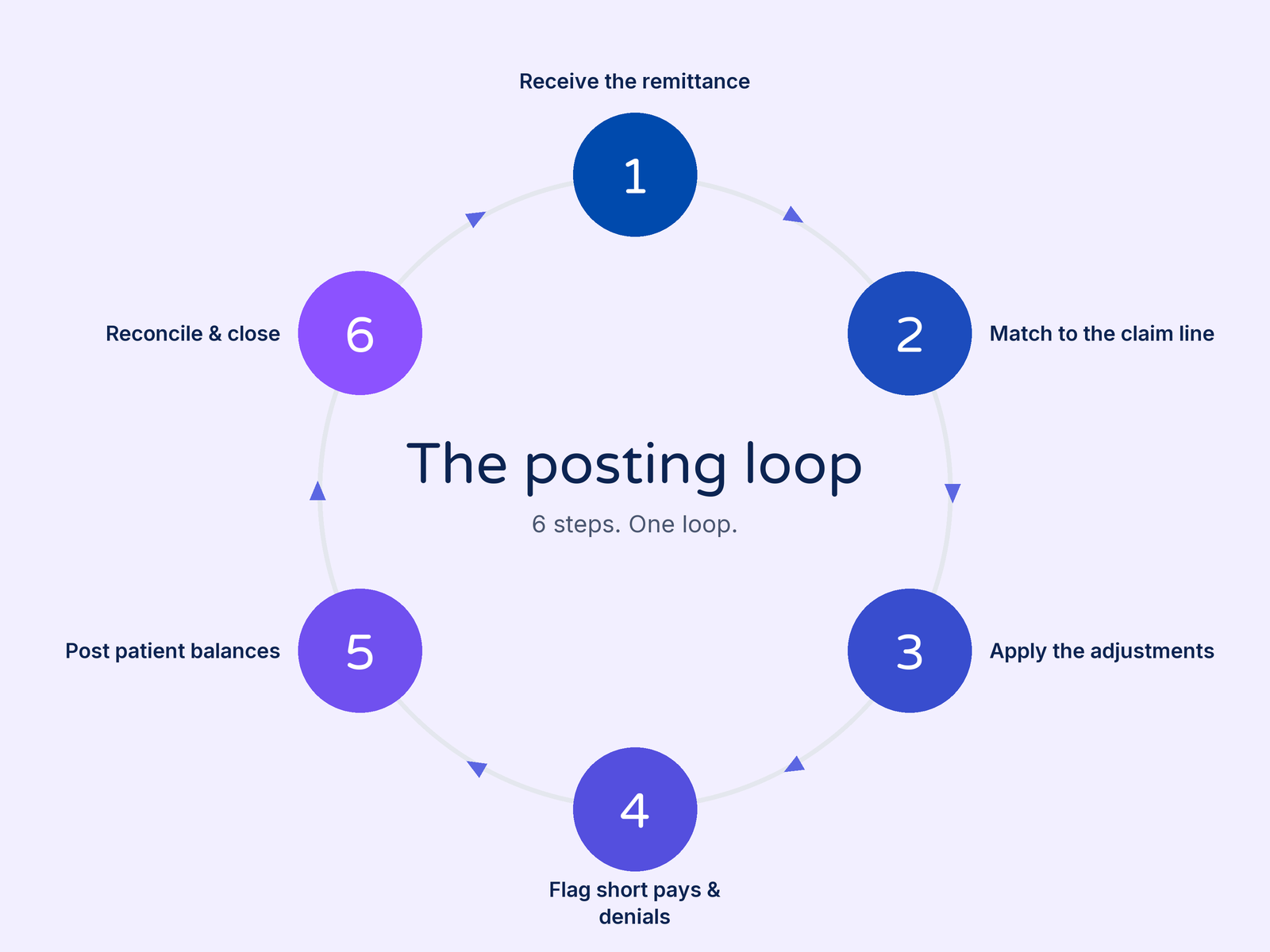
Posting looks clerical and decides more than any other step after the claim goes out. Each remittance arrives as an electronic remittance advice, the 835 health care claim payment and advice transaction, or as a paper explanation of benefits, and carries three kinds of code: group codes that say who owes the adjusted amount, claim adjustment reason codes that, in X12’s words, describe why a claim or service line was paid differently than it was billed, and remark codes that add the explanation. Post those correctly to the line and the practice knows what was paid, what was written off by contract, what the patient owes, and what was denied. Post them to the account as a lump, and all four are lost. Summit Billing Solutions posts to the line, inside your own practice management system, the day the remittance arrives.
Paper is the expensive way to do it. The 2024 CAQH Index puts the provider’s cost of handling one remittance advice at $5.67 manually and $2.95 electronically, and one claim payment at $4.99 manually and $3.16 electronically (CAQH Index 2024, p. 56), which is why our payer enrollment work enrolls every payer that offers electronic remittance and deposit before the first claim goes out.
| Number | Posting decision | What happens | Where it goes wrong, and what we do | Related service |
|---|---|---|---|---|
| 1 | Match the payment to the claim line | Each paid amount in the remittance is applied to the specific claim and service line it pays, not to the patient's account as a total, so every line shows its own paid, adjusted and remaining amounts. | Bulk posting to the account balances the money and hides which lines were paid, short-paid or denied. We post to the line from the ERA, and from the EOB when a payer still sends paper. | Claim submission |
| 2 | Contractual adjustments and underpayments | The contractual obligation adjustment is the difference between what was billed and what the contract allows. It is correct only when the allowed amount on the remittance matches the fee schedule the practice agreed with that payer. | The adjustment is posted as sent, so a payer that allows less than the contract is never noticed. We load your fee schedules and flag every line where the allowed amount is short, for follow-up as an underpayment. | A/R recovery |
| 3 | Patient responsibility | Copay, coinsurance and deductible amounts carry the patient responsibility group code and move to the patient's balance, ready for a statement, once every payer on the claim has paid. | Patient balances are statemented before the secondary pays, or never, because the remittance was posted to the account. We move each patient amount to the patient balance at the right moment and hand it to statements. | Patient statements |
| 4 | Denials inside the remittance | Many denials never arrive as a letter; they arrive as a zero-paid line with a reason code and a remark code. Posting is where they are found. | Zero-paid lines are posted as adjustments and vanish into write-offs. We read every reason and remark code, post the denial as a denial, and send it to the denial queue the same day. | Denial management |
| 5 | Secondary and crossover claims | After the primary payer posts, the balance and the primary remittance go to the secondary payer, either by crossover from Medicare or as a secondary claim with the primary's adjudication attached. | The secondary claim is never sent, or is sent without the primary remittance and denied. We trigger the secondary the day the primary posts and attach what the second payer needs. | Secondary claims & COB |
| 6 | Refunds, credit balances and overpayments | A payer that pays twice, a patient who paid a copay the plan later covered, or a primary and secondary that both paid in full create credit balances that belong to someone else. | Credits sit on accounts for months. We identify each credit at posting, determine who it belongs to, and hand you a refund list with the deadlines that apply; identified Medicare overpayments must be reported and returned within 60 days under 42 CFR 401.305. | Medical billing audit |
| Compare | Batch posting, weekly | Summit Billing Solutions |
|---|---|---|
| Timing | Weekly, or when the pile gets tall. | The day the remittance arrives, electronic or paper. |
| Where the payment lands | On the account, as a total. | On the claim line, with its reason and remark codes. |
| Adjustments | Posted as the payer sent them. | Checked against your fee schedule; short lines flagged as underpayments. |
| Denials in the remittance | Written off as adjustments. | Posted as denials and sent to the denial queue the same day. |
| Secondary claims | Sent when someone remembers. | Triggered the day the primary posts, with the primary remittance attached. |
| Reconciliation | Whatever the bookkeeper can tie out at month end. | Remittance to deposit daily, a tie-out for the bank, and unapplied cash explained the same week. |
We pull your unposted remittances, unapplied cash and credit balances, sample the last 90 days of posted payments against your fee schedules, and show you the underpayments and buried denials, whether or not you go further with us.
We enrol every payer that offers electronic remittance and deposit, load your fee schedules for the variance check, agree the posting rules for adjustments, patient balances and credits, and connect to your practice management system. Most practices are live within one to two weeks.
Electronic remittances post to the line as they arrive; paper remittances are posted the day they are received. Every adjustment is checked, every zero-paid line goes to the denial queue, every patient amount moves to the patient balance at the right time, and every remittance is tied to its deposit.
Posting lag by payer, unapplied cash, underpayments found and recovered, credits identified and refunded, and deposits still without a remittance, reviewed with your named contact on the weekly call.


We sign a Business Associate Agreement with every practice before we handle any patient information, as HIPAA requires.
You know who is working your account, and you hear from them every week. A familiar face, not a ticket queue.
If we are not earning the relationship, you can leave. That keeps us honest.
We are in Salem, NH, and we bill for practices nationwide, with the state-by-state payer knowledge that takes.
95-98%
First-pass claim rate
24 hrs
Claims submitted within
28
Average days in A/R

I’ve been in billing for 30+ years and Summit is the best I’ve worked with. They’re knowledgeable, detailed, and persistent to get claims paid instead of writing them off. They take the burden off providers so we can focus on patients.

We billed in-house for decades, but it was time for a change. I couldn’t be happier with Summit. The transition was seamless thanks to their strong systems and clear communication. If you’re considering a switch, talk to Summit.


When Summit Billing Solutions handles your billing, posting is part of the service, inside the fee of 3% to 9% of monthly collections. Posting is where underpayments and buried denials are found, so it is never an add-on.
A practice that keeps its billing in house can have posting alone. That is quoted after the free account review, based on how many remittances and deposits arrive each month, how many payers still send paper, and whether your fee schedules are available for the variance check, because those three things decide the effort. We do not quote an accuracy percentage; we describe the checks. How billing companies structure their fees more generally is covered in our guide to medical billing pricing.
50A Northwestern Dr Ste 3, Salem, NH 03079-4827
603-207-3172
(866) 906-3116
info@summitbillingsolutions.com
Mon - Fri @ 9am - 5pm
Summit Billing Solutions has been one of the best decisions for my business. They’re responsive, transparent, and make billing feel organized and manageable. They truly feel like a partner, not a vendor. Highly recommend.