


Medical accounts receivable services are usually sold as a separate rescue, and sometimes that is what a practice needs: a backlog built up after a biller left or a system changed. More often the receivable ages because follow-up is nobody’s job on a Tuesday. Summit Billing Solutions does both: daily follow-up on every open claim as part of medical billing, and clean-up projects for balances that have already aged, inside your own practice management system.
Time is the whole game. Every payer sets a limit on how long after the visit it will accept a claim, and a separate window for appeals. Medicare’s rule is the clearest: claims must be filed no later than 12 months, or one calendar year, after the date the services were furnished (CMS Medicare Claims Processing Manual, chapter 1, section 70). A balance that crosses that line is not slow. It is gone, and no recovery service can bring it back.
| Number | Age of the balance | What is usually going on | What we do and what is recoverable | Related service |
|---|---|---|---|---|
| 1 | 0 to 30 days | Normal. Clean electronic claims adjudicate in this window. The only balances to touch are clearinghouse rejections and claims with no acknowledgement from the payer. | Rejections are corrected and resent the same day; unacknowledged claims are traced. Fully recoverable, and the cheapest work on this page: a claim fixed here never becomes A/R. | Claim submission |
| 2 | 31 to 60 days | Something stalled: a request for records, a pending status nobody chased, a denial posted to the account and not worked, or a secondary claim never filed. | This is where scheduled follow-up starts. Every open claim is checked with the payer, the reason is recorded, and the fix goes out that week. Still fully recoverable if the appeal and filing windows are watched. | Denial management |
| 3 | 61 to 90 days | Denials that were resubmitted without a fix and came back; underpayments posted as if paid in full; claims sent to the wrong payer or the wrong plan. | Each balance is traced to its cause and worked as a corrected claim or an appeal. Most are still recoverable, but commercial appeal windows are set by contract and some close here, so these are worked before anything younger. | Payment posting |
| 4 | 91 to 120 days | Balances everyone has stopped looking at. Some payers have already closed their appeal window; others still allow a corrected claim. | Triage first: what has a live deadline is worked immediately, what is past every window is listed with the reason. Partly recoverable; the share depends on the payer mix and how the denials were handled the first time. | A/R clean-up |
| 5 | Over 120 days | The backlog. Claims that were never followed, patient balances never statemented, and payer balances that crossed a filing limit. Medicare's limit is 12 months from the date of service. | We work it as a project, closest deadline first. What is inside a window is recovered; what is past every window is reported to you with the reason, so you write it off knowingly, not silently. | A/R clean-up projects |
| 6 | Patient balances after insurance | The patient's share sits unbilled because statements go out late or not at all, or it was billed once and never followed. | Statements go out on a fixed cadence with a clear amount and a way to pay, and are followed up before they age. Recoverable while the balance is recent; collectability drops with every month a statement is late. | Patient statements |
| Compare | Ad-hoc follow-up | Summit Billing Solutions |
|---|---|---|
| What gets worked | The largest balances, when someone notices them. | Every open balance, on a schedule, sorted by deadline and then by dollar. |
| Timing | After the 90-day column grows, which is often after the appeal window has closed. | Follow-up starts at 31 days and repeats until the balance is resolved. |
| Cause | Claims are resubmitted as they were, so the same ones return. | The reason is recorded on every touch and fixed upstream when it repeats. |
| Patient balances | Statemented late, rarely followed. | Statemented on a fixed cadence and followed before they age. |
| Visibility | A total on the aging report. | A/R aging in 30-day buckets, days in A/R, and a list of what was recovered, in progress or closed, every month. |
| Write-offs | Decided when the number gets embarrassing. | Only with a reason, after every window is checked, and you decide. |
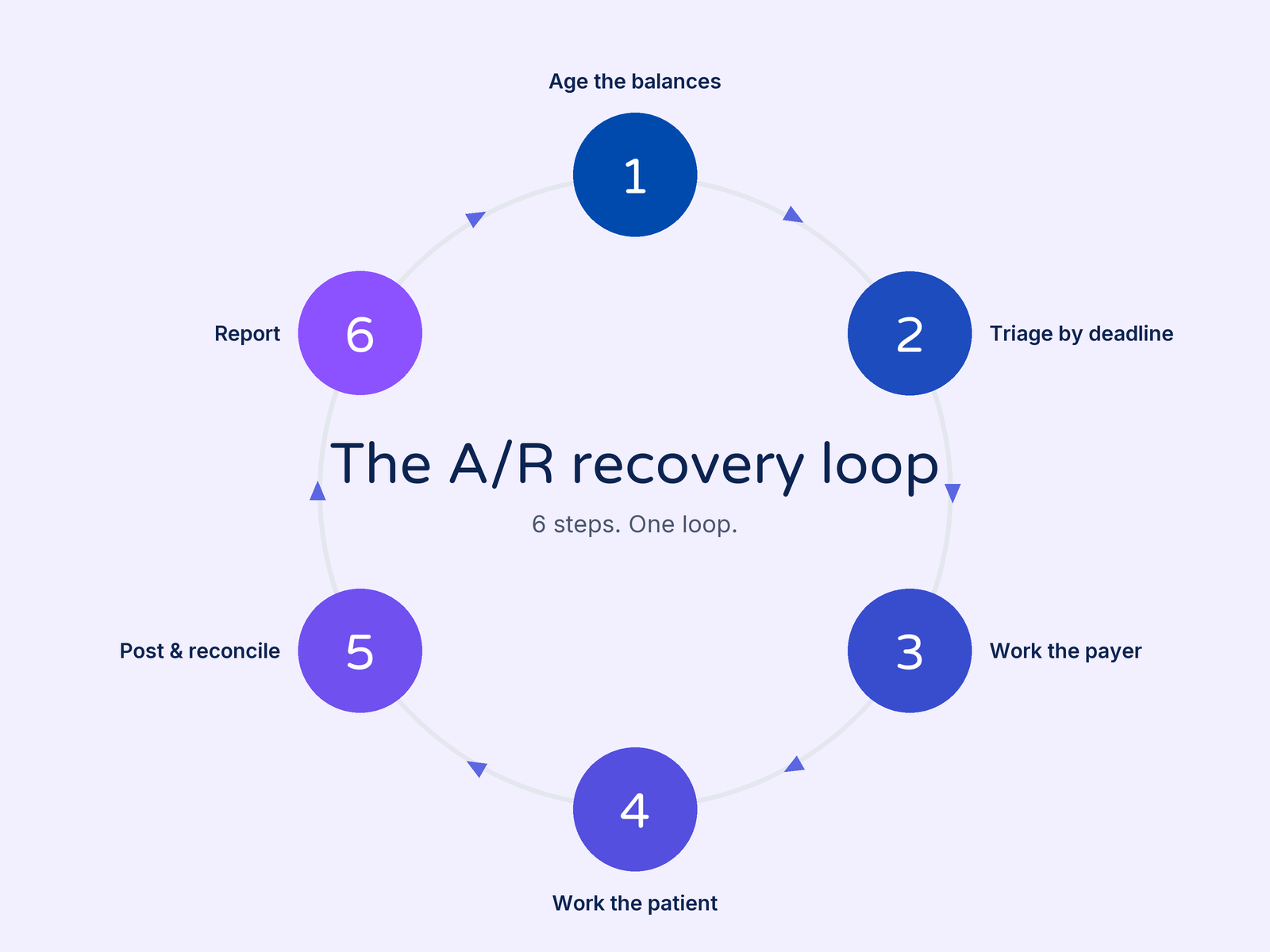
We pull your aging report and your open claims from your practice management system, and show you what is in each bucket, which payers hold the most, and how much is still inside a deadline, whether or not you go further with us.
Every open balance is sorted by the deadline it is closest to, then by dollar, then by age. Balances past every window are set aside and listed with the reason.
Corrected claims, appeals, secondary claims and patient statements go out in that order, inside your system. Every touch is recorded: who was contacted, what they said, what happens next and when.
Weekly during a clean-up, monthly after: what was recovered, what is in progress, what was closed and why, with A/R aging in 30-day buckets and your days in A/R against your own history.


We sign a Business Associate Agreement with every practice before we handle any patient information, as HIPAA requires.
You know who is working your account, and you hear from them every week. A familiar face, not a ticket queue.
If we are not earning the relationship, you can leave. That keeps us honest.
We are in Salem, NH, and we bill for practices nationwide, with the state-by-state payer knowledge that takes.
95-98%
First-pass claim rate
24 hrs
Claims submitted within
28
Average days in A/R

I’ve been in billing for 30+ years and Summit is the best I’ve worked with. They’re knowledgeable, detailed, and persistent to get claims paid instead of writing them off. They take the burden off providers so we can focus on patients.

We billed in-house for decades, but it was time for a change. I couldn’t be happier with Summit. The transition was seamless thanks to their strong systems and clear communication. If you’re considering a switch, talk to Summit.


When Summit Billing Solutions handles your billing, A/R follow-up is part of the service, inside the fee of 3% to 9% of monthly collections. Following up on every claim is not an add-on; it is what makes the percentage worth paying.
A backlog clean-up for a practice that keeps its billing in house is a project, quoted after the free account review. The quote depends on three things we can only see in your system: how many balances are open, how old they are, and how many are still inside a deadline. We do not quote a recovery percentage before seeing the list, and we do not promise one after. How billing companies structure their fees more generally is covered in our guide to medical billing pricing.
50A Northwestern Dr Ste 3, Salem, NH 03079-4827
603-207-3172
(866) 906-3116
info@summitbillingsolutions.com
Mon - Fri @ 9am - 5pm
Summit Billing Solutions has been one of the best decisions for my business. They’re responsive, transparent, and make billing feel organized and manageable. They truly feel like a partner, not a vendor. Highly recommend.