


Payer enrollment registers a provider with each insurance company: the applications, the plan’s approval to join its network, and the setup that lets it pay. For Medicare, that is the application through PECOS, CMS’s online enrollment system, using the CMS-855 application family, with the CMS-588 electronic funds transfer agreement and the CMS-460 participation agreement that CMS lists as routinely submitted with an enrollment application; for each plan, the provider record, the group and location linkage, and the electronic claim, remittance and payment enrollments that make the claim cycle run without paper. Credentialing, the check of the provider’s licence, training and history, is on our provider credentialing page. It is usually addressed first, though the two often run at the same time, and Summit Billing Solutions handles both together for one fixed fee per payer application, in the order the practice needs, with every effective date recorded in your billing system.
The electronic pieces are worth the forms. The 2024 CAQH Index puts the provider’s cost of handling one remittance advice at $5.67 manually and $2.95 electronically, and one claim payment at $4.99 manually and $3.16 electronically (CAQH Index 2024, p. 56). Multiply by a year of remittances and deposits, and ERA and EFT enrollment is the cheapest improvement a practice can make to its cash flow.
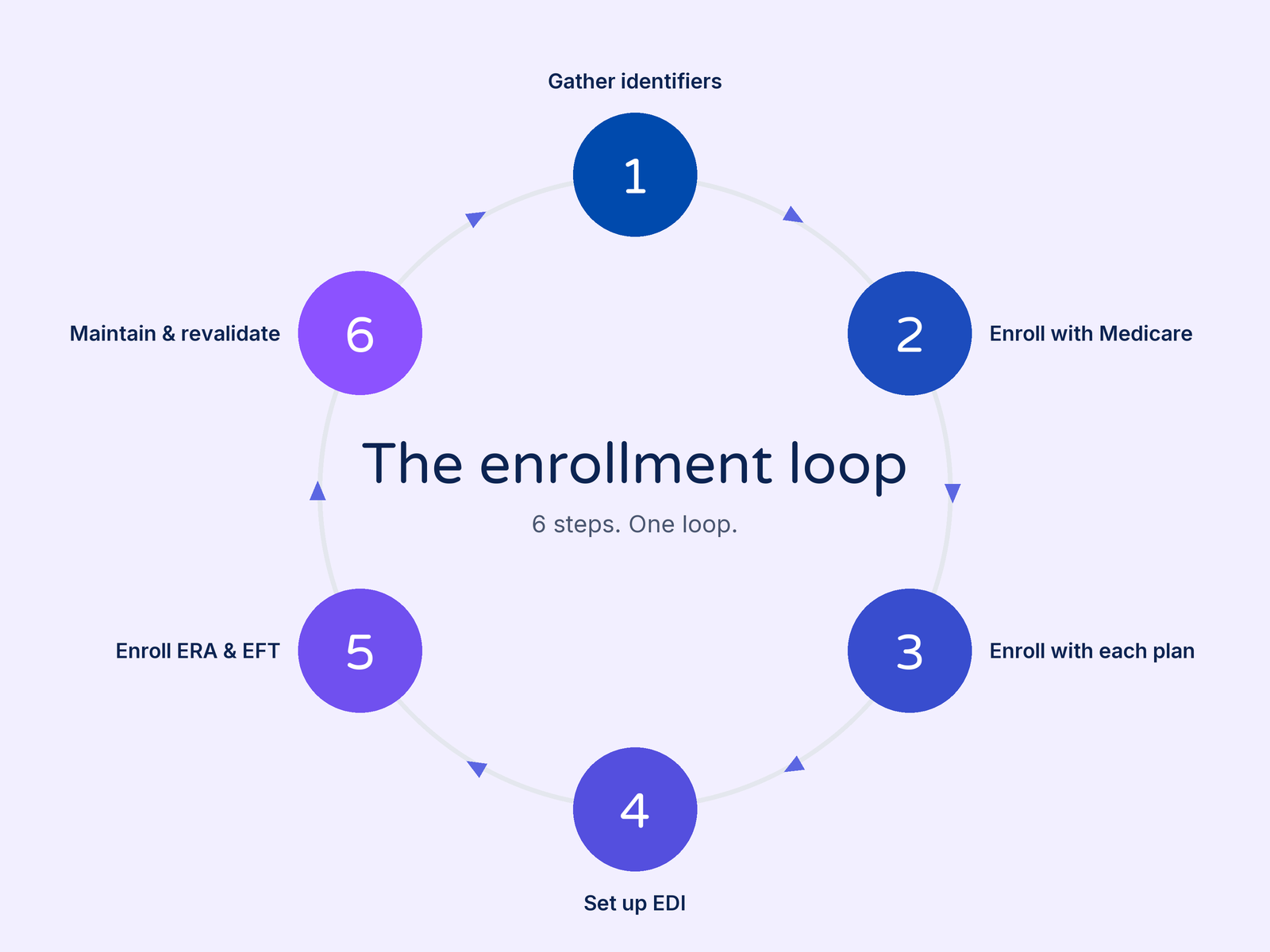
| Number | What is set up | What it involves | Where it stalls, and what we do | Related service |
|---|---|---|---|---|
| 1 | Medicare enrollment (PECOS) | The CMS-855I for the individual provider or the CMS-855B for the group, filed through PECOS, with the CMS-588 EFT agreement and the CMS-460 participation agreement, and reassignment of benefits to the group where that applies. | The Medicare Administrative Contractor sends a development request for one missing item and the application waits. We file complete applications, answer development requests the same day, and track each one to its approval letter and effective date. | Provider credentialing |
| 2 | Medicaid enrollment | Each state runs its own program with its own portal, forms and managed care plans. Enrollment with the state comes first; the managed care organizations in that state usually follow. | The state application is approved but the managed care plans were never enrolled, and those claims deny. We enroll with the state and with each managed care plan the practice's patients carry, in the states where our clients practice. | Insurance eligibility verification |
| 3 | Commercial plan setup | After credentialing, the plan builds the provider's record: the group and location linkage, the tax ID and NPI combinations, the products the provider participates in, and the fee schedule that applies. | The provider is credentialed but linked to the wrong location or tax ID, and claims pay to the wrong place or not at all. We confirm the record in writing and test it with the first claim. | Medical billing |
| 4 | EDI enrollment | The electronic claim connection: submitter IDs through your clearinghouse, EDI enrollment with the Medicare Administrative Contractor for your jurisdiction, and payer-specific EDI agreements where a plan requires one. | Claims are ready and the connection is not, so they sit or go out on paper. We set up EDI alongside the enrollment, so the first claim goes electronically on the effective date. | Claim submission |
| 5 | ERA enrollment | The electronic remittance advice, the 835 health care claim payment and advice transaction, enrolled with each payer so remittances arrive in the clearinghouse and post automatically. | Paper remittances arrive weeks after payment, are posted by hand, and underpayments hide in them. We enroll ERA with every payer that offers it and route it to your practice management system. | Payment posting |
| 6 | EFT enrollment | Electronic funds transfer, so each payer deposits directly to the practice's bank account: the CMS-588 for Medicare, and each plan's own EFT enrollment, some through the plan and some through a shared enrollment service. | Cheques go to an old address, or a plan's EFT is never enrolled and payments lag the remittance by weeks. We enroll EFT payer by payer and reconcile the first deposits against the remittances. | Payment posting |
| 7 | Revalidation and changes | Medicare requires revalidation, every five years for most providers and suppliers and every three for DMEPOS suppliers, according to CMS. Plans have their own cycles, and changes of address, ownership or banking have to be reported. | A missed revalidation or an unreported change can deactivate billing privileges, and the claims stop paying. We keep every date on a calendar and start each renewal before the notice arrives. | Revalidation |
| Compare | Do it yourself | Summit Billing Solutions |
|---|---|---|
| Order of work | Whatever form is open, usually after a denial points to it. | Credentialing first, then Medicare, Medicaid and each plan, then EDI, ERA and EFT, in the order the practice needs paid. |
| Development requests | Noticed when someone checks the portal. | Answered the same day, with the application tracked to its approval letter. |
| The plan's record | Assumed correct because credentialing was approved. | Confirmed in writing and tested with the first claim. |
| ERA and EFT | Enrolled with the big payers, if at all. | Enrolled with every payer that offers them, and reconciled on the first deposit. |
| Revalidation and changes | Handled when the notice arrives, or after billing stops. | On a calendar, started before the notice, changes reported the week they happen. |
| Visibility | The office manager's inbox. | A status for every provider and every payer, reviewed on the weekly call. |
We list every provider and every payer you bill, show which are enrolled, pending or missing, which payers still send paper remittances or cheques, and which revalidations are coming up, whether or not you go further with us.
We gather the identifiers once: NPIs, tax IDs, licences, bank details for EFT, PECOS and portal access, and the clearinghouse account. Applications are prepared in the order the practice needs paid.
Medicare, Medicaid, each commercial plan, then EDI, ERA and EFT with each payer. Every submission is logged with its date and reference, every development request answered the same day, and every effective date confirmed in writing and loaded into billing.
Revalidations started before the notice, changes reported the week they happen, and the first claims and deposits after any change reconciled to confirm the payer's record took. A status for every provider and payer on your weekly call.


We sign a Business Associate Agreement with every practice before we handle any patient information, as HIPAA requires.
You know who is working your account, and you hear from them every week. A familiar face, not a ticket queue.
If we are not earning the relationship, you can leave. That keeps us honest.
We are in Salem, NH, and we bill for practices nationwide, with the state-by-state payer knowledge that takes.
95-98%
First-pass claim rate
24 hrs
Claims submitted within
28
Average days in A/R

I’ve been in billing for 30+ years and Summit is the best I’ve worked with. They’re knowledgeable, detailed, and persistent to get claims paid instead of writing them off. They take the burden off providers so we can focus on patients.

We billed in-house for decades, but it was time for a change. I couldn’t be happier with Summit. The transition was seamless thanks to their strong systems and clear communication. If you’re considering a switch, talk to Summit.


Payer enrollment and credentialing are priced together: one fixed fee per payer application. It covers the credential review, preparing and submitting the application, communication with the insurance company, and follow-up through enrollment and approval, so you never pay for enrollment and credentialing as two separate services.
We quote the fee after the free account review, once we know how many providers and how many payer applications you need, and how much of the work is new enrollment rather than ERA, EFT or revalidation. We do not promise a turnaround, because CMS and each plan set it; we promise that every application is followed until it has a date. How billing companies structure their fees more generally is covered in our guide to medical billing pricing.
50A Northwestern Dr Ste 3, Salem, NH 03079-4827
603-207-3172
(866) 906-3116
info@summitbillingsolutions.com
Mon - Fri @ 9am - 5pm
Summit Billing Solutions has been one of the best decisions for my business. They’re responsive, transparent, and make billing feel organized and manageable. They truly feel like a partner, not a vendor. Highly recommend.