


In-house medical billing costs a small practice a fixed salary plus benefits, whatever it collects. Outsourced medical billing costs a percentage of what the practice collects. Which one is cheaper depends on one number most practices can pull from last year’s reports: total collections.
Here is the in-house side, using federal data. A full-time billing and posting clerk earned a median of $48,500 in May 2025, and a medical records specialist, the occupation that includes medical coders, earned $51,140 (BLS Occupational Employment and Wage Statistics). Add the employer’s share of insurance, retirement and payroll taxes, and one median billing clerk costs about $64,000 a year. Summit Billing Solutions charges between 3% and 9% of monthly collections. So the question becomes simple arithmetic: at your collections, which number is smaller?
If you are setting next year’s budget now, this guide gives you the method. It covers what one billing hire really costs, what an outsourced fee covers, where the break-even point sits at each fee rate, and the costs on both sides that a price quote does not show.
Key Takeaways
- One full-time billing clerk at the national median costs about $64,000 a year with benefits, and a median coder about $67,500, based on BLS wage data for May 2025 and benefit costs for June 2026.
- An outsourced fee moves with collections. Divide your loaded staff cost by the fee rate to find the break-even point: $64,000 at 6% breaks even at about $1,067,000 in annual collections.
- Below break-even, outsourcing costs less than one salary. Above it, payroll alone is cheaper, but software, clearinghouse fees, coverage for time off and turnover still sit on the in-house side.
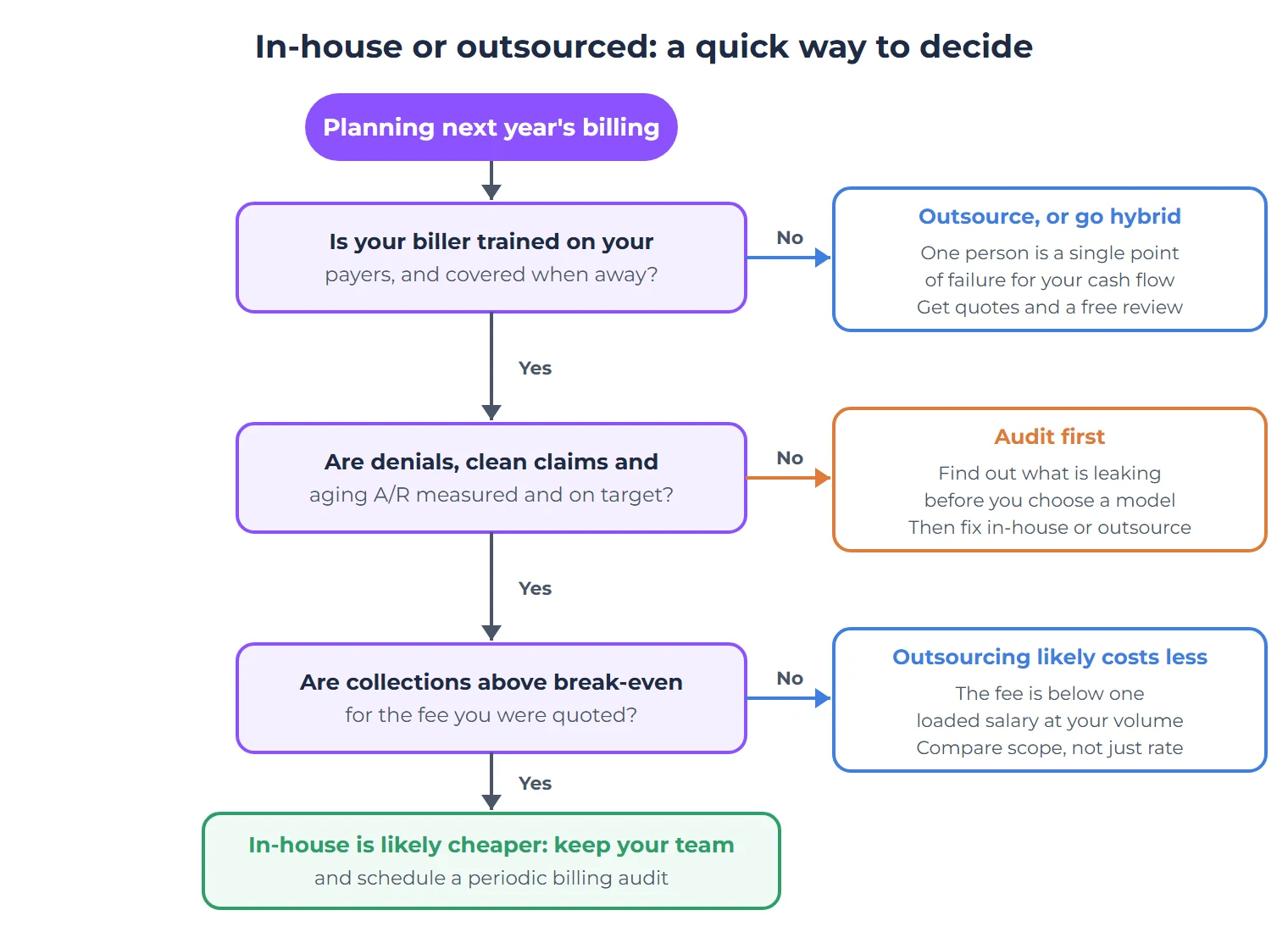
- One biller is a single point of failure. Coverage, specialty knowledge and denial follow-up often decide the choice more than the rate does.
- Either way, sign a business associate agreement, and keep Medicare payments going into the practice’s own bank account.
In-house vs outsourced medical billing at a glance
The two models differ more in how the cost behaves than in its size. An in-house team is a fixed cost that stays the same in a slow month. An outsourced fee is a variable cost that falls when collections fall and rises when they grow.
| In-house billing | Outsourced billing | |
|---|---|---|
| How you pay | Salary, benefits and payroll taxes, every pay period | A percentage of collections, usually monthly |
| Cost in a slow month | The same | Lower |
| Cost as you add providers | Steps up when you hire | Rises with collections, with no hiring |
| Coverage for vacation, illness or a resignation | Your problem to solve | The company’s problem to solve |
| Payer and specialty knowledge | Whatever your staff bring and keep | Spread across the company’s clients |
| Control | You can walk over and ask about any claim | Through reports, calls and system access |
| HIPAA paperwork | Your own policies and training | Your policies plus a business associate agreement |
| Usually fits | Practices with high collections and stable, trained staff | Practices below break-even, or without reliable coverage |
Neither column wins on every row. The rest of this guide puts numbers on the cost rows, so you can weigh them against the rest.
What does an in-house medical biller really cost?
A billing employee costs about a third more than their salary. That is the short answer once you add the benefits an employer pays on top of wages. Here is how we calculated it, so you can repeat it with your own payroll numbers.
Wages. The Bureau of Labor Statistics (BLS) publishes national wages for both billing occupations. For May 2025, the median annual wage was $48,500 for billing and posting clerks and $51,140 for medical records specialists. The 75th percentile, a reasonable figure for an experienced hire, was $58,290 and $64,820 (BLS OEWS profiles, May 2025). Offices of physicians are the largest employer of billing and posting clerks, with 65,230 of them.
Benefits. BLS’s Employer Costs for Employee Compensation survey shows what employers pay on top of wages. In June 2026, for office and administrative support workers in health care and social assistance, employers paid $23.50 an hour in wages and $11.08 in benefits. Benefits were 32.0% of total compensation (BLS ECEC, table 4). The benefits break down like this:
- $4.63 for health and other insurance
- $2.71 for paid leave
- $2.29 for legally required benefits, such as Social Security, Medicare, unemployment insurance and workers’ compensation
- $0.78 for retirement and savings
- $0.67 for supplemental pay
One adjustment avoids double counting. BLS’s annual wage estimates “assume a full-time, year-round schedule of 2,080 hours” (BLS OEWS FAQ), so the annual figure already pays for vacation and holiday weeks. The ECEC survey, by contrast, counts paid leave as a separate benefit. So we left paid leave out and added the other benefits. That adds about 32% to the annual wage.
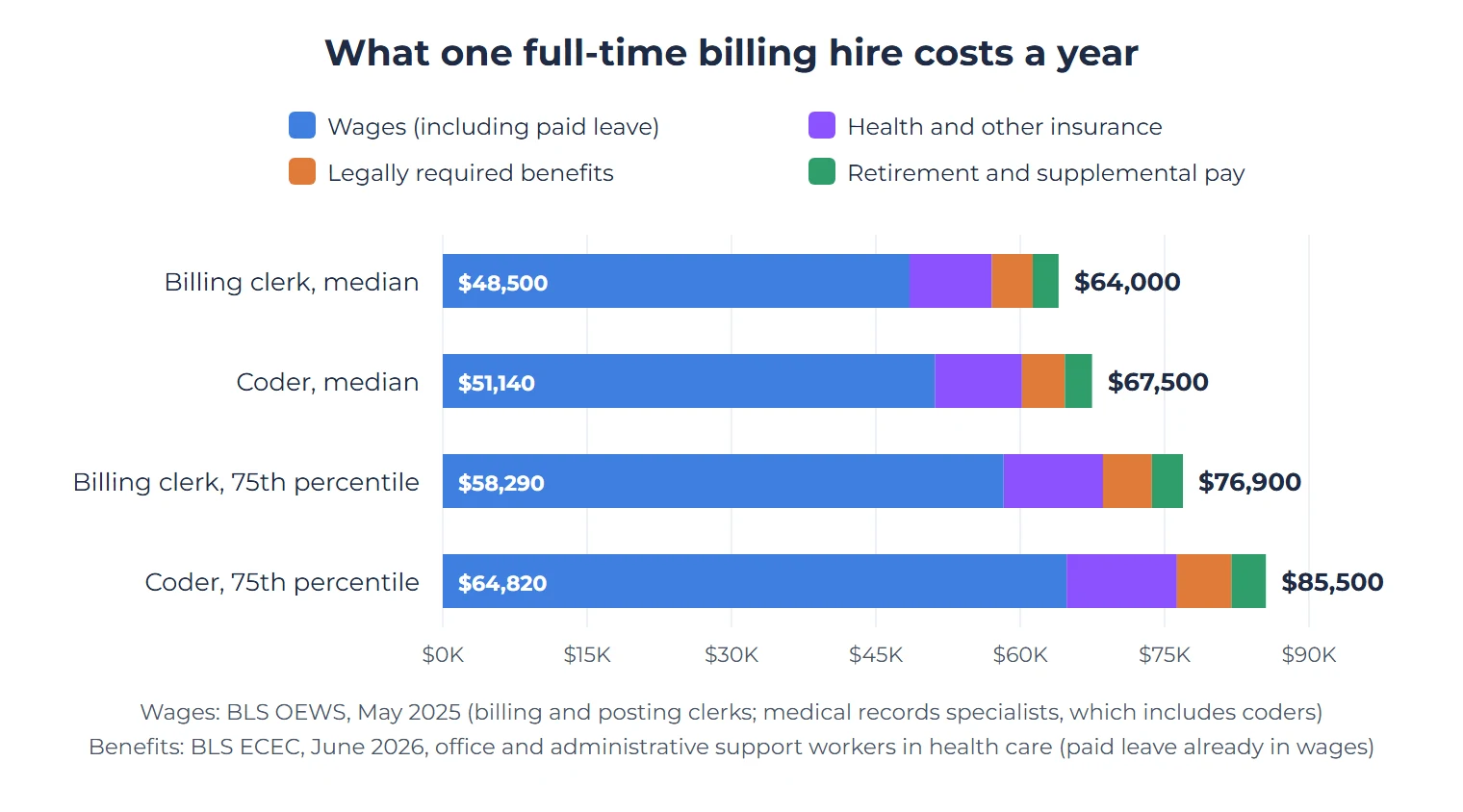
| Hire | Annual wage (BLS, May 2025) | With benefits (about +32%) |
|---|---|---|
| Billing and posting clerk, median | $48,500 | about $64,000 |
| Medical records specialist (coder), median | $51,140 | about $67,500 |
| Billing and posting clerk, 75th percentile | $58,290 | about $76,900 |
| Medical records specialist (coder), 75th percentile | $64,820 | about $85,500 |
These are national figures. Wages in your metro area can be higher or lower, and BLS publishes state and metro tables that you can substitute.
The in-house costs the BLS numbers leave out
The loaded salary is only the part of the in-house cost that is easy to measure. A practice that bills for itself also pays for:
- Software and clearinghouse fees. Practice management licenses, claim submission and eligibility checks are priced per provider, per claim or per month, depending on the vendor. Our guide to choosing a clearinghouse explains what to compare.
- Coverage. One person takes vacation and gets sick. Claims that wait a week for that person to return also wait a week to be paid.
- Turnover. BLS projects about 14,000 openings for medical records specialists each year through 2035, and says many of them will come from the need to replace workers who change occupations or retire (BLS Occupational Outlook Handbook). Each departure means recruiting, training and a backlog.
- Management time. Somebody has to check the biller’s work, read the aging report and decide which denials to appeal. In a small practice, that is often the physician or the practice manager.
- Training and compliance. Coding updates arrive every year, and payer rules change in between.
We have not put dollar figures on these, because they vary too much from one practice to the next to estimate honestly. Add your own numbers to the in-house side of the worksheet below.
What does outsourced medical billing cost?
Most medical billing companies charge a percentage of what they collect. For outsourced medical billing, Summit Billing Solutions charges between 3% and 9% of monthly collections. Where a practice lands in that range depends on its specialty, claim volume, payer mix and how clean its receivables are when we take them on. We quote an exact rate after a free account review, not before. Our medical billing pricing guide explains the other models: per-claim fees, flat monthly fees and hybrids.
A percentage fee has one built-in advantage for a small practice. The billing company is paid when you are paid, so a slow month costs less, and the company has a reason to chase every unpaid claim. Before you compare two quotes, ask each company:
- A percentage of what? Net collections, gross collections, or all receipts including patient payments?
- What about old receivables? Is A/R that predates the contract billed at the same rate, a different rate, or not at all?
- Is there a minimum monthly fee, a setup fee or a termination fee?
- What is included? Coding review, denial management, patient statements, credentialing and reporting can be part of the rate or billed on top.
- Whose software is used? If the company works inside your existing practice management system, you keep paying for that system. If it moves you to its own, ask who owns the data when you leave.
A low rate with a narrow scope can cost more than a higher rate that covers the whole cycle. Our guide to affordable medical billing services covers what cheap quotes tend to leave out.
Where is the break-even point?
The break-even point is the level of annual collections at which an outsourced fee equals the cost of the staff it replaces. The formula is one line:
Break-even collections = loaded annual cost of the staff you would replace ÷ outsourced fee rate
Using one median billing clerk at about $64,000:
| Fee rate | Break-even annual collections | Break-even monthly collections |
|---|---|---|
| 3% | about $2,133,000 | about $178,000 |
| 5% | about $1,280,000 | about $107,000 |
| 7% | about $914,000 | about $76,000 |
| 9% | about $711,000 | about $59,000 |
If your collections are below the break-even point for the rate you are quoted, the outsourced fee costs less than one salary with benefits, before you count software, coverage or turnover. If your collections are above it, payroll alone is cheaper, and the decision depends on the costs in the list above and on how well your billing actually performs.
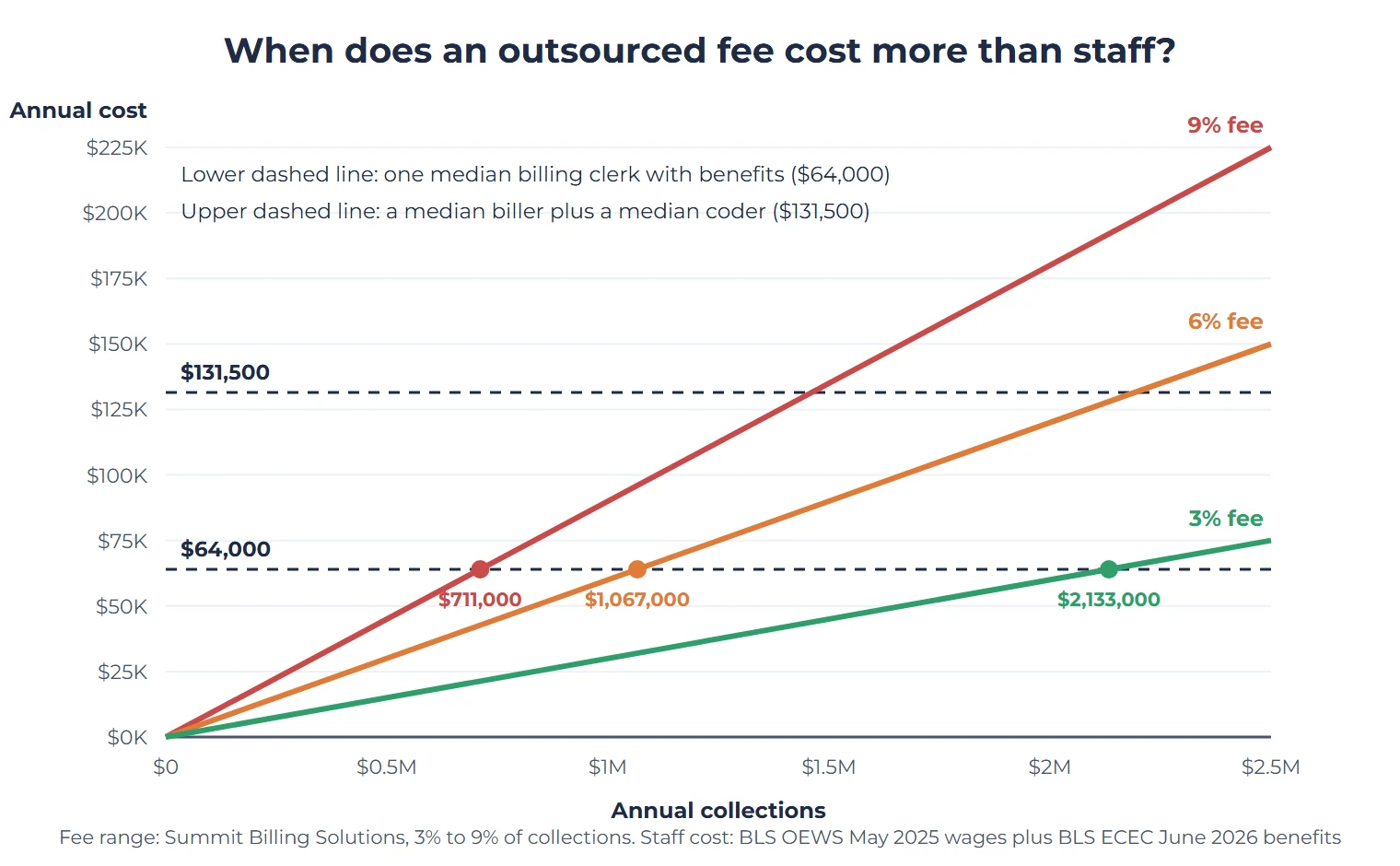
The chart also shows a second line. Many practices that bill in-house need more than one person, because billing and coding are different skills. A median biller plus a median coder costs about $131,500 a year. At a 9% fee, outsourcing stays cheaper than that pair until collections pass about $1,461,000 a year.
A worked example
Take a hypothetical practice that collects $900,000 a year, or $75,000 a month. This is an illustration, not a Summit client.
- In-house: one billing clerk at the national median costs about $64,000 with benefits. Software, clearinghouse fees and cover for time off come on top.
- Outsourced at 3%: $27,000 a year, about $37,000 less than the clerk’s pay and benefits.
- Outsourced at 6%: $54,000 a year, about $10,000 less.
- Outsourced at 9%: $81,000 a year, about $17,000 more than the clerk’s pay and benefits. That gap shrinks or reverses once you add the in-house costs that are not in the BLS figures.
So at $900,000 in collections, the rate you are quoted decides the answer. That is why it pays to get an exact quote rather than a range before you set the budget.
Which is better for a small practice, factor by factor?
Cost is one factor of several. This is how the two models compare on the others, and which one usually comes out ahead for a practice with a handful of providers.
Cost predictability: in-house wins on predictability, outsourcing on flexibility. A salary is easy to budget, but you pay it in a slow month too. A percentage fee is harder to predict to the dollar, but it never asks you to pay full price for half the work.
Coverage and continuity: outsourcing usually wins. A billing company has more than one person who can work your claims. A one-person billing office stops when that person is away, and its knowledge leaves when they do.
Specialty and payer knowledge: it depends. An experienced biller who has worked your payers for years is hard to beat. A billing company sees the same payers’ rule changes across many practices, which helps if your biller is new or your specialty has complex rules. If coding is the weak spot, a medical coding service can cover it either way.
Control and visibility: in-house wins. You can walk over and ask about any claim. With an outsourced team, you get control through reporting, regular calls and your own access to the practice management system. Ask any company to show you a sample monthly report before you sign.
Compliance: equal, if the paperwork is right. HHS lists billing and claims processing among the services that make a vendor a business associate. A practice may share patient information with one only after getting “satisfactory assurances, in the form of a contract or other written arrangement,” which is the business associate agreement (HHS business associate FAQs). Our HIPAA compliance checklist covers the rest.
Who receives Medicare payments: keep them in your account. Medicare will pay a billing agent in the provider’s name only if, among other conditions, “the agent’s compensation is not related in any way to the dollar amount billed or collected” (Medicare Claims Processing Manual, chapter 1, section 30.2.4). Those conditions do not apply when the agent “merely prepares bills” and does not receive and negotiate the payments. So with percentage pricing, Medicare deposits should go straight into the practice’s own bank account, and the billing company is paid separately, for example by monthly invoice.
How to run the numbers for your own practice
You can build the comparison in a spreadsheet in an hour. Use 12 months of data, not one good or bad month.
- Total your collections for the last 12 months from your practice management system, including patient payments.
- List everyone who touches billing and the share of their week it takes: the biller, the coder, and the front desk staff who post payments or check eligibility.
- Load their pay. Multiply each person’s billing share of wages by about 1.32 to add benefits, or use your own payroll and benefits totals if you have them.
- Add the systems. Include practice management licenses, clearinghouse fees, statement printing and postage, and any coding tools.
- Price the gaps. Estimate what time off and turnover cost you in delayed claims or temporary help.
- Get exact quotes from two or three billing companies, with the scope written down, and multiply each rate by your 12-month collections.
- Compare performance, not just cost. Measure your clean-claim rate, denial rate and days in A/R. A cheaper model that collects less is not cheaper.
If your current numbers look weak, a medical billing audit will show what is leaking before you decide. If they look strong and your collections are well above break-even, keeping billing in-house may be the right call. For a wider view of everything a billing team handles, see our comparison of medical billing and revenue cycle management.
How Summit prices outsourced medical billing
Summit Billing Solutions charges between 3% and 9% of monthly collections, quoted after a free account review that looks at your clean-claim rate, denial rate, aging A/R and the payers costing you the most. We sign a business associate agreement with every practice before we handle any patient information, and we work inside your existing EHR and practice management system, in any specialty. Our first-pass claim rate is 95% to 98%. Our medical billing services page sets out the full scope, including which practices it suits and which it does not.
Want to know which side of the break-even line your practice is on?
Summit Billing Solutions will review your billing for free, then give you an exact rate so you can set it next to your in-house numbers before the new budget year starts.
Frequently Asked Questions About In-House vs Outsourced Medical Billing
1. How much does it cost to keep medical billing in-house?
At the national median, one full-time billing and posting clerk costs about $64,000 a year with benefits, and a medical coder about $67,500. That is based on BLS wages for May 2025 ($48,500 and $51,140) plus the benefits employers paid health care office staff in June 2026. Software, clearinghouse fees, training and cover for time off are extra.
2. What percentage do medical billing companies charge?
Most charge a percentage of collections. Summit Billing Solutions charges between 3% and 9% of monthly collections, depending on specialty, claim volume, payer mix and the state of the practice’s receivables. Always ask whether the rate applies to net or gross collections, and whether old A/R, minimum fees or extra services are billed on top.
3. Is outsourcing medical billing cheaper than hiring a biller?
It depends on your collections. Divide the loaded cost of the staff you would replace by the fee rate. One median biller at about $64,000 breaks even at about $711,000 a year at a 9% fee and about $1,067,000 at 6%. Below that level, outsourcing costs less than one salary with benefits.
4. Should a billing company receive our Medicare payments?
Not under a percentage-of-collections contract. Medicare pays a billing agent in the provider’s name only if the agent’s pay is not related to the amount billed or collected. With percentage pricing, have Medicare deposit payments into the practice’s own account and pay the billing company separately.
5. Do we need a business associate agreement to outsource medical billing?
Yes. HHS lists billing and claims processing as business associate services. A practice must have a business associate agreement in place before it shares patient information with a billing company. A company that will not sign one should not get access to your system.