


Most medical billing companies charge a percentage of what they collect for you. The rates they publish on their own websites mostly fall between about 4% and 10% of collections. Others charge a fixed fee per claim, a flat monthly fee, an hourly rate for projects, or a mix.
The rate alone won’t tell you what you’ll pay, though. Two things decide the real cost: what the percentage is taken from, and what the fee covers. This guide explains each medical billing pricing structure, runs the same practice through a percentage quote and a per-claim quote, and shows how to put any two quotes on equal footing. If you’re still deciding whether to outsource at all, start with our comparison of in-house vs outsourced medical billing, which works out the break-even point against a biller’s salary.
Key Takeaways
- Most billing companies charge a percentage of net collections. Published rates mostly sit between about 4% and 10%, but those figures come from the companies themselves, not from an independent survey.
- The base matters as much as the rate. In our example, 6% of billed charges costs two and a half times as much as 6% of net collections.
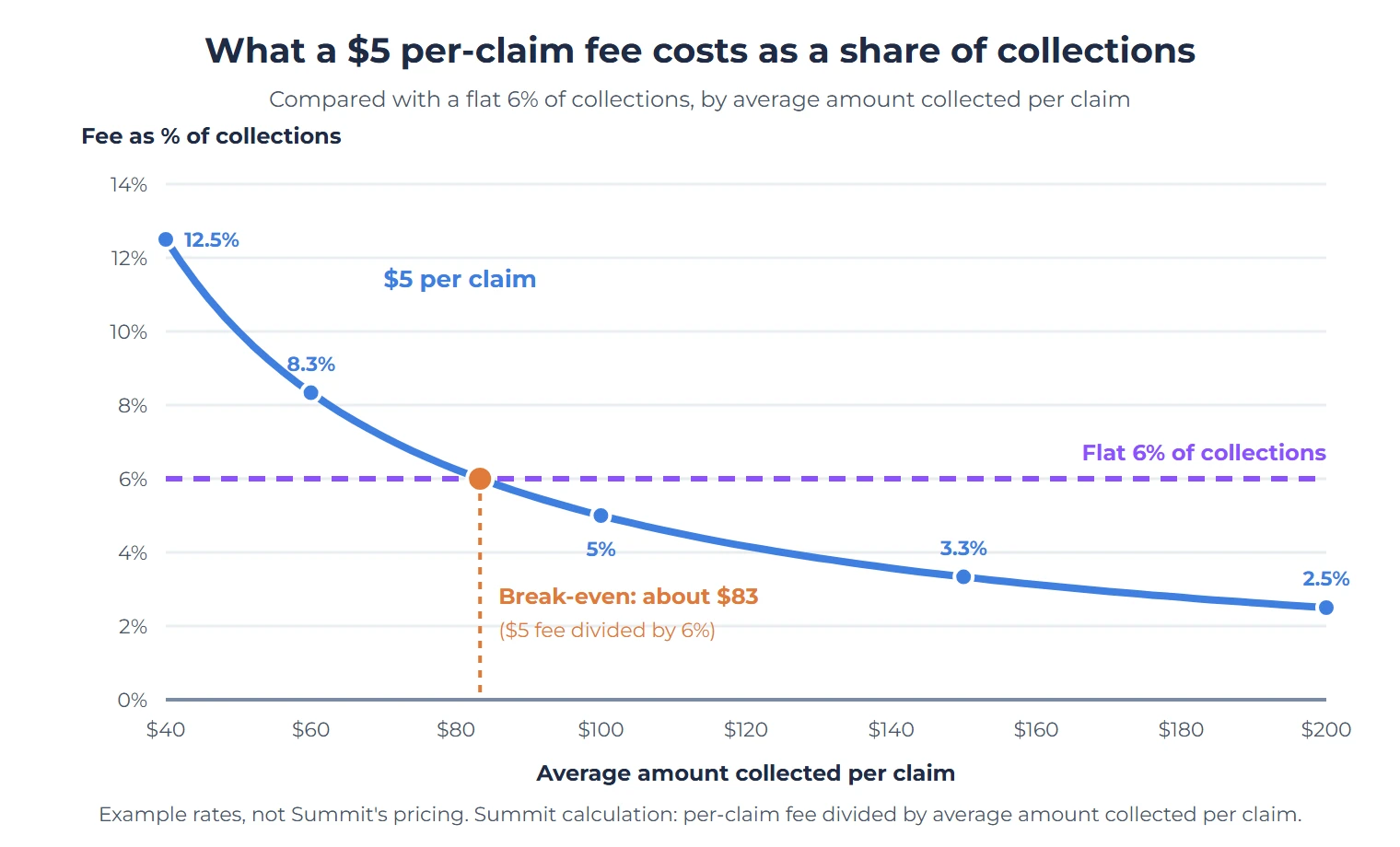
- A per-claim fee costs more, as a share of collections, the less each claim pays. A $5 fee is 5% of a claim that collects $100 and 12.5% of one that collects $40.
- Medicare and Medicaid won’t pay a billing agent whose pay depends on what it bills or collects. Under a percentage contract, payments go to your own account and the company invoices you.
- Compare quotes on an effective rate: every monthly fee, minimum and add-on, divided by net collections, priced on the same months of your own data.
What Is a Medical Billing Pricing Structure?
A medical billing pricing structure is the formula a billing company uses to set its fee: what triggers a charge, what the charge is measured against, and which tasks it covers. There are five common types. When MGMA surveys practices that outsource their billing, it sorts the answers into three of them: a percentage of collections, “a fixed dollar rate per claim”, or a hybrid that charges a percentage for some payers or balances and a flat fee for others (MGMA practice survey questions). Flat monthly fees and hourly rates make up the rest.
| Pricing structure | What triggers the fee | How the cost moves | Usually fits | Ask first |
|---|---|---|---|---|
| Percentage of collections | Money reaching your account | Rises and falls with collections | Full-service billing | A percentage of what, exactly? |
| Per claim | Each claim submitted | Rises with claim volume | High volume, simple claims, follow-up kept in-house | Is a resubmitted claim charged again? |
| Flat monthly fee | The calendar | Fixed up to a cap | Small practices with steady volume | What happens above the cap? |
| Hourly or project | Hours worked | Rises with the hours | A/R cleanup, audits, credentialing | Is there a cap and a finish line? |
| Hybrid | Two or more of the above | Depends on the mix | Mixed payers, patient billing, old A/R | Which fee applies to which dollar? |
Scope matters as much as structure. When you outsource medical billing, some companies quote only claim submission and payment posting, while others take on everything from eligibility checks to appeals. Our guide to medical billing vs revenue cycle management lists all 10 steps of the cycle, so you can see which ones a quote leaves with your staff.
What Percentage Do Most Medical Billing Companies Charge?
Most medical billing companies charge a percentage of net collections, and the rates they publish mostly fall between about 4% and 10%. Treat that range as a rough guide. We found no free, independent survey of these fees, so the numbers come from billing companies’ own pricing pages.
Where a practice lands in that range depends on a few things:
- How much each claim pays. Billing work doesn’t grow in step with what a claim pays, so low-dollar claims cost more to bill as a share of revenue. A 2018 JAMA study at an academic health system in North Carolina estimated billing and insurance work at $20.49 for a primary care visit and $215.10 for an inpatient surgical procedure. As a share of physician revenue per encounter, professional billing costs came to 14.5% for the primary care visit and 3.1% for the surgery (Tseng et al., JAMA, 2018). That’s one reason percentage quotes vary so much by specialty.
- Specialty and payer rules. Modifiers, prior authorizations and time-based codes add work. Behavioral health is a good example: psychotherapy is billed by the minute, and a separate company often manages the benefit, as our guide to mental health insurance billing services explains.
- Claim volume. Setup and account management costs spread over more claims in a bigger practice.
- Denial rate and the state of your A/R. A backlog of old claims or a high denial rate means more follow-up, which companies either price in or bill separately.
- Scope. Credentialing, coding from notes, patient statements and patient calls can sit inside the rate or be billed on top.
Use the published range to sanity-check a quote, not to judge it. A higher rate that includes denial management and old A/R can cost less in the end than a low rate that stops at claim submission.
What Is the Percentage Taken From?
A percentage can be taken from billed charges or from collections, and the same rate gives very different bills. Billed charges are the list prices on your fee schedule, not what payers actually pay.
Take an example practice that bills $240,000 in charges in a month and collects $95,000 after contractual adjustments, refunds and recoupments:
| Fee base | Amount | A 6% fee on it |
|---|---|---|
| Billed charges | $240,000 | $14,400 |
| Net collections | $95,000 | $5,700 |
A fee on charges also grows whenever you raise your fee schedule, even if you don’t collect a dollar more. A fee on net collections avoids both problems. Then pin down what counts as a collection:
- Copays and other patient payments your front desk collected
- Refunds and payer recoupments, and whether they’re subtracted
- Payments on claims that were already in A/R before the contract started
- Capitation, incentive and value-based payments that no claim produced
- Payments that arrive after the contract ends
Medicare and Medicaid payments should go to your account
Federal rules shape how a percentage contract has to work. Medicare pays a billing agent in the provider’s name only if “the agent’s compensation is not related in any way to the dollar amounts billed or collected” and doesn’t depend on payment actually being collected (42 CFR 424.73(b)(3), which 42 CFR 424.80(b)(5) applies to physicians). Medicaid’s rule is just as direct. A billing service that receives payments in the provider’s name must be paid in a way that is “not related on a percentage or other basis to the amount that is billed or collected” (42 CFR 447.10(f)).
Those conditions don’t apply when the company “merely prepares bills” and doesn’t receive and negotiate the payments (Medicare Claims Processing Manual, chapter 1, section 30.2.4). So a percentage contract usually works like this: Medicare and Medicaid pay into the practice’s own bank account, the billing company posts the payments, and it invoices you for its percentage. If a percentage-based company wants payments sent to its own account, have your healthcare attorney review the arrangement first. This section is general information, not legal advice.
The HHS Office of Inspector General has raised a second point. Its compliance guidance for third-party billing companies notes a “longstanding concern that percentage billing arrangements may increase the risk of upcoding and similar abusive billing practices” (OIG, 63 FR 70138, December 18, 1998). The guidance is old, but OIG hasn’t issued a newer one for billing companies. It doesn’t make percentage pricing improper. It does mean a percentage-based company should be able to show how it keeps coding accurate, for example with regular coding audits and review before claims go out. Because the claims carry your number, coding errors stay your problem; our guide to whether you’re liable for your billing company’s mistakes explains what stays with the practice.
How Do Medical Billing Companies Typically Charge for Their Services?
Medical billing companies typically charge in one of five ways. Each one rewards a different kind of work, so the structure tells you where the company’s attention will go.
Percentage of collections
The company keeps a share of what it collects for you, usually measured on net collections each month. At 6%, a month with $95,000 collected costs $5,700. Because the company earns more only when you collect more, it has a reason to chase denials and underpayments. The weak spots are the base, monthly minimums and old A/R. A minimum hits new and small practices hardest: a 6% rate with a $1,500 monthly minimum is really 10% in a month when you collect $15,000.
Per claim
The company charges a fixed dollar amount for each claim it submits. At $5 a claim, 1,000 claims cost $5,000, whatever they pay. The cost is easy to forecast from your claim count, and it can be cheap when your claims pay well. The catch: the company is paid when a claim goes out, not when it’s paid, so denial follow-up and appeals are often outside the fee. Ask whether a corrected or resubmitted claim is charged as a new claim, and who works the denials.
Flat monthly fee
The company charges the same amount every month for a defined scope, often with a cap on claims or providers. It suits small practices with steady volume that want a fixed budget line. Check what happens above the cap, and whether denials, patient statements and old A/R are inside the fee.
Hourly or project pricing
Hourly rates show up mostly for one-off work: clearing an A/R backlog, a billing audit, credentialing or a software change. They rarely suit ongoing billing, because the monthly cost is hard to predict. Ask for an estimate of the hours, a cap and a clear definition of done. Our A/R recovery page describes what a backlog cleanup involves.
Hybrid pricing
A hybrid mixes structures: a percentage of insurance payments plus a fee per patient statement, a lower percentage plus a monthly base fee, or one rate for current claims and another for old A/R. Hybrids can fit a practice with mixed needs, but they’re the hardest to audit. Ask the company to walk you through a sample invoice and show which fee applies to which dollar.
Percentage-Based vs. Per-Claim Medical Billing Fees: A Worked Example
Percentage and per-claim pricing are the two quotes practices most often end up comparing. Here’s one example practice under both. The practice and both rates are examples, not Summit’s pricing.
The practice submits 1,000 claims a month and collects $95,000, or about $95 per claim. Quote A is 6% of net collections and includes denial follow-up and appeals. Quote B is $5 per claim submitted, charges resubmitted claims as new claims, and leaves denial follow-up to the practice’s own staff.
| Month | Claims billed | Net collections | Quote A: 6% of collections | Quote B: $5 per claim | Quote B as a share of collections |
|---|---|---|---|---|---|
| Typical month | 1,000 | $95,000 | $5,700 | $5,000 | 5.3% |
| Slow month: payers pay 15% less | 1,000 | $80,750 | $4,845 | $5,000 | 6.2% |
| Denial month: 120 claims corrected and resubmitted | 1,120 | $88,000 | $5,280 | $5,600 | 6.4% |
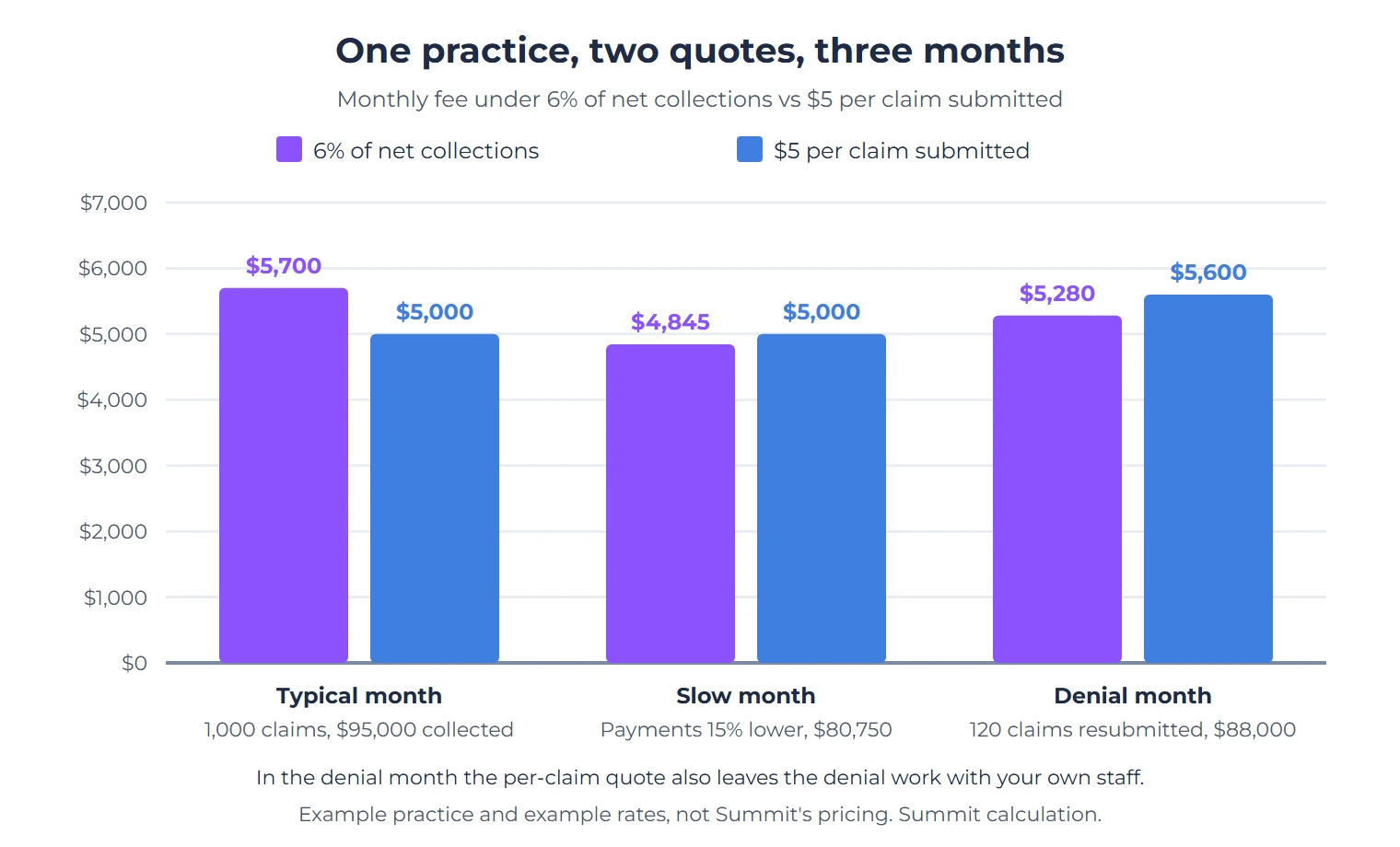
In a typical month, the per-claim quote is $700 cheaper. In the slow month it costs $155 more, because the fee doesn’t fall when payments do. In the denial month it costs $320 more, and the practice’s staff still had to work the 120 denials themselves. Which quote wins over a year depends on how many of each kind of month you have. That’s why it pays to price quotes on your own recent months, not on a typical one.
The break-even point
You can find the break-even between any per-claim fee and any percentage with one division:
Break-even amount collected per claim = per-claim fee ÷ percentage rate
For a $5 fee against 6%, that’s $5 ÷ 0.06, or about $83 collected per claim. If your claims collect more than that on average, the per-claim fee is cheaper in a normal month. If they collect less, the percentage is cheaper. A practice whose claims collect $40 on average would pay the equivalent of 12.5% of collections at $5 a claim.
What Else Can Show Up on the Invoice?
The headline rate is rarely the whole bill. These charges are where two quotes with the same rate end up far apart:
- Setup or onboarding fees for connecting to your practice management system and clearinghouse.
- Monthly minimums, which raise your effective rate in slow months or while a new practice ramps up.
- Old A/R. Claims that were open before the contract started may be excluded, worked at a higher rate, or worked at the same rate. Get it in writing.
- Patient statements and patient calls, often priced per statement or per month.
- Credentialing and payer enrollment, usually priced per provider or per payer.
- Software and clearinghouse fees, if the company moves you onto its own system or passes claim fees through.
- Coding, if the company codes from your notes rather than billing the codes your providers pick.
- Termination and run-out: who works the claims still open when the contract ends, at what rate, and how you get your data back.
How to Compare Two Medical Billing Quotes
A fair comparison puts every quote on the same data and the same scope.
- Give each company the same numbers. Share three recent months of claim counts, net collections and denials, including at least one slow month.
- Get the scope in writing, task by task, from eligibility checks to appeals and patient statements.
- Convert every quote to an effective rate. Add every monthly fee, minimum and add-on, then divide by net collections for the same month.
- Check the base. Confirm the percentage is taken from net collections, and which receipts count.
- Price a bad month, with slower payments and a denial spike, as in the example above.
- Check where payments land. Under a percentage contract, Medicare and Medicaid should pay into your own account.
- Read the exit terms before you sign, not when you want to leave. Our medical billing contract checklist covers the exit terms and the other clauses to check.
Effective rate = total monthly billing cost ÷ net collections for the month
If the cheaper quote leaves denials or patient balances with your staff, add the cost of that staff time before you compare. Our guide to in-house vs outsourced medical billing shows how to work out what a biller’s time costs, using federal wage data.
How Summit Billing Solutions Prices Medical Billing
Summit Billing Solutions charges a percentage of monthly collections. We quote the exact rate after a free account review that looks at your clean-claim rate, denial rate, aging A/R and the payers costing you the most, so the rate reflects your specialty, volume and receivables rather than a guess. We sign a business associate agreement with every practice before we handle any patient information, and we work inside your existing EHR and practice management system, in any specialty. Our first-pass claim rate is 95% to 98%. Our medical billing services page sets out the full scope.
Want to compare your quotes on equal terms?
Summit Billing Solutions will review your billing for free, then give you an exact rate, worked out on your own numbers, that you can set beside any other quote.
Frequently Asked Questions About Medical Billing Company Pricing
1. What percentage do most medical billing companies charge?
Most charge a percentage of net collections. The rates billing companies publish mostly fall between about 4% and 10%, though those are the companies’ own figures rather than an independent survey. Where a practice lands depends on how much each claim pays, the specialty, claim volume, the denial rate, old A/R and what the fee covers.
2. How much does a medical billing company charge per claim?
Per-claim fees are quoted in dollars per claim submitted. To compare one with a percentage, divide the fee by your average amount collected per claim. A $5 fee on claims that collect $95 on average works out to about 5.3% of collections; on claims that collect $50, it’s 10%. Ask whether resubmitted claims are charged again.
3. Is percentage or per-claim medical billing cheaper?
It depends on how much your claims pay and how often they’re denied. Divide the per-claim fee by the percentage rate to find the break-even: at $5 a claim against 6%, it’s about $83 collected per claim. Above that, per-claim is cheaper in a normal month. Below it, the percentage is cheaper. Per-claim fees also don’t fall in slow months.
4. Can a billing company take its percentage out of our Medicare payments?
Not if it receives those payments in your name. Medicare and Medicaid pay a billing agent only when its pay isn’t tied to the amount billed or collected (42 CFR 424.73 and 447.10). Under a percentage contract, have Medicare and Medicaid pay into your practice’s own account, and pay the billing company by invoice.
5. Do medical billing companies charge more for old A/R?
Often, yes, or they leave it out. Claims that were open before the contract started take more work to collect, so some companies price them at a higher rate or as a separate project. Ask for the old A/R terms in writing before you sign.