


The CO-11 denial code means the payer decided the diagnosis on a claim line does not support the procedure billed on that line. “CO” is the group code for a contractual obligation, so the unpaid amount is the provider’s to fix or write off, not the patient’s to pay. “11” is claim adjustment reason code (CARC) 11, which X12 defines as “The diagnosis is inconsistent with the procedure” (X12 claim adjustment reason codes).
Most CO-11 denials can be fixed, and many can be prevented. The usual causes are a diagnosis pointer aimed at the wrong code, a code that is not specific enough, a diagnosis the payer’s policy does not list for that CPT code, or documentation that never captured the real reason for the service. This month adds one more cause. The FY2027 ICD-10-CM update took effect on October 1, 2026, with 190 new codes, 30 deleted codes and 4 revised titles. That took the code set from 74,719 to 74,879 codes (CMS FY2027 ICD-10-CM code descriptions). Some common codes, such as I42.0 for dilated cardiomyopathy and M72.2 for plantar fasciitis, are no longer valid on their own.
This guide explains what CO-11 means on your remittance, how it differs from the denial codes next to it, and how to work it step by step. It also covers which route to take with Medicare and with other payers. (If you were looking for the UB-04 date code, see our guide to occurrence code 11, which is a different thing.)
Key Takeaways
- CO-11 is a line-level denial: the ICD-10-CM code linked to that service line does not support the CPT or HCPCS code, in the payer’s view.
- The CO group code puts the balance on the provider. Medicare says you may bill a beneficiary for an unpaid amount only when the group code is PR.
- Check the diagnosis pointer first. It is the fastest fix, and Medicare treats a transposed diagnosis code as a clerical error that a reopening can correct.
- Only change a diagnosis if the medical record supports it. If it does not, the denial is correct.
- Since October 1, 2026, codes such as I42.0, I49.8, M72.2 and Z68.1 need more characters, and plantar fasciitis has moved to M67.A0-. Update templates and superbills now.
What does the CO-11 denial code mean?
CO-11 is two codes read together. The group code says who is financially responsible for the adjustment. The reason code says why the payer adjusted the line. CMS explains that a Contractual Obligation (CO) group code assigns responsibility to the provider, a Patient Responsibility (PR) group code assigns it to the patient, and providers “may bill Medicare beneficiaries for an unpaid portion only when an adjustment shows Group Code PR” (CMS Remittance Advice Resources and FAQs booklet).
Reason code 11 has been in the X12 code list since 1995. Its usage note tells the reader to check the Healthcare Policy Identification segment of the 835 remittance (loop 2110, the service payment REF segment) if one is present (X12). In practice, that segment is where a payer can name the coverage policy it applied. Pull it before you call the payer. It often tells you exactly which list of diagnoses the claim failed.
Three details shape how you work a CO-11:
- It applies to one service line. The payer judged the diagnosis linked to that line, not every diagnosis on the claim. A correct code can sit in item 21 of the claim and still not help a line that points somewhere else.
- It is about the pairing. The diagnosis may be valid and the procedure may be covered. CARC 11 says the two do not belong together.
- It is not the same as occurrence code 11, place of service 11 or CARC B11. Each “11” lives in a different field. B11 means the claim was sent to the wrong payer and has been transferred.
How is CO-11 different from other diagnosis denial codes?
Payers have several reason codes for diagnosis problems, and which one they choose changes the fix. The wording below is X12’s (claim adjustment reason codes). The “usual first check” column is our working guidance, not part of the code list.
| Code | X12 description | Usual first check |
|---|---|---|
| CO-11 | The diagnosis is inconsistent with the procedure. | Diagnosis pointer, code specificity, payer policy for the CPT code |
| CO-9 | The diagnosis is inconsistent with the patient’s age. | Patient’s date of birth, age-limited codes such as pediatric or newborn codes |
| CO-146 | Diagnosis was invalid for the date(s) of service reported. | Deleted or incomplete code, code set year used for the date of service |
| CO-167 | This (these) diagnosis(es) is (are) not covered. | Whether the plan covers the condition at all, not just for this service |
| CO-50 | These are non-covered services because this is not deemed a “medical necessity” by the payer. | Coverage policy criteria, documentation, any advance notice given |
| CO-16 | Claim/service lacks information or has submission/billing error(s). | The remark code on the line, which names the missing or invalid field |
| CO-4 | The procedure code is inconsistent with the modifier used. | Modifier choice, such as modifier 59 or 25 |
Payers do not always choose the same code for the same problem. One payer may report a diagnosis that is missing from its policy list as CO-11, and another may use CO-50 or CO-167. Always read the remittance advice remark code (RARC) and the policy reference on the line before you decide what went wrong.
What causes a CO-11 denial?
Five problems cause most CO-11 denials. Work through them in this order, because the first two are the quickest to confirm and fix.
1. The diagnosis pointer links the wrong code
On a CMS-1500 or 837P claim, item 21 holds up to 12 diagnosis codes, lettered A to L. Item 24E links each service line to those codes. CMS says to enter the diagnoses “in priority order” and use item 24E “to relate the date of service and the procedures performed to the primary diagnosis” (Medicare Claims Processing Manual, chapter 26, sections on items 21 and 24E). The NUCC manual allows up to four pointer letters per line, with the primary reason listed first (NUCC 1500 Claim Form Reference Instruction Manual, version 13.0).
A pointer error is easy to miss because the claim looks complete. In the example below, the visit for hypertension and the ECG for chest pain both point to A. The ECG line is then judged against hypertension alone, and a payer whose ECG policy expects a cardiac symptom can deny it with CO-11.
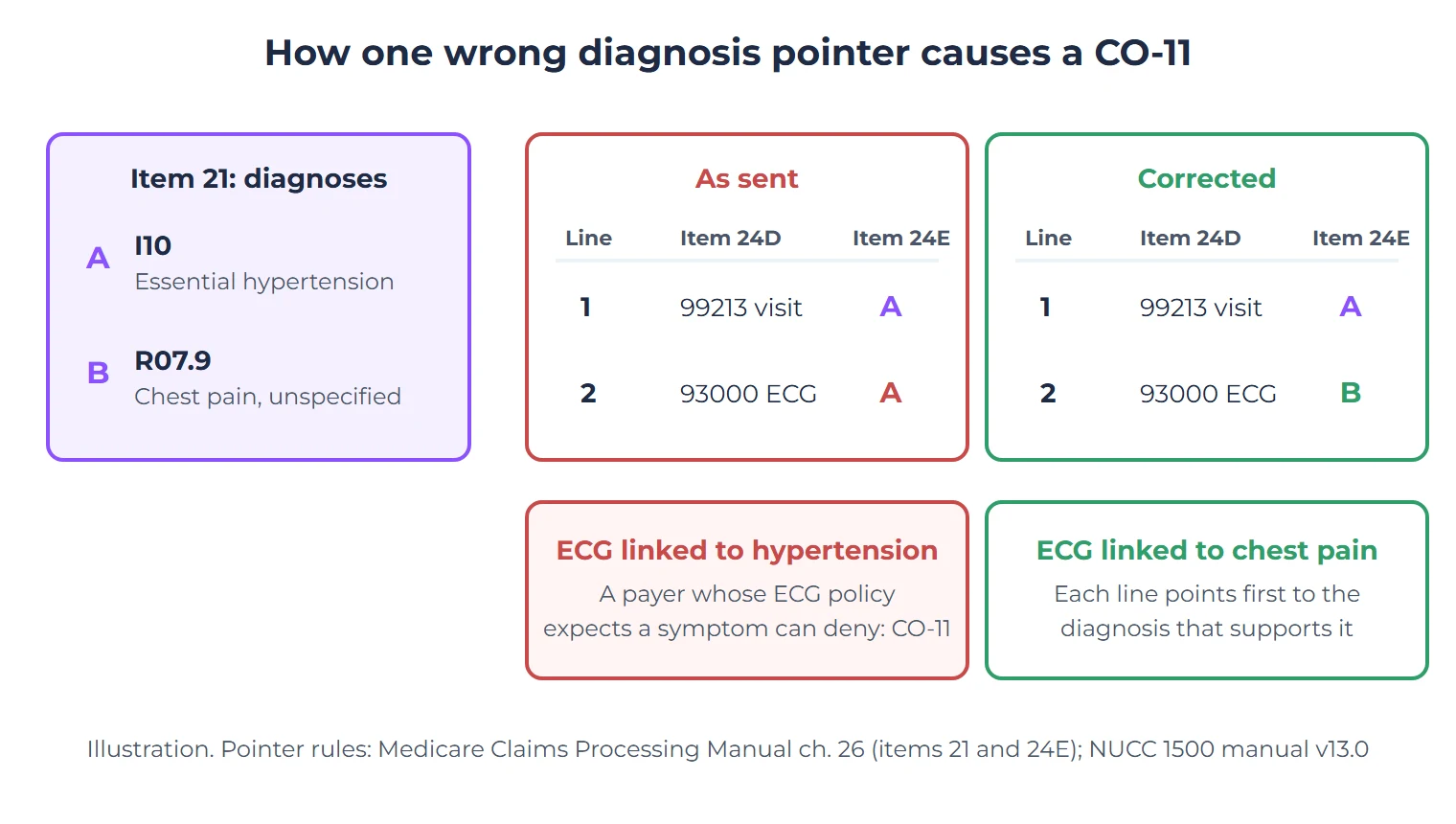
Medicare’s paper claim instructions are stricter than NUCC’s general guidance. They say to enter only one pointer per line and reference the primary diagnosis. So make sure the first pointer on each line is the one that supports that service.
2. The code is not specific enough, or is not valid for the date of service
The official guidelines say a code “is invalid if it has not been coded to the full number of characters required for that code, including the 7th character, if applicable.” They also say to “code to the highest level of specificity when supported by the medical record documentation” (FY2027 ICD-10-CM Official Guidelines, section IV.F). Many payer edits accept a specific code and reject the unspecified one. A truncated code usually rejects at the front end or comes back as CO-146 or CO-16. An unspecified code that is valid but not on the payer’s list for the procedure can come back as CO-11.
3. The documentation was coded from the order, not the result
For outpatient care, the guidelines say not to code diagnoses documented as “probable”, “suspected”, “rule out” or similar. Code the symptoms, signs or abnormal findings instead (section IV.H). For diagnostic tests that a physician has interpreted, they say to code any confirmed diagnosis in the interpretation and not the related signs and symptoms (section IV.K). A coder who works from the order alone may report a symptom when the final report confirms a condition. That condition may be the diagnosis the payer’s policy actually lists for the test.
4. The payer’s coverage policy does not list the diagnosis for that procedure
Medicare publishes its coverage rules in national coverage determinations (NCDs) and local coverage determinations (LCDs). Many LCDs come with a billing and coding article that lists the ICD-10-CM codes that support the service. You can search them in the Medicare Coverage Database. Medicare Advantage, Medicaid and commercial payers publish their own policies, and their lists can differ from traditional Medicare’s for the same CPT code.
When the documented diagnosis is not on the list, changing the code is not the answer. The fix is either a better-documented reason for the service, if one exists in the record, or an appeal that shows medical necessity.
5. The code set changed under you on October 1
ICD-10-CM codes are tied to the date of service. CMS’s FY2027 files apply to “patient encounters” from October 1, 2026 through September 30, 2027 (CMS ICD-10 codes page), and its claims manual tells physicians to use codes “to the highest level of specificity for the date of service” (chapter 26, item 21). Claims for September visits keep the FY2026 codes. Claims for October visits need FY2027 codes, even if they go out together.
Which FY2027 ICD-10-CM changes can trigger diagnosis edits?
We compared CMS’s FY2027 addenda file with the full code list (CMS FY2027 code descriptions). Most of the 190 new codes are injury, poisoning and pregnancy codes. But several of the codes a physician practice reports every week now need more characters. A deleted code on a claim fails as invalid for the date of service. The less obvious risk is a payer edit table that has not loaded the new code yet, which can deny a correct claim with CO-11 or CO-167.
| Code deleted on October 1, 2026 | Report one of these instead | Who it affects |
|---|---|---|
| I42.0 Dilated cardiomyopathy | I42.00 unspecified, I42.01 familial-genetic, I42.09 other dilated cardiomyopathy | Cardiology, echocardiography, internal medicine |
| I42.8 Other cardiomyopathies | I42.81 arrhythmogenic, I42.89 other cardiomyopathies not elsewhere classified | Cardiology |
| I49.8 Other specified cardiac arrhythmias | I49.81 Brugada syndrome, I49.82 ventricular bigeminy, I49.89 other specified | Cardiology, primary care ECG billing |
| M72.2 Plantar fascial fibromatosis (included plantar fasciitis) | M67.A01, M67.A02, M67.A09 plantar fasciitis by foot; M72.20 to M72.22 for fibromatosis only | Podiatry, physical therapy, orthopedics |
| Z68.1 BMI 19.9 or less, adult | Z68.18 BMI 18.4 or less, Z68.19 BMI 18.5 to 19.9 | Primary care, nutrition and weight management |
The plantar fasciitis change is the one most likely to cause wrong codes rather than rejected ones. Plantar fasciitis used to be indexed to M72.2. Now M72.2- means plantar fascial fibromatosis (Ledderhose disease), and plantar fasciitis has its own codes under M67.A0- (CMS FY2027 tabular addenda). A therapy or podiatry template that maps “plantar fasciitis” to M72.21 will produce valid claims with the wrong diagnosis. Those claims are exactly the kind a payer’s policy edit flags as inconsistent with the procedure.
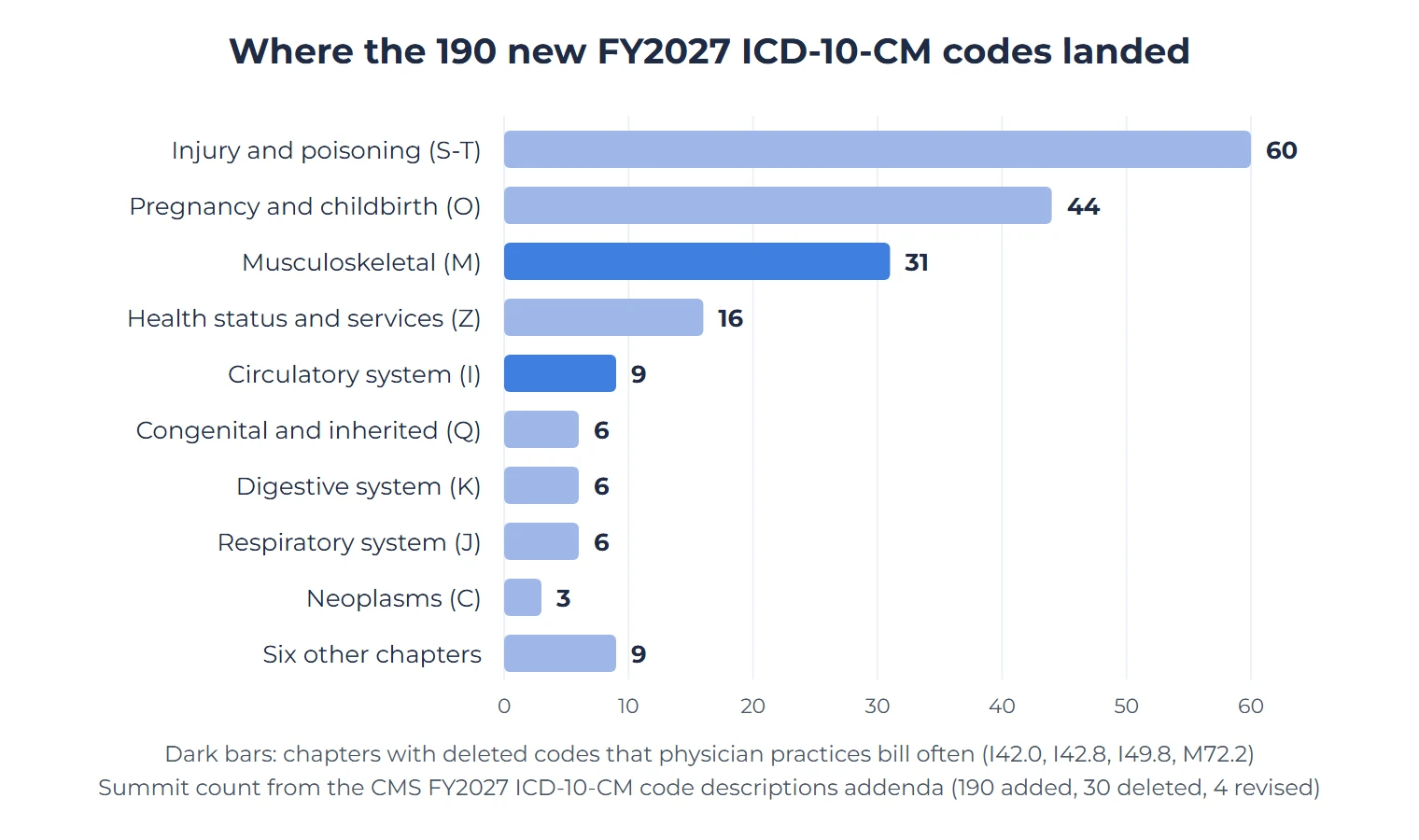
For echocardiograms, the cardiomyopathy split matters on every 93306 or 93308 billed for a known dilated cardiomyopathy. Our echocardiogram CPT code guide covers how those codes are chosen. The cardiology billing, podiatry billing and rehab therapy billing pages show how Summit handles those specialties.
How do you fix a CO-11 denial, step by step?
Work each CO-11 in five steps. Steps 1 to 3 find the cause. Step 4 picks the route, and step 5 stops the same denial from coming back.
Step 1: Read the whole remittance line
Write down the CARC, every RARC on the line and any policy reference in the 835 REF segment. Note the date of the remittance too. It starts the clock for Medicare’s appeal deadlines.
Step 2: Compare the claim with the note
Open the claim as sent and the signed note side by side. Check:
- Pointers. Does the denied line point first to the diagnosis that supports it?
- Codes. Is each code complete, valid for the date of service and as specific as the note allows?
- Order. Is the reason for the encounter listed first?
Step 3: Check the payer’s policy for that procedure code
Look up the CPT or HCPCS code in the payer’s coverage policy, or in the Medicare Coverage Database for traditional Medicare. Confirm whether the documented diagnosis is on the supported list for that date of service.
Step 4: Choose the right route
The route depends on what you found and who the payer is.
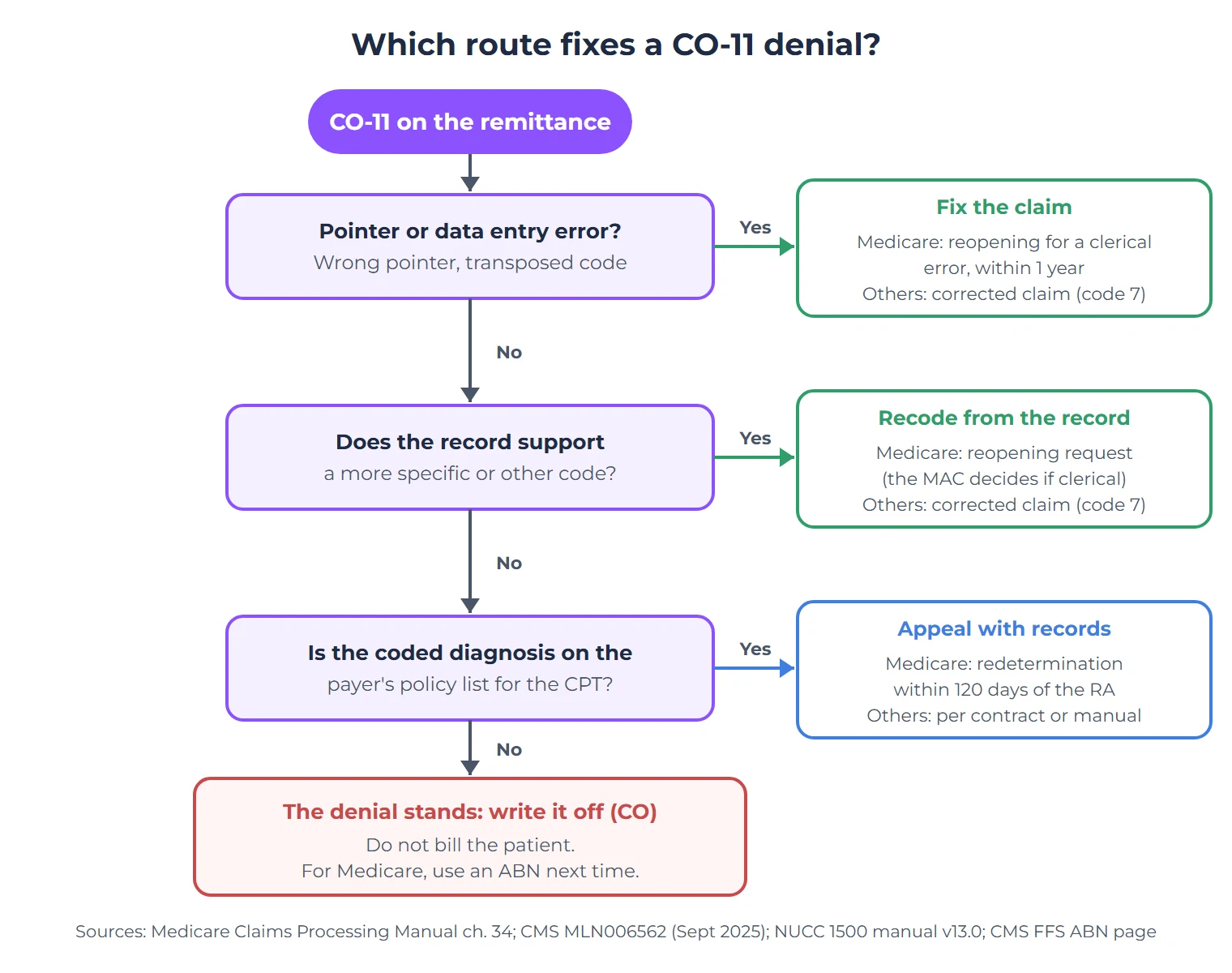
- Medicare Part B, clerical error. Medicare treats clerical errors as reopenings, not appeals, and its examples include “transposed procedure or diagnostic codes” and incorrect data items (Medicare Claims Processing Manual, chapter 34, section 10.4). A party may ask for a reopening within one year of the initial determination for any reason (section 10.6.2). Your MAC decides what counts as clerical, so check its reopening options, which often include a portal or a phone line.
- Medicare Part B, coding was correct. If the record supports the service and the code, request a redetermination within 120 days of the date you receive the remittance advice (CMS Medicare Parts A and B Appeals Process booklet, MLN006562). Send the note, any test interpretation and the policy section that the diagnosis meets.
- Other payers. Most commercial plans, Medicare Advantage plans and Medicaid programs accept a corrected claim. On the CMS-1500, that means frequency code 7 (replacement of prior claim) in item 22 with the payer’s original claim number (NUCC manual, item 22). Follow each payer’s corrected-claim deadline, which is set by its provider manual or your contract.
- The record does not support a covered diagnosis. Do not change the code to fit the policy. The CO-11 stands, and the CO group code means the patient cannot be billed. For traditional Medicare, the way to protect future visits is an Advance Beneficiary Notice (form CMS-R-131), which providers issue when “Medicare payment is expected to be denied” (CMS FFS ABN page).
Step 5: Fix the cause upstream
Log every CO-11 by payer, CPT code and cause. One wrong pointer is a typo. Twenty on the same CPT code is a charge-entry rule or a template that needs fixing. Our denial management team tracks denials this way so the fix lands in the workflow, not just on the claim.
How can a practice prevent CO-11 denials?
Most CO-11 denials are preventable before the claim leaves the office. A short checklist covers them:
- Update templates, superbills and EHR favorites for FY2027. Remove I42.0, I42.8, I49.8, M72.2 and Z68.1, and add the new codes your providers actually use.
- Add a pointer check to charge review. Flag claims where every line points to the same diagnosis but the note gives a different reason for one of the services.
- Code diagnostic tests from the final interpretation when it is available, as the outpatient guidelines require.
- Keep the payer policy lists for your top 20 procedures in your claim scrubber, and check them each October and whenever a payer revises its policy.
- Audit a sample of claims each quarter. Pair it with provider feedback on documentation. Our medical billing audit service does this against the payer rules, and our medical coding services apply the same checks before claims go out.
If you are new to how diagnosis and procedure codes work together, start with our guide to medical coding.
How Summit works CO-11 denials
Our coders check every CO-11 against the record, the pointer and the payer’s policy for the date of service before choosing a corrected claim, a reopening or an appeal. We then fix the template or scrubber rule that caused it, so the same denial stops repeating. It is part of our denial management services.
Want to know how many of your denials are diagnosis and procedure mismatches?
Summit Billing Solutions will review your recent remittances, sort the denials by cause and payer, and show you which ones are still recoverable.
Frequently Asked Questions About the CO-11 Denial Code
1. What does the CO-11 denial code mean?
CO-11 means the payer decided the diagnosis linked to a service line does not support the procedure on that line. CO is the contractual obligation group code, so the provider is responsible for the balance. Reason code 11 is defined by X12 as “The diagnosis is inconsistent with the procedure.”
2. Can I bill the patient for a CO-11 denial?
No. The CO group code assigns the unpaid amount to the provider. CMS says providers may bill Medicare beneficiaries for an unpaid portion only when an adjustment shows group code PR. Correct the line through a corrected claim, a reopening or an appeal, or write it off if the record does not support a covered diagnosis.
3. What is the difference between CO-11 and CO-50?
CO-11 says the diagnosis and the procedure do not match. CO-50 says the payer does not consider the service medically necessary. Payers sometimes use either one for a diagnosis that is missing from a coverage policy. Read the remark code and the policy reference on the remittance to see which problem you are fixing.
4. Is CO-B11 the same as CO-11?
No. CARC B11 means the claim or service was transferred to the proper payer or processor because this payer does not cover it. It is about where the claim was sent, not about the diagnosis. CO-11 is about the pairing of diagnosis and procedure codes on one service line.
5. How long do I have to fix a CO-11 denial with Medicare?
For a clerical error such as a transposed diagnosis code, you can ask your MAC for a reopening within one year of the initial determination. If the coding was correct and you disagree with the denial, file a redetermination within 120 days of receiving the remittance advice.