


Occurrence code 11 tells the payer the date a patient’s symptoms or illness began. It’s an institutional billing code: hospitals and other facilities report it on the UB-04 (CMS-1450) in form locators 31 through 34, as the code “11” plus a six-digit date, or in the claim-level HI segment of the electronic 837I.
Looking for the CO-11 denial code? That’s claim adjustment reason code 11, “The diagnosis is inconsistent with the procedure,” which appears on a remittance, not on the UB-04. Our CO-11 denial code guide explains what causes it and how to fix it.
Key Takeaways
- Occurrence code 11 means the onset of symptoms or illness. The date that goes with it is when the condition began, not the admission or visit date (CMS, CMS-1450 and 837I billing course).
- On the UB-04 it goes in form locators 31 to 34 as a two-character code and an MMDDYY date; on the 837I, in the loop 2300 HI segment.
- It isn’t condition code 11, value code 11 or place of service 11. Each “11” sits in a different field and means something different.
What occurrence code 11 means
Occurrence codes are two-character codes that put a date on an event connected to the billing period. CMS’s training course on the CMS-1450 and 837I says they help payers decide payment liability, coordinate benefits and administer subrogation, and it lists code 11 as the onset of symptoms or illness (CMS, CMS-1450 and 837I billing course).
The date reported with it is the day the patient first noticed symptoms or the illness began. It isn’t:
- A diagnosis. The ICD-10-CM codes on the claim say what the condition is; occurrence code 11 only dates it.
- The admission or visit date. Those have their own fields on the UB-04.
- The date treatment started. Outpatient therapy uses separate occurrence codes for that, covered below.
The National Uniform Billing Committee (NUBC) maintains the full code list in its Official UB-04 Data Specifications Manual. CMS points billers to the NUBC and to their Medicare Administrative Contractor (MAC) for the codes Medicare uses (Medicare Claims Processing Manual, chapter 25).
Where occurrence code 11 goes on the UB-04 and the 837I
On the paper UB-04, occurrence codes and their dates go in form locators (FL) 31 through 34. Each entry is a two-character code paired with a six-digit date in MMDDYY format. CMS tells providers to complete the “a” line of fields 31 to 34 before the “b” line, and the occurrence span fields can hold extra occurrence codes when a claim needs more, for up to 10 in total (Medicare Claims Processing Manual, chapter 25, section 75.3).
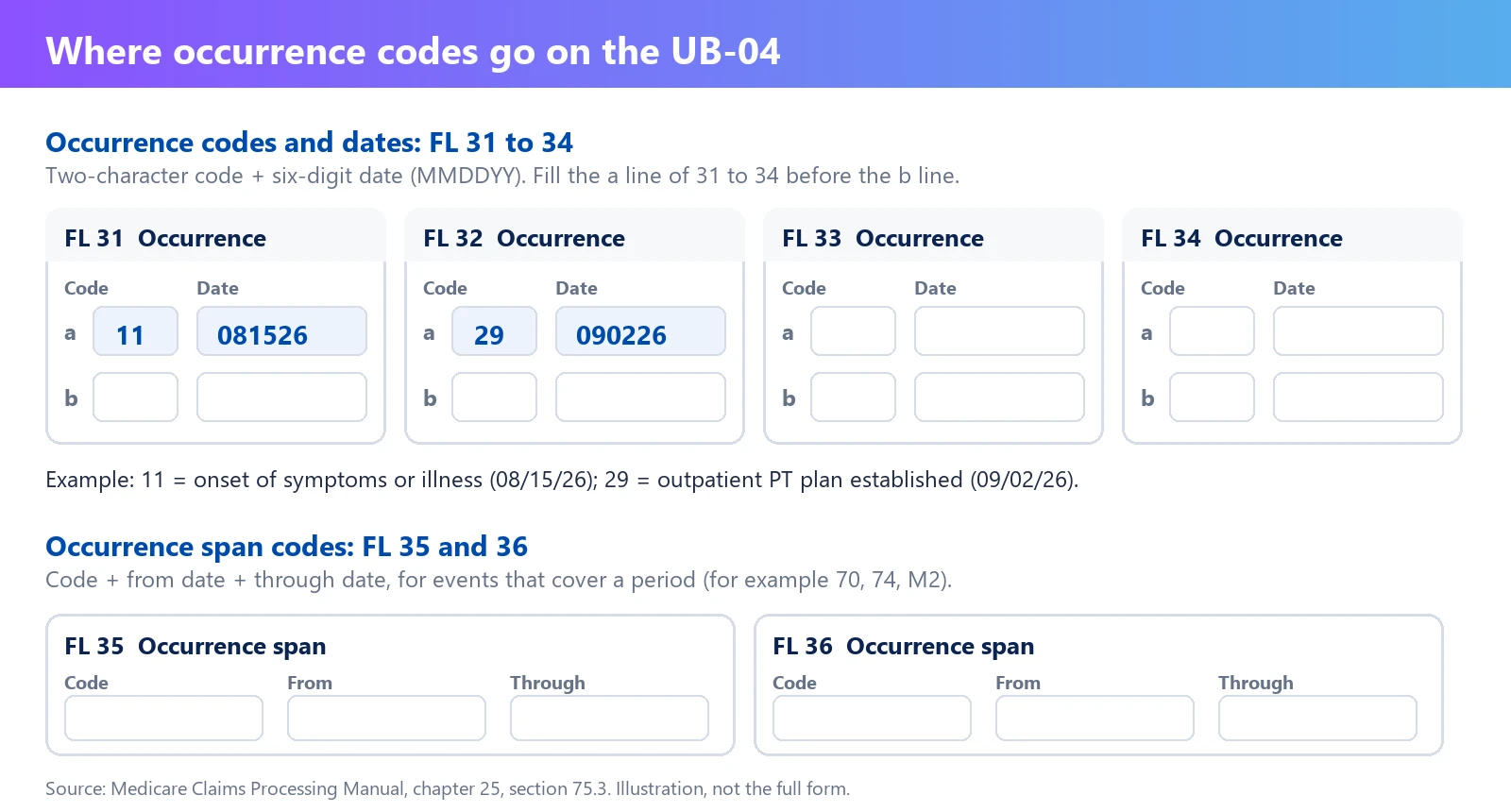
Here’s how a filled-in line reads. The dates are made up to show the format:
| Form locator | Code | Date | What it tells the payer |
|---|---|---|---|
| 31a | 11 | 081526 | Symptoms began on August 15, 2026 |
| 32a | 29 | 090226 | The outpatient physical therapy plan was established on September 2, 2026 |
On the electronic 837I, the same code and date travel in the HI (health care information codes) segment of loop 2300, the claim-level loop that CMS’s billing course maps to form locators 31 to 34 (CMS, CMS-1450 and 837I billing course). Most facilities don’t key these fields by hand: billing systems and UB-04 software map them to the 837I, and a clearinghouse integration checks them before the claim reaches the payer.
When payers look for the onset date
The onset date gives the claim a clinical timeline: when the condition began, measured against the services being billed. That timeline matters when a reviewer compares the claim with the medical record, so it has to agree with the history the clinician documented.
Outpatient therapy shows how dated events build that timeline on a Medicare claim. Providers billing outpatient therapy to their MAC must report the date the plan of care was established or last reviewed in occurrence code 17, 29 or 30, and the first day of treatment in occurrence code 35, 44 or 45 (Medicare Claims Processing Manual, chapter 5, section 20). When the payer also asks for the onset date, occurrence code 11 completes the picture: when the problem began, when the plan was set and when treatment started.
Requirements differ by payer and claim type. Medicare contractors publish the occurrence codes they expect, so check your MAC’s claim instructions for Medicare and the payer’s own billing manual for Medicaid and commercial plans.
Occurrence code 11 vs condition code 11, value code 11 and place of service 11
Searches for “code 11” land on four different codes. They sit in different fields and mean different things:
| Code | Where it goes | What it means |
|---|---|---|
| Occurrence code 11 | UB-04 FL 31 to 34, with a date | Onset of symptoms or illness (CMS) |
| Condition code 11 | UB-04 FL 18 to 28, no date | Disabled beneficiary and/or family member is employed but has no large group health plan, a Medicare Secondary Payer code (CGS) |
| Value code 11 | UB-04 FL 39 to 41, with an amount | Medicare coinsurance amount in the second calendar year of the billing period (CMS) |
| Place of service 11 | CMS-1500 item 24B | Office, the setting code used on professional claims (CMS) |
Condition code 11 is about who pays first, not when anything happened. Value code 11 is a dollar amount, used when an inpatient stay crosses into a new calendar year. And place of service 11 belongs on professional claims, telling the payer the service happened in an office. For hospital outpatient settings, see our POS 22 guide; for nursing facilities, the POS 32 guide.
The onset date on a CMS-1500
Professional claims don’t use occurrence codes. On the CMS-1500, the onset date goes in item 14, date of current illness, injury or pregnancy. The current form has a qualifier box beside the date: qualifier 431 means onset of current symptoms or illness, and 484 means last menstrual period (NUCC 1500 instruction manual).
Medicare is the exception. Its instructions say not to enter a qualifier in item 14 for Medicare claims (Medicare Claims Processing Manual, chapter 26). Commercial payers that follow the national instructions usually expect 431 with the onset date.
Other occurrence codes billers look up
CMS’s billing course lists these as common occurrence codes on Medicare institutional claims (CMS, CMS-1450 and 837I billing course):
| Code | What the date marks |
|---|---|
| 02 | No-fault insurance involved, including auto accident or other |
| 11 | Onset of symptoms or illness |
| 16 | Date of last therapy |
| 17 | Outpatient occupational therapy plan established or last reviewed |
| 23 | Cancellation of a hospice election period |
| 29 | Outpatient physical therapy plan established or last reviewed |
| 30 | Outpatient speech pathology plan established or last reviewed |
| 41 | First test for preadmission testing |
| 47 | Cost outlier status begins |
| A3 | Benefits exhausted |
CMS’s own example shows the format: a hospital patient whose Medicare Part A benefits ran out on January 8, 2005 is reported with code A3 and the date 010805 (Medicare Claims Processing Manual, chapter 25).
Occurrence span codes carry a from date and a through date and go in form locators 35 and 36. Examples from the same course include 70 (qualifying stay dates, SNF use only), 74 (noncovered level of care or leave of absence dates) and M2 (inpatient respite dates).
Common errors that hold up the claim
Most occurrence code 11 problems come from the date, not the code, and they’re cheapest to fix early in the revenue cycle:
- The admission or visit date entered instead of the onset date. Take the onset from the history in the clinical note, not from the registration screen.
- The wrong date format. The paper UB-04 needs six digits, MMDDYY.
- An onset date after the service date. Symptoms can’t begin after the visit they prompted, and a reviewer will question it.
- A code without its date, or a date without its code. Every occurrence code needs its paired date.
- An onset date that doesn’t match the record. If the note says the pain started three weeks ago, the claim’s date has to fit that.
- The wrong “11”. Code 11 entered in the condition code or value code fields means something else entirely.
A coding check before submission catches these before the payer does. When a claim comes back anyway, denial management works it back to the cause, and medical coding review keeps the same error from repeating.
Documentation that supports the onset date
The claim can only be as accurate as the note behind it:
- Record the onset in the history of present illness as an actual date or a clear interval, such as “symptoms began on August 15” or “two weeks before this visit.”
- Capture it at intake, and update it if the history changes.
- Keep it consistent across the clinical note, the claim and any therapy plan of care.
- When the date is an estimate, say so in the note.
Frequently Asked Questions About Occurrence Code 11
1. What is occurrence code 11 on a UB-04?
Occurrence code 11 is the onset of symptoms or illness. It’s reported in form locators 31 to 34 with the six-digit date the patient’s condition began.
2. Is occurrence code 11 the same as condition code 11?
No. Condition code 11 is a Medicare Secondary Payer code reported in form locators 18 to 28. It means a disabled beneficiary or family member is employed but has no large group health plan, and it carries no date.
3. What date format does occurrence code 11 use?
Six digits in MMDDYY format on the paper UB-04. For example, 081526 means August 15, 2026.
4. Is code 11 the same as place of service 11?
No. Place of service 11 means office and goes on professional claims (the CMS-1500). Occurrence code 11 is an institutional code that always comes with a date.
5. Do professional claims use occurrence codes?
No. On the CMS-1500, the date of current illness goes in item 14. Medicare says not to enter a qualifier there, while payers that follow the national instructions expect qualifier 431 for onset of symptoms.
6. Can a claim have more than one occurrence code?
Yes. Form locators 31 to 34 hold several code and date pairs, and CMS allows extra occurrence codes in the occurrence span fields, for up to 10 in total.
Get your institutional claims checked
Want a second set of eyes on your UB-04 claims?
Summit Billing Solutions reviews occurrence, condition and value codes against the record before claims go out, and a free account review shows where your claims are getting held up.