


Optometry RCM (revenue cycle management) is how an eye care practice turns each visit into collected payment. It runs from scheduling and eligibility checks through coding, claims, payment posting, denials and patient balances. What sets it apart from other specialties is that one visit can belong to two insurance systems at once. A medical plan pays for eye disease and medical complaints. A vision plan pays for routine exams, glasses and contacts. Most optometry billing problems start when a service goes to the wrong one.
Key Takeaways
- Route each visit by the reason for the visit and the diagnosis, not by the card the patient hands over. Routine refractive care goes to the vision plan. Eye disease and medical complaints go to the medical plan.
- Medicare never pays for a refraction. The Medicare Benefit Policy Manual excludes eye refractions “by whatever practitioner and for whatever purpose performed”, and the 2026 fee schedule lists 92015 as non-covered.
- Medicare does cover several eye services optometrists provide. Examples are yearly glaucoma screening for high-risk patients (G0117), eye exams for patients with diabetes, and glasses after cataract surgery with a lens implant (CMS MLN907165, June 2026).
- In cataract co-management, the surgeon bills 66984 with modifier 54 and the optometrist bills the same code with modifier 55. The postoperative share of 66984 is 20% in the 2026 fee schedule, or $92.52 nationally before geographic adjustment.
What Is Optometry Revenue Cycle Management?
Optometry revenue cycle management is every task between booking an eye care visit and collecting the last dollar for it. It covers three sides of the practice. The medical side is eye disease, injuries and testing. The vision side is routine exams, refraction and eyewear. The retail side is the frames, lenses and contacts the practice sells.
In practice the cycle has three parts:
- Front end: scheduling, collecting both insurance cards, checking eligibility and benefits on each plan, and telling the patient what they’ll owe.
- Middle: documenting the exam, choosing codes, capturing every test and material, and scrubbing the claim before it goes out.
- Back end: submitting claims, working rejections, posting payments, appealing denials, billing patients and following up on unpaid balances.
The medical side runs on the same rules as any physician claim. Since April 1, 1987, Medicare has treated optometrists as physicians. That applies to every service the optometrist is licensed to perform under state law. Those services still have to be reasonable and necessary for diagnosing or treating an illness or injury (Medicare Benefit Policy Manual, ch. 15, sec. 30.4). Comparing this with general billing? Our guide to medical billing vs revenue cycle management explains where one ends and the other begins.
Why Optometry RCM Is Uniquely Complex
Most specialties bill one payer per visit. Optometry often bills two, plus the patient, plus a separate retail sale. The American Optometric Association notes that medical and nonmedical (vision) plans can both cover eye care services and materials. Each plan’s rules shape the practice’s billing procedures and fees (AOA, third-party programs).
The two plan types work differently:
| Medical plan (including Medicare) | Vision plan | |
|---|---|---|
| What it pays for | Diagnosis and treatment of eye disease, injury or symptoms | Routine eye exams, refraction, frames, lenses and contacts, within plan allowances |
| Typical exam codes | 92002 to 92014 or E/M office visit codes, plus tests such as 92083, 92133 and 92250 | The plan’s own exam codes. HCPCS S0620 and S0621 describe a routine exam including refraction |
| Diagnosis on the claim | Must support medical necessity, such as glaucoma, diabetes or a red eye | Usually a refractive error (ICD-10-CM category H52) |
| What the patient owes | Deductible, copay and coinsurance | Copay plus any overage above the materials allowance |
| Frequency limits | Medical necessity decides | Exams and eyewear allowed on a set schedule |
Four other things add work that a family practice never sees:
- Medicare exclusions. Routine eye exams and refractions are never covered, so the front desk has to collect for them.
- Co-management. Cataract patients often split their surgical care between an ophthalmologist and an optometrist, with each billing part of one code.
- Bilateral pricing. Most eye exam and imaging codes are already priced for both eyes, so adding modifiers doesn’t raise payment.
- Retail sales. Frames, lenses and contacts create inventory, lab orders and patient overages that have to reconcile with plan payments.
Medical or Vision Plan? Decide Before the Claim
The payer decision belongs at the front of the cycle, not at coding. Made late, it sends the claim to the wrong plan. The patient gets a surprise bill. The practice works a denial it could have avoided.
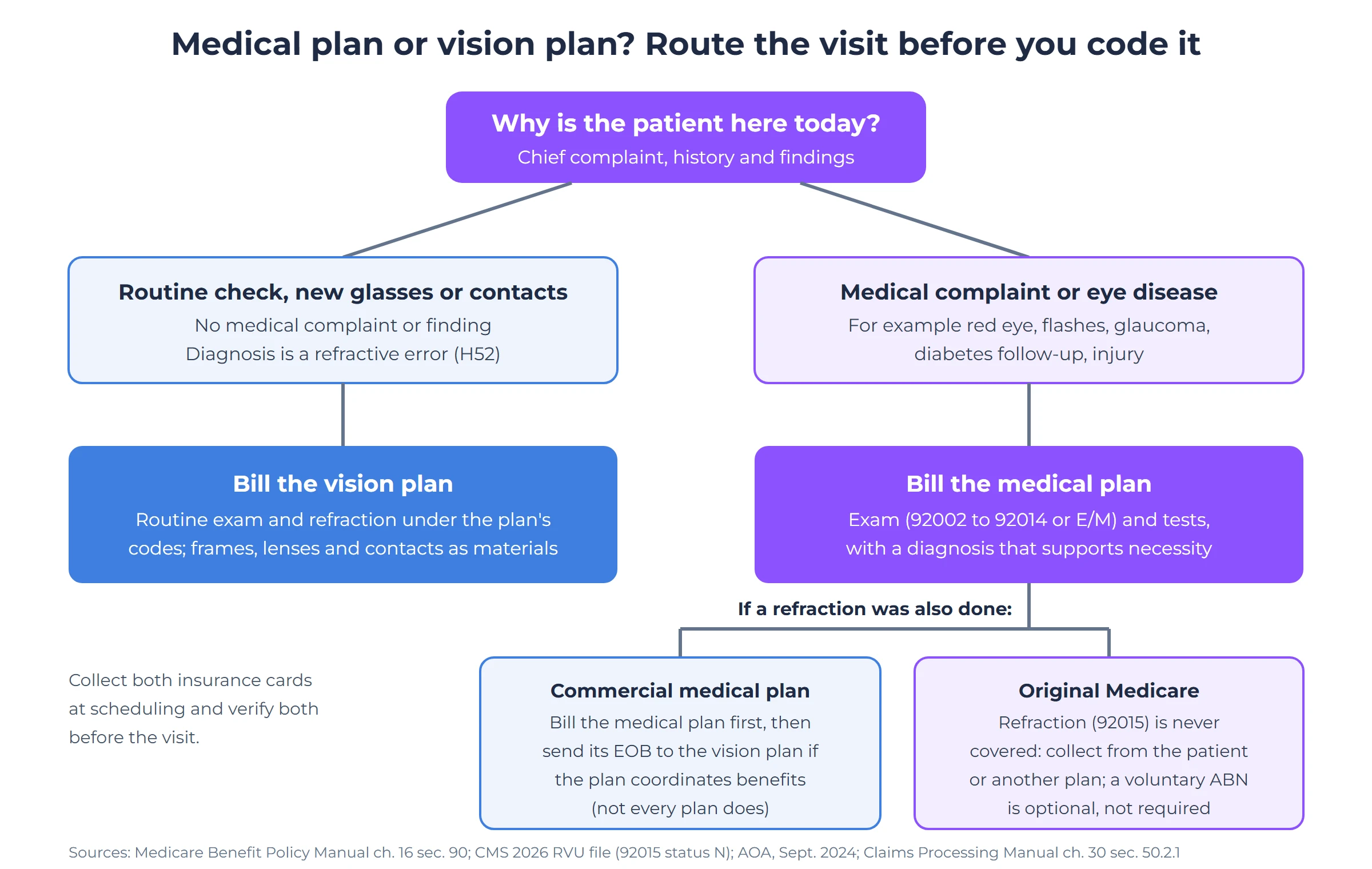
Use these rules to route each visit:
- Start with the reason for the visit. “My glasses aren’t sharp anymore” with no medical finding is a vision visit. Flashes and floaters, a red or painful eye, a diabetic eye check or glaucoma follow-up is a medical visit.
- Make the diagnosis match the payer. For Medicare, an exam whose purpose is prescribing or changing glasses falls under the routine exclusion (Medicare Benefit Policy Manual, ch. 16, sec. 90). A medical claim whose only diagnosis is a refractive error describes a service the plan doesn’t cover.
- When both happen, bill the medical plan first. The AOA says coordination of benefits applies only when a medical exam and a refraction happen together. Both go to the medical plan first. The vision plan may then pay copays, deductibles or non-covered amounts up to its exam benefit. Not every plan coordinates, and it varies by plan and employer (AOA, September 2024).
- Verify both plans before the visit. Collect both cards when the appointment is booked and check eligibility, frequency limits and copays on each. A consistent insurance eligibility verification routine catches these problems before the patient is in the chair.
- Send “needs COB” denials back to the patient quickly. Some denials happen because the patient hasn’t updated their primary or secondary coverage. Only the patient can fix that with their insurer (same AOA source). The sooner they call, the sooner the claim pays.
Medicare Rules Every Optometry Biller Should Know
Medicare billing for optometry turns on one line in the Benefit Policy Manual. Medicare doesn’t cover routine eye exams for prescribing or changing glasses, or the glasses and contacts themselves. It also excludes “eye refractions by whatever practitioner and for whatever purpose performed” (ch. 16, sec. 90). The same section keeps coverage for care of eye disease, such as glaucoma or cataracts. It also covers prosthetic lenses after the eye’s own lens is removed.
Here’s how that plays out by service:
| Service | Medicare status | How to bill it |
|---|---|---|
| Routine exam to prescribe glasses or contacts | Excluded | Bill the vision or Medicare Advantage plan, or collect from the patient |
| Refraction (92015) | Excluded. Status N (non-covered) in the 2026 fee schedule file | Collect from the patient or another plan, even when the exam itself is medical |
| Contact lens fitting (92310) | Status N (non-covered) in the 2026 fee schedule file | Treat as a patient or vision plan charge |
| Routine exam codes S0620 and S0621 | Coverage code I, “not payable by Medicare,” in the October 2026 HCPCS file | Use only for payers that ask for them |
| Glaucoma screening (G0117, G0118) | Covered once a year for high-risk patients | Diagnosis Z13.5; document the risk group; deductible and coinsurance apply |
| Eye exam for a patient with diabetes | Covered as a medical exam | Bill the exam with the diabetes diagnosis that supports it |
| Glasses or contacts after cataract surgery with an IOL | One pair after each surgery | The DME supplier bills its DME Medicare Administrative Contractor |
Sources: the status indicators come from the CMS 2026 relative value file, October release. The coverage codes come from the CMS HCPCS quarterly update. The screening, diabetic exam and eyewear rules come from MLN907165.
The glaucoma screening rule is narrower than many front desks assume. CMS covers it once a year only for Part B patients in one of these groups:
- People with diabetes
- People with a family history of glaucoma
- Black or African American patients aged 50 or older
- Hispanic or Latino patients aged 65 or older
The record must show which group the patient is in (MLN907165).
ABNs for refraction. You don’t need an Advance Beneficiary Notice for care that Medicare never covers. CMS lists routine eye care as an example. CMS still “strongly” encourages a voluntary ABN as a courtesy, so the patient knows the charge is theirs. With a voluntary ABN, don’t ask the patient to choose an option or sign (Medicare Claims Processing Manual, ch. 30, sec. 50.2.1). Two HCPCS modifiers describe these lines. GY means the service is excluded by law. GX means a voluntary notice of liability was issued. Some practices put the excluded line on the claim with GY when a secondary plan wants Medicare’s denial first. Confirm that with your Medicare contractor.
Medicare Advantage is different. An MA plan may add routine vision benefits, the same MLN booklet notes. Examples are routine exams and frames or lenses every 24 months. Check each MA plan’s rules instead of applying Original Medicare’s exclusions.
Coding Details That Change Optometry Payment
Coding decisions in eye care move money in ways that aren’t obvious from the code descriptions. Four come up on almost every claim review.
Eye exam codes or E/M codes. Medicare pays both the eye exam codes (92002 to 92014) and the E/M office visit codes. Both have active status in the 2026 fee schedule. Pick the family the documentation supports for that exam. One exam gets one exam code.
Bilateral pricing. Look at 92002 to 92014 and the common imaging tests: 92083 (visual field), 92133 and 92134 (OCT) and 92250 (fundus photos). The 2026 relative value file gives each a bilateral indicator of 2. That means the payment already assumes both eyes. Reporting modifier 50, or RT and LT on two lines, still pays no more than 100% of one code (CMS relative value file documentation).
Professional and technical components. Those same tests split into a professional (26) and technical (TC) component. If the practice owns the equipment and the optometrist interprets the results, bill the global code with no modifier. If someone else owns the equipment or reads the test, bill only your part.
Laterality in the diagnosis. Most eye codes in ICD-10-CM chapter 7 (H00 to H59) carry a character for the right eye, left eye or both. Unspecified codes are easy to pick from a drop-down and hard to defend when a payer reviews the claim.
Modifier 25 also deserves care when a minor procedure and an exam happen on the same day. The guide to modifiers 24 and 25 explains when each applies. For help with eye care code selection, see our medical coding services.
Co-Management After Cataract Surgery
Co-management lets an optometrist handle the postoperative visits after an ophthalmologist removes a cataract. Medicare pays it as a split global surgery. Both doctors bill the same procedure code and date of service. Modifiers separate their parts (Medicare Claims Processing Manual, ch. 12, sec. 40.2):
- The surgeon bills the surgery code with modifier 54 (surgical care only).
- The optometrist bills the same code with modifier 55 (postoperative management only).
- The claim shows the date care was relinquished or assumed, in the remarks field or free text segment.
- Both practices keep a copy of the written transfer agreement in the patient’s record.
- The optometrist can’t bill until they’ve seen the patient at least once. They then bill from the date they took over care.
Medicare pays each side a fixed percentage of the fee schedule amount. Take 66984, the most common cataract code. The 2026 file assigns 10% to preoperative care, 70% to the surgery and 20% to postoperative care. The global period is 90 days.
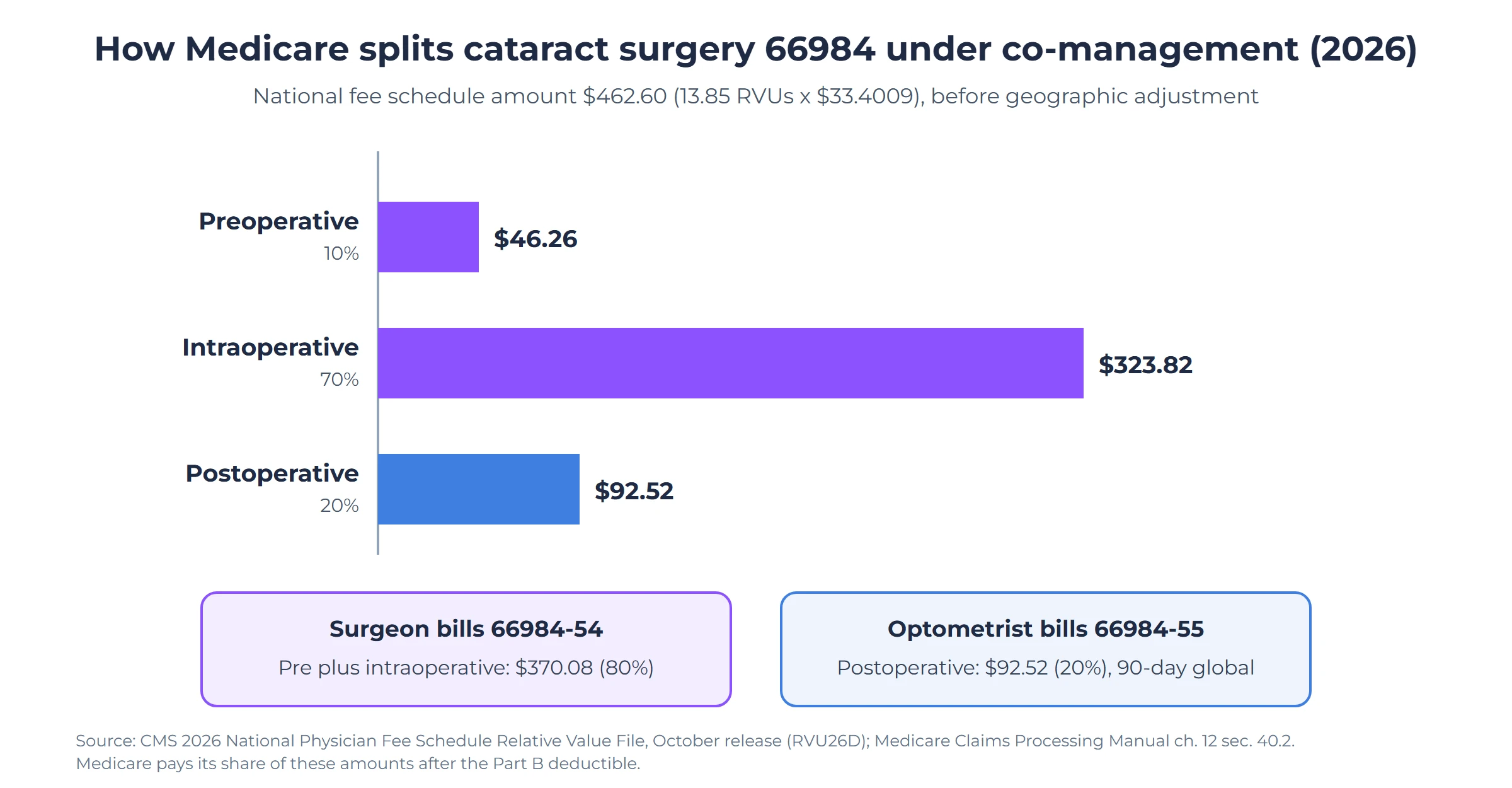
Two details catch practices out. First, modifier 54 pays the surgeon the preoperative and intraoperative shares together. There’s no separate claim for the preoperative share. Second, the surgeon may keep the patient for part of the 90 days. Then Medicare splits the 20% postoperative share by the days each doctor was responsible. A transfer on day 30 leaves the optometrist with about two thirds of $92.52, not all of it. The surgeon’s side of the same claims is covered on the ophthalmology billing page.
Optical Materials and Contact Lenses
The optical shop is a revenue cycle of its own. Frames, lenses and contacts are billed to vision plans with HCPCS V-codes. Examples from the October 2026 HCPCS file are V2020 (frames), V2100 (single vision spherical lenses) and V2500 (PMMA spherical contact lenses). The plan pays an allowance, and the patient owes the difference for upgraded frames, coatings or premium lenses.
Three controls keep the optical side from leaking:
- Collect overages at the order, not at pickup. A patient who never returns for their glasses leaves an unpaid lab bill behind.
- Match every lab order to a claim. Remakes, warranty replacements and plan-paid orders should each have a record, so lab invoices reconcile with plan payments.
- Check plan frequency before ordering. Vision plans limit how often they pay for frames and lenses. An order placed a month early is a full-price patient sale, not a plan claim.
Medicare covers eyewear only after cataract surgery with an IOL. For most Medicare patients, the optical sale is private pay or a Medicare Advantage benefit.
The Optometry Revenue Cycle, Step by Step
Every eye care practice runs the same eleven steps. The difference is what can go wrong at each one.
| Step | What to get right in an eye care practice |
|---|---|
| 1. Scheduling and intake | Ask the reason for the visit and collect both medical and vision insurance cards |
| 2. Eligibility and benefits | Check both plans, including exam and eyewear frequency limits and Medicare Advantage vision benefits |
| 3. Patient financial talk | Tell Medicare patients the refraction is their cost; quote materials overages before ordering |
| 4. Documentation | Record the chief complaint, findings and laterality that support the codes |
| 5. Coding and charge capture | Choose 920xx or E/M codes, capture tests, and add modifiers such as 54, 55, GY or GX where they apply |
| 6. Claim scrubbing | Confirm the diagnosis supports each line and that bilateral codes aren’t billed twice |
| 7. Submission and rejections | Work clearinghouse rejections daily, before they age into timely filing problems |
| 8. Payment posting | Post the standard electronic remittance (835) for both plan types and flag underpayments (CMS, remittance advice and EFT) |
| 9. Denial management | Sort denials by cause: eligibility, coordination of benefits, routine exclusion, frequency or coding |
| 10. Patient billing | Bill refraction fees, deductibles and overages promptly and clearly |
| 11. A/R follow-up | Work unpaid claims by payer type and age, oldest high-value claims first |
Sorting denials into the causes in step 9 shows which step of the cycle needs fixing. Denial management works best when each denial is sorted by root cause and tracked to payment. For how these steps fit together in any specialty, see this overview of revenue cycle management services.
Optometry RCM Metrics to Track
Track each metric separately for medical plans and vision plans. Blended numbers hide problems, because vision claims and medical claims fail for different reasons.
- First-pass acceptance rate: the share of claims accepted on the first submission, by payer type.
- Denial rate by reason: eligibility, coordination of benefits, routine exclusion, frequency and coding, counted separately.
- Days in accounts receivable: how long claims take to pay, by payer type.
- Net collection rate: what you collected compared with what you could have collected under your contracts.
- Collected at checkout: refraction fees, copays and overages collected the same day.
- Optical reconciliation: lab invoices matched to orders and plan payments each month.
- Co-management claims open: modifier 55 claims waiting for the surgeon’s claim or the transfer date.
Review the numbers monthly with the front desk, the optical staff and whoever works the claims. Many of the fixes in optometry belong at the front desk, not in the billing office.
Optometry RCM Software and Outsourcing
The right optometry RCM software handles both plan types without workarounds. Eye care platforms that market revenue cycle tools include Crystal PM, RevolutionEHR’s RevClear, Eyefinity Encompass and Compulink. Some practices pair a practice management system with a clearinghouse such as Office Ally.
Ask each vendor to demonstrate these with your own claims:
- Medical and vision claims from the same visit, including coordination of benefits
- Real-time eligibility for both plan types
- Optical orders, lab tracking and inventory tied to billing
- Automatic posting of electronic remittances, with exceptions flagged
- Denial reports by reason and payer
- Full data export if you ever leave
Outsourcing fits when claims age because staff are pulled to the front desk, or when one biller holds all the knowledge. Before you sign, ask a billing company how it handles Medicare refraction fees, coordination of benefits and co-management claims. Ask, too, who keeps your plan enrollments and medical credentialing current.
Want a second opinion on your optometry claims?
Summit’s billing team will review a sample of your medical and vision claims. We’ll flag the denials that keep coming back and show where payment is slipping. Request a free account review to get started.
Frequently Asked Questions About Optometry RCM
1. What does RCM mean in medical terms?
RCM stands for revenue cycle management. It’s how a practice manages the money side of patient care. It runs from registration and insurance checks through coding, claims, payments, denials and collections. In eye care it covers both medical plans and vision plans.
2. Does Medicare pay for a refraction?
No. The Medicare Benefit Policy Manual excludes refractions for any purpose and by any practitioner, and the 2026 fee schedule lists 92015 as non-covered. The patient pays, or a vision or Medicare Advantage plan may cover it. An ABN isn’t required, though CMS encourages a voluntary one as a courtesy.
3. Can an optometrist bill a medical plan and a vision plan for the same visit?
Yes, when the visit includes both a medical exam and a refraction. Bill the medical plan first, then send its explanation of benefits to the vision plan if the plan coordinates benefits. Not every plan does, so check during eligibility verification.
4. What is TPA in optometry?
TPA usually means third-party administrator. A TPA runs claims, networks or benefits for an insurer or an employer’s plan. Before the first claim goes out, confirm each TPA’s claim address or portal, authorization process, fee schedule and appeal route.
5. What is the best RCM software for an optometry practice?
The best fit is the system that handles your medical and vision payer mix, your optical workflow and your EHR. Ask vendors such as Crystal PM, RevolutionEHR, Eyefinity and Compulink to run your real claims in a demo. Confirm current features and fees with each vendor directly.