

Dental billing for general, endodontic and orthodontic practices: CDT coding by tooth and surface, frequency limits and waiting periods, narratives and X-rays for major work, orthodontic payment schedules, and medical claims when medical insurance or Medicare pays for dental care.


Dental billing gets each procedure paid under the plan that covers it. Benefits, frequencies and waiting periods are checked before treatment, each procedure is coded with the tooth, surface or quadrant, major work goes out with the X-rays and narrative the plan wants, and medical claims are sent when medical insurance should pay.
66.7%
of US adults had a dental exam or cleaning in the past year, according to the CDC
25.9%
of US adults aged 20 to 44 had untreated tooth decay, according to CDC survey data
Dental plans are built around limits: two cleanings a year, a full set of X-rays every few years, a crown on the same tooth once in five years, an annual maximum and a lifetime maximum for orthodontics. A claim that ignores one of them is denied, and the patient learns about it after treatment. Some care is not a dental plan’s to pay at all, such as oral surgery that a medical plan covers, or dental care Medicare pays because it is linked to a covered medical treatment.
The limits and the plan decide the claim. That is why we check each patient’s history and benefits before treatment and decide which plan, dental or medical, each procedure goes to.
Dental practices bill routine care, major restorations and long orthodontic cases, sometimes to two plans at once. Each fails in its own way. Here are the failure points, and our fix for each.
Pays forPeriodic and comprehensive exams, cleanings, X-rays and fluoride, usually within frequency limits.
Where it breaks
What we do
Pays forFillings, crowns, root canals, periodontal treatment and extractions, often subject to waiting periods and narratives.
Where it breaks
What we do
Pays forOrthodontic cases paid over time, and dental care paid by medical insurance or Medicare.
Where it breaks
What we do
Medicare does not cover routine dental care, but since 2023 it pays for dental services that are inextricably linked to covered medical treatment. Examples include the dental exam and necessary treatment before an organ transplant or a heart valve replacement, before or during treatment for head and neck cancer and some other cancer treatments, and, from 2025, before or during dialysis for end-stage renal disease. The dentist must be enrolled in Medicare, and the claim must show the link.
Since July 2025, CMS looks for modifier KX on these claims and a diagnosis code for the linked condition on dental-format claims; without them, the claim is processed as if the coverage criteria were not met. Commercial medical plans may also pay for some care, such as treatment after an accident or oral surgery, billed on a medical claim with CPT and ICD-10 codes.
What we do: when a patient’s dental care may be linked to medical treatment, we confirm the medical condition and the coordination with the medical team, add KX and the diagnosis, and send the claim to Medicare or the medical plan before billing the dental plan as secondary.
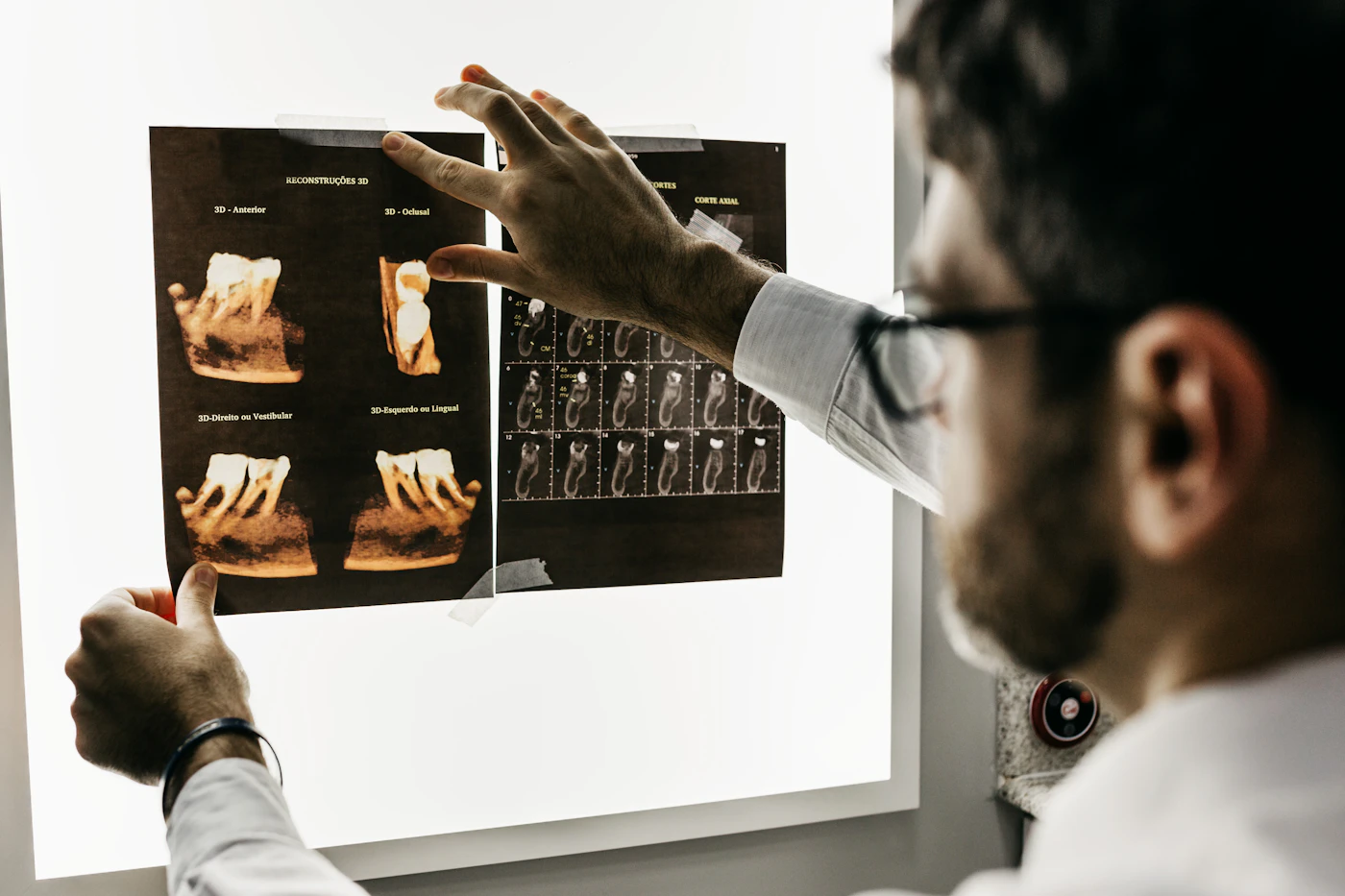
Dental claims use CDT codes from the American Dental Association, tied to a tooth, surface or quadrant. These are the ones we see most, with what plans check on each.
| Code | What it covers | What plans look for |
|---|---|---|
| D0120D0150 | Periodic and comprehensive oral evaluations | Frequency limits; D0150 is often limited to once per patient per practice. |
| D0210D0274 | Full mouth X-rays and four bitewings | Each plan's frequency limit, often every three to five years for a full set. |
| D1110D1120 | Cleanings, adult and child | Usually twice a year; the age the plan uses to switch codes. |
| D2740 | Crown, porcelain or ceramic | Tooth number, X-rays, narrative and the replacement limit. |
| D3310D3320D3330 | Root canal therapy, anterior, premolar and molar | Tooth number, pre-operative X-ray and any waiting period. |
| D4341D4342 | Scaling and root planing, four or more teeth or one to three, per quadrant | Quadrant, periodontal charting and X-rays. |
| D7140D7210 | Extractions, simple and surgical | Tooth number; X-ray and narrative for surgical extractions. |
| D8080D8670 | Comprehensive orthodontics and periodic visits | Age limits, the lifetime maximum and the plan's payment schedule. |
The tooth treated, using the universal numbering system.
The surfaces restored, such as mesial, occlusal or distal.
For procedures billed by area, such as scaling and root planing.
Why the treatment was needed, with X-rays or photos for major work.
Medicare: the dental care is linked to a covered medical treatment.
Medicare: a dental service Medicare excludes, so a secondary plan can be billed.
Sources: American Dental Association CDT code set; CMS Physician Fee Schedule final rules for 2023 to 2025 (dental services); CMS Transmittal 13096. CDT is a registered trademark of the American Dental Association; the descriptions above are summaries. Reviewed October 2026.
It is not for every practice. If you are a hospital-employed group whose billing the hospital handles, you do not need us. And if your in-house team keeps denials low and receivables current, keep them, and consider a periodic billing audit instead.
We look at your clean-claim rate, your denials by payer and reason, frequency and benefit checks, narratives and attachments, orthodontic payments and medical claims, and your aging receivables, and tell you what we find, whether or not you go further with us.
We get access to your practice management system and clearinghouse, load each payer's authorization and bundling rules and your fee schedules, list active orthodontic cases and patients with pending major work, and agree how escalations work. Most practices are live within one to two weeks.
Procedures are coded by tooth, surface and quadrant and claims submitted within 24 hours. Rejections are corrected the same day, remittances posted as they arrive, frequencies, attachments and the right plan checked, and denials worked to their cause, all inside your system.
A report you can read in ten minutes: what was billed and collected by payer, site and service line, what was denied and why, authorizations pending, and what is aging.
You do not change systems to work with Summit Billing Solutions. We work in the software you already use and through your existing clearinghouse. The systems below are the medical practice systems we work in most; tell us what you use, and we will confirm how we would work in it.


We check each patient's frequencies, waiting periods and maximums before treatment, attach the X-rays and narratives major work needs, and send care medical insurance should pay to the medical plan.
You know who is working your account, and you hear from them every week. A familiar face, not a ticket queue.
If we are not earning the relationship, you can leave. That keeps us honest.
Summit is a US company based in Salem, New Hampshire, billing for practices nationwide with the state-by-state payer and Medicaid knowledge that takes.
95-98%
First-pass claim rate
24 hrs
Claims submitted within
28
Average days in A/R
Dental revenue mixes many routine visits with fewer, larger cases such as crowns and orthodontics. A fee based on collections means our pay depends on getting both kinds paid, not on how many claims we send.
Summit Billing Solutions charges between 3% and 9% of monthly collections. Your rate depends on patient volume, your mix of preventive, major and orthodontic work, how many patients have two plans and the state of the receivables, which we see in the free account review.
3% to 9%
of monthly collections
We bill for more than 40 specialties, for practices in all 50 states, from Salem, New Hampshire. Each one has its own codes, modifiers and payer rules.
A free account review looks at your clean-claim rate, your denials by payer and reason, frequency and benefit checks, attachments, orthodontic payments and medical claims, and your aging receivables, and tells you what we would change. No cost, no obligation, and no pressure to continue. What the review covers, step by step, is on the free account review page.
50A Northwestern Dr Ste 3, Salem, NH 03079-4827
603-207-3172
(866) 906-3116
info@summitbillingsolutions.com
Mon - Fri @ 9am - 5pm


