


G2211 is a Medicare add-on code that pays a little extra on an office or outpatient visit, and since January 2026 on a home or residence visit, when the practitioner is the patient’s continuing focal point for care or is managing a single serious or complex condition over time. It is billed on the same claim as the visit code, CMS requires no extra documentation for it, and in 2026 it is worth about $17 a visit nationally before geographic adjustment.
Most practices that could bill it still don’t. Of the 855,265 clinicians who billed a G2211-eligible visit in 2024, only 24.0% billed G2211 at all (Ganguli et al., JAMA, February 2026). Now the code itself may change: in its CY 2027 Physician Fee Schedule proposed rule, CMS proposed replacing G2211 with a modifier that adds 16% to the visit, or 32% for practitioners in a Medicare ACO (CMS fact sheet, July 14, 2026). This guide covers who can bill G2211, when it applies, what the record should show, and what the 2027 proposal would change.
Key Takeaways
- Any practitioner who can bill office or outpatient E/M codes (99202 to 99205, 99211 to 99215) or home or residence E/M codes may add G2211, regardless of specialty. The test is the ongoing relationship with the patient, not the diagnosis.
- Medicare denies G2211 on a visit billed with modifier 25, except when the same-day service is an annual wellness visit, a vaccine administration or another Part B preventive service.
- CMS requires no extra documentation for G2211, but reviewers use the assessment, plan and diagnoses to confirm the ongoing relationship.
- For 2027, CMS proposed replacing G2211 with a modifier worth 16% of the E/M payment (32% for Shared Savings Program and LEAD ACO participants). The final rule is expected around November 1, 2026.
What is G2211?
G2211 is a HCPCS add-on code for “visit complexity inherent to evaluation and management” when the visit is part of an ongoing relationship: either the practitioner is the continuing focal point for all of the patient’s health care services, or the practitioner provides ongoing care for a single, serious condition or a complex condition. CMS says the code captures the complexity that comes from “the longitudinal nature of the practitioner and patient relationship” (CMS G2211 FAQs).
The complexity is not in the patient’s condition on that day. CMS’s own example is a primary care practitioner treating sinus congestion: the problem is simple, but being responsible for all of that patient’s care, and using the relationship to decide how to treat and how to explain it, makes the visit inherently more complex. In that example, the practitioner may bill G2211 (MLN Matters MM13473).
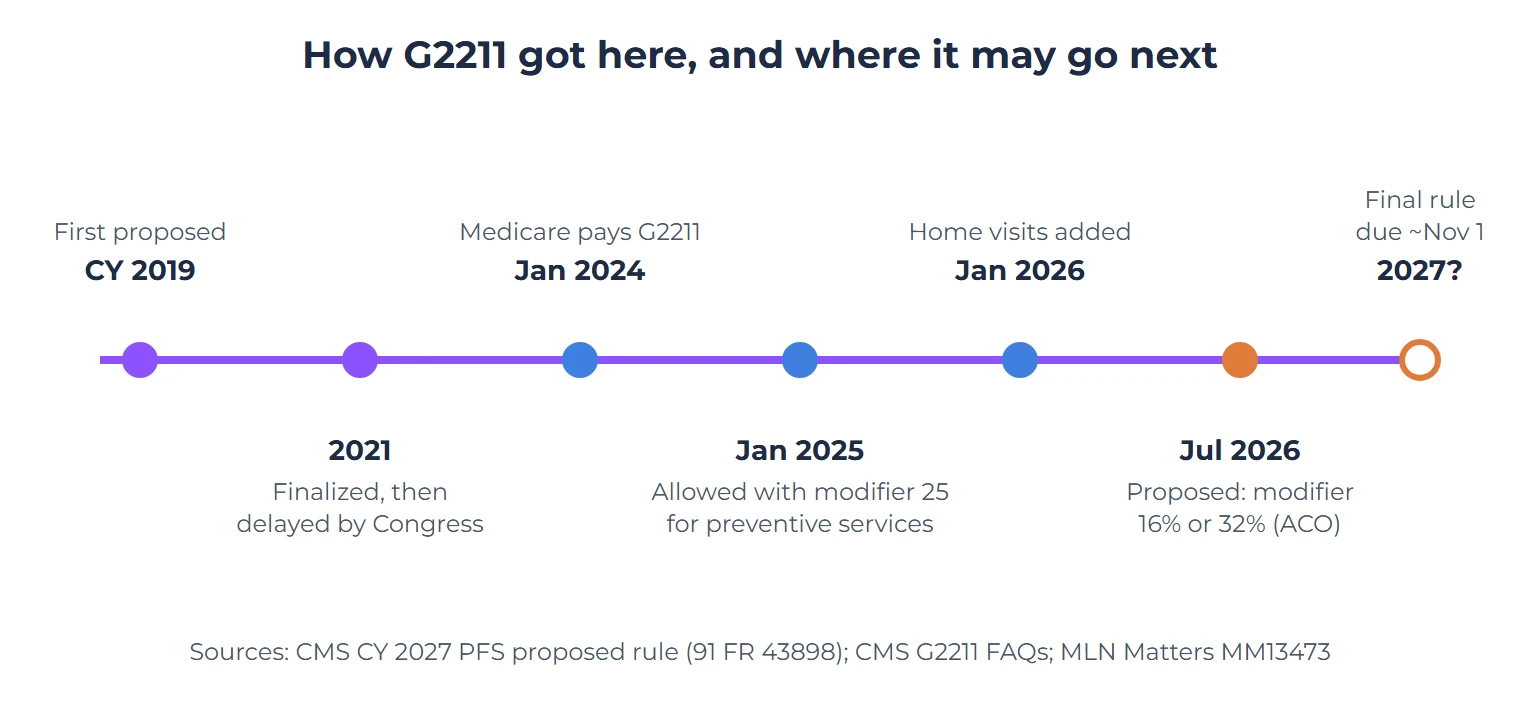
The code took years to reach a claim. CMS first proposed complexity add-ons in the CY 2019 rule cycle, finalized the code for 2021, and then Congress delayed it in the Consolidated Appropriations Act, 2021. Medicare started paying for G2211 on January 1, 2024 (CY 2027 PFS proposed rule, 91 FR 43898).
Who can bill G2211?
Any physician or practitioner who can bill Medicare for office or outpatient E/M visits or home or residence E/M visits can report G2211, and CMS does not limit it by specialty (CMS G2211 FAQs). That includes nurse practitioners and physician assistants billing under their own NPI, and specialists who manage a condition over time.
The base code decides whether G2211 is even possible:
| Setting | Base codes | Can G2211 be added? |
|---|---|---|
| Office or outpatient visit | 99202 to 99205, 99211 to 99215 | Yes, at any level, since 2024 |
| Home or residence visit | 99341, 99342, 99344, 99345, 99347 to 99350 | Yes, since January 1, 2026 |
| Hospital inpatient, emergency department, nursing facility | Other E/M families | No |
| FQHC or RHC | Encounter-based payment | No separate payment; it is bundled into the encounter rate |
A few situations come up often in practices:
- Another clinician in your group sees the patient. If the patient has an ongoing relationship with a care team in the practice, and the other requirements are met, the covering colleague may be able to report G2211 (CMS G2211 FAQs, Q3).
- Teaching settings. G2211 can be billed for visits billed under the primary care exception (modifier GE) when its criteria are met.
- Care management in the same month. G2211 can be billed in the same period as chronic or principal care management, because CMS sees care management as work done between visits and G2211 as work done during them.
The code was valued by crosswalk to CPT 90785, the interactive complexity add-on used in psychotherapy, at a work RVU of 0.33 (CY 2027 PFS proposed rule). Our guide to how mental health insurance billing works covers 90785 itself.
When G2211 applies and when it doesn’t
G2211 applies when the billing practitioner has taken responsibility, or plans to take responsibility, for the patient’s ongoing care with consistency and continuity over time. It doesn’t apply when the relationship is “discrete, routine, or time-limited.” No specific diagnosis is required, and CMS gives no minimum number of visits (CMS G2211 FAQs, Q1, Q8 and Q9).
| Likely appropriate (CMS examples) | Not appropriate (CMS examples) |
|---|---|
| A primary care practitioner treating any problem, even sinus congestion, for a patient whose care they direct | Removing a mole, or referring a patient for mole removal |
| An infectious disease physician providing ongoing HIV care | Treating a simple virus |
| A practitioner who is part of ongoing care for sickle cell disease | Counseling for seasonal allergies |
| Ongoing management of a chronic condition such as hypertension, the most common condition billed with G2211 in 2024 | Initial onset of gastroesophageal reflux disease, or treating a fracture, where comorbidities are not present or not addressed |
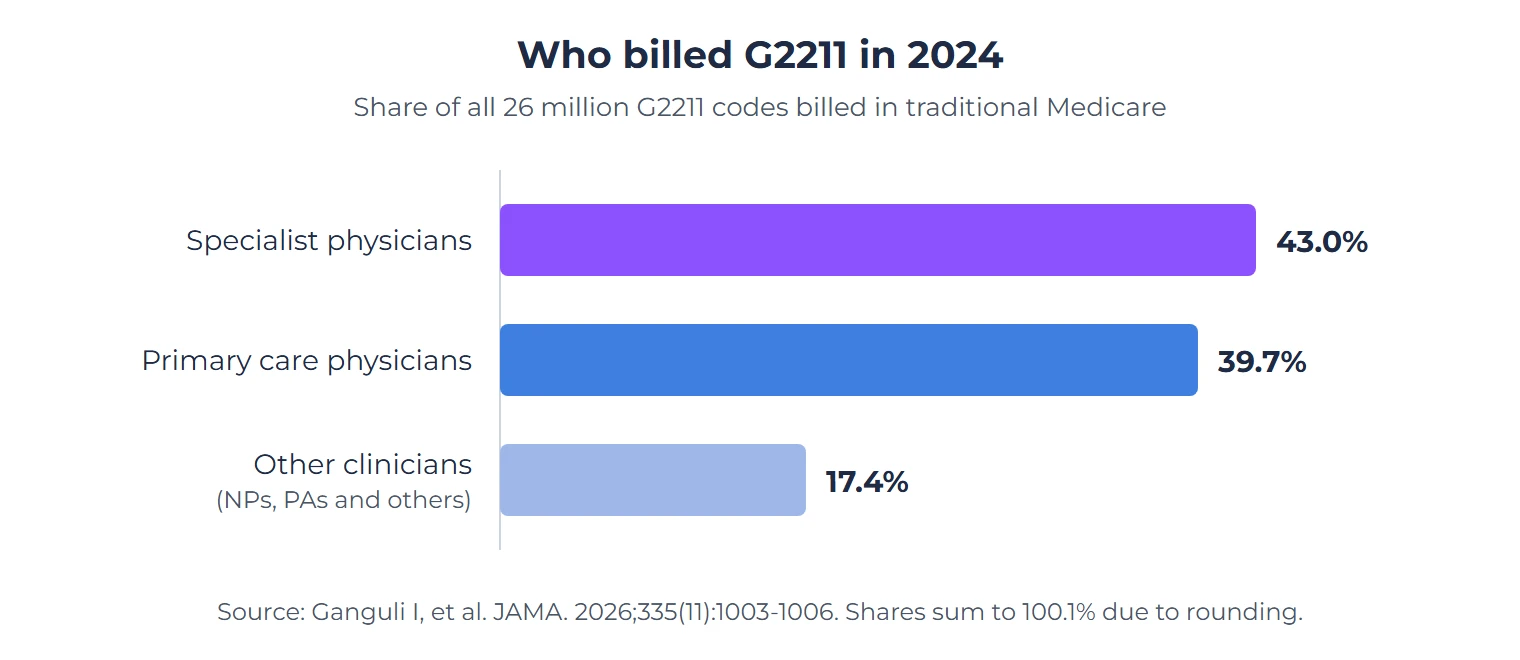
The specialist side is where most of the risk sits. Specialists billed 43.0% of all G2211 codes in 2024, more than primary care physicians at 39.7% (Ganguli et al., JAMA, 2026). The same study found that 15.2% of the first G2211-billed visits between a clinician and a patient had no prior or subsequent visit with that clinician, and that common specialist diagnoses included asymptomatic coronary artery disease, GERD and mild glaucoma. Those are the patterns a payer review would look at first.
How to bill G2211 step by step
By the end of these steps, a visit that qualifies will carry G2211 on a clean claim, and one that doesn’t will go out without it.
- Confirm the base code. The visit must be billed with an office or outpatient code (99202 to 99205, 99211 to 99215) or a home or residence code (99341, 99342, 99344, 99345, 99347 to 99350). G2211 is never billed on its own.
- Confirm the relationship. Ask whether this practitioner, or the practice’s care team, is the patient’s continuing focal point for care, or is managing a single serious or complex condition over time. If the visit is a one-off, skip G2211.
- Check for modifier 25. If the E/M carries modifier 25, Medicare denies G2211 unless the same-day service is an annual wellness visit, a vaccine administration or another Medicare Part B preventive service. Since January 2026 that exception also covers home or residence visits (CMS G2211 FAQs, Q6). A minor procedure on the same day, such as a joint injection, still blocks it.
- Add G2211 as its own line. Today G2211 is a separate claim line, with the same date of service and rendering provider as the E/M line. Point it to the diagnosis that reflects the ongoing care.
- Check the payer. The rules above are Medicare’s. Medicare Advantage and commercial plans set their own policies on G2211, so check each contract before adding it to non-Medicare claims.
- Tell the patient it carries cost sharing. The usual Part B deductible and coinsurance apply to G2211 (MLN Matters MM13473). Front-desk scripts should cover this, because patients notice a new line on their statement.
Modifier 25 is the rule most likely to trip up a G2211 claim, because it depends on what else happened that day rather than on the visit itself. Our modifier 24 vs 25 guide explains when modifier 25 belongs on the E/M in the first place.
What to document for G2211
CMS has not set any extra documentation requirement for G2211. The visit itself has to be reasonable and necessary, and Medicare’s reviewers “may use the medical record documentation to confirm the medical necessity of the visit and the patient care relationship.” CMS expects the diagnoses, the practitioner’s assessment and plan of care, and other codes in the claims history to serve as support (CMS G2211 FAQs, Q7).
In practice, that means the note should let a reviewer see the relationship without opening other records. The elements below make that easier. They are good practice, not CMS requirements:
- The ongoing role. A short line such as “patient’s primary care practitioner, managing all chronic conditions” or “following for ongoing management of rheumatoid arthritis.”
- The condition being managed over time. The diagnosis pointed to on the G2211 line should be one the practitioner is actively managing, not a self-limited problem.
- A plan that looks forward. Follow-up interval, medication changes, monitoring or referrals coordinated by this practitioner.
- Shared decision-making. CMS describes the collaborative care behind G2211 as including patient education, expectations and responsibilities, and shared decisions about treatment goals.
Template language that pastes the same G2211 sentence into every note proves nothing. A reviewer will compare it with the claims history, and a patient seen once with no follow-up won’t support it.
How much does G2211 pay in 2026?
G2211 has a total non-facility value of 0.52 RVUs, including a work RVU of 0.33 (CY 2027 PFS proposed rule). At the 2026 non-APM conversion factor of $33.40 (CMS CY 2026 PFS final rule fact sheet), that is about $17.37 per visit nationally, before your locality’s geographic adjustment. The patient’s 20% Part B coinsurance on that amount is about $3.47.
The amount is small per visit and large across a panel. In 2024, Medicare paid $394 million for 26 million G2211 codes billed by 206,813 clinicians. Clinicians who used the code billed it on a median of 30.1% of their eligible visits (Ganguli et al., JAMA, 2026).
What the 2027 modifier proposal would change
In the CY 2027 Physician Fee Schedule proposed rule (CMS-1848-P, published July 16, 2026), CMS proposed deleting G2211 and replacing it with two modifiers that go on the E/M line itself (91 FR 43898 to 43903):
- MOD1 (a placeholder name; the real two-character modifier would be assigned if finalized) would add 16% to the payment for the office, outpatient or home visit. It would be billed in the same circumstances G2211 is billed now.
- MOD2 would add 32% and would be available only to participants in a Medicare Shared Savings Program ACO, the ACO PC Flex model, or the LEAD model that launches January 1, 2027. Its use would be voluntary, and CMS proposed letting those practitioners use it for every Medicare patient they see, whether or not the patient is assigned to the ACO.
- The modifier 25 limit stays. Both modifiers would keep the current rule: no payment with modifier 25 unless the same-day service is an AWV, a vaccine administration or a Part B preventive service. CMS asked for comments on allowing them with 0-, 10- and 90-day global procedures.
CMS’s reason is that a flat add-on rewards low-level visits more than complex ones. The proposed rule shows that G2211 adds 29% to the value of a 99212 (total non-facility RVU 1.78) but only 9% to a 99215 (5.76). The 16% figure is a utilization-weighted average of G2211’s current share, set to be budget neutral.
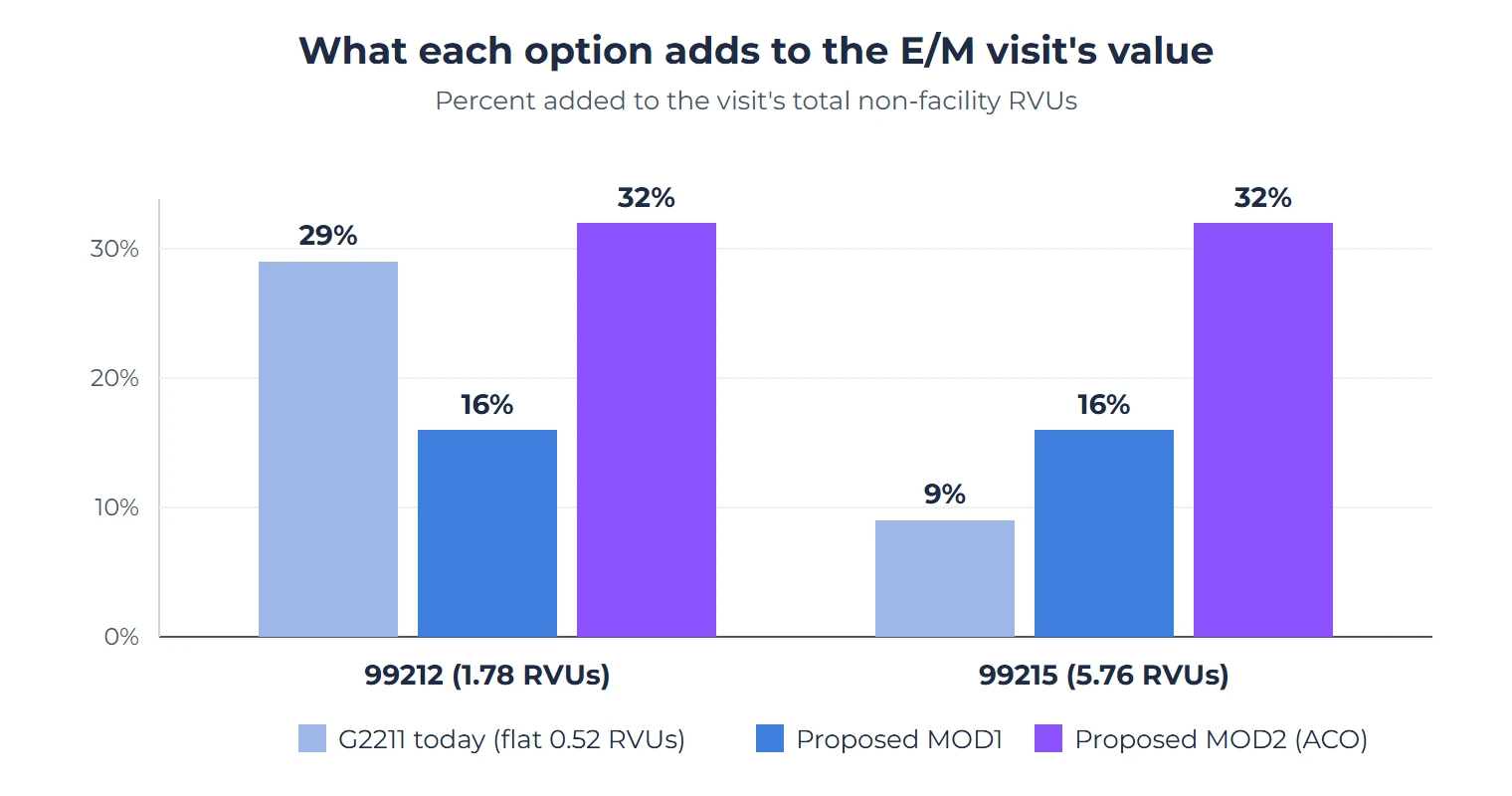
The math has a break-even point. A 16% modifier pays more than today’s flat 0.52 RVUs only when the visit’s total non-facility value is above 3.25 RVUs (0.52 divided by 0.16). Using the proposed rule’s figures, the add-on on a 99212 would fall from 0.52 to about 0.28 RVUs, while the add-on on a 99215 would rise to about 0.92 RVUs. At the 2026 conversion factor, that is roughly $9.51 instead of $17.37 on a 99212, and $30.78 instead of $17.37 on a 99215. These are illustrations only: 2027 RVUs, the conversion factor and your locality will change the real numbers.
So a practice that bills G2211 mostly on short follow-ups would likely earn less from it under MOD1, and one that bills it mostly on level 4 and 5 visits would likely earn more. ACO participants would see the largest change, because MOD2 doubles the percentage.
How to prepare before the final rule
The comment period closed on September 14, 2026, and the final rule is expected around November 1. The last two came out on October 31, 2025 and November 1, 2024. Nothing changes on your claims until January 1, 2027 at the earliest, and only if CMS finalizes the proposal. These steps make sense either way:
- Measure your current G2211 rate. For each practitioner, count eligible visits and how many carried G2211. A rate near zero usually means missed revenue; a rate near 100% across every patient usually means the relationship test isn’t being applied.
- Find the modifier 25 denials. Pull 2026 G2211 denials and check whether the same-day service was preventive (payable) or a procedure (not payable). Fix the rule in your claim scrubber, not by hand.
- Check the visit-level mix. Group your G2211 visits by E/M level to estimate whether a 16% modifier would pay you more or less than the flat add-on.
- Confirm ACO status. If your TIN participates in a Shared Savings Program ACO, or has joined LEAD for 2027, find out whether MOD2 would apply to your clinicians.
- Plan the system change. If the final rule converts G2211 to a modifier, charge masters, EHR order sets and scrubber edits will need to move the add-on from its own line to a modifier on the E/M line before January claims go out.
How Summit handles G2211
Our coders check G2211 on eligible Medicare visits against four things: the base code, the relationship, the modifier 25 rule and the note. When a practice’s G2211 rate looks off in either direction, we flag it at the provider level so it can be fixed before a payer asks. It’s part of our medical coding services, and our family practice billing team applies it alongside care management and annual wellness visits. If G2211 denials are already piling up, our denial management team works them back.
Want to know how much G2211 revenue your practice is missing or putting at risk?
Summit Billing Solutions will review your E/M claims, modifier 25 use and G2211 rate by provider, and show you what the 2027 proposal would mean for your visit mix.
Frequently Asked Questions About G2211
1. Can nurse practitioners and physician assistants bill G2211?
Yes. Any practitioner who can bill Medicare for office or outpatient E/M visits, or home or residence E/M visits, can report G2211, and CMS does not limit it by specialty. In 2024, nurse practitioners, physician assistants and other non-physician clinicians billed 17.4% of all G2211 codes.
2. Can specialists bill G2211?
Yes, when they are part of ongoing care for a single, serious condition or a complex condition, such as an infectious disease physician managing HIV. They shouldn’t bill it when the relationship is discrete, routine or time-limited, such as a one-time consultation or a mole removal. Specialists billed 43.0% of all G2211 codes in 2024.
3. Does G2211 need a specific diagnosis code?
No. CMS does not require a particular diagnosis for G2211. The diagnosis on the claim should reflect the condition the practitioner is managing over time, and the assessment and plan should show that ongoing role.
4. Can G2211 be billed with a home visit?
Yes, since January 1, 2026. Medicare now pays G2211 with home or residence E/M codes 99341, 99342, 99344, 99345 and 99347 to 99350. It still can’t be billed with hospital inpatient, emergency department or nursing facility E/M codes.
5. Will G2211 still exist in 2027?
That depends on the CY 2027 final rule, expected around November 1, 2026. CMS proposed deleting G2211 and replacing it with a modifier that adds 16% to the E/M payment, or 32% for Shared Savings Program and LEAD ACO participants. Until a final rule says otherwise, keep billing G2211 under the current rules.