


For a small practice, the service is people and process working inside your own practice management system. You keep your software, your payer contracts and the final word on any write-off, and Summit Billing Solutions does the daily work of getting claims out clean and paid. That work is the core of the wider revenue cycle; the front-end steps before the visit and the recovery work after it sit around that core, and we explain the split in medical billing vs revenue cycle management.
Clean submission matters because denials are routine, not rare: among the ACA marketplace plans sold on HealthCare.gov, the one segment where CMS publishes the figures, insurers denied 20% of in-network claims in 2023 (KFF, January 2025). A claim that goes out right the first time is the cheapest claim you will ever collect.
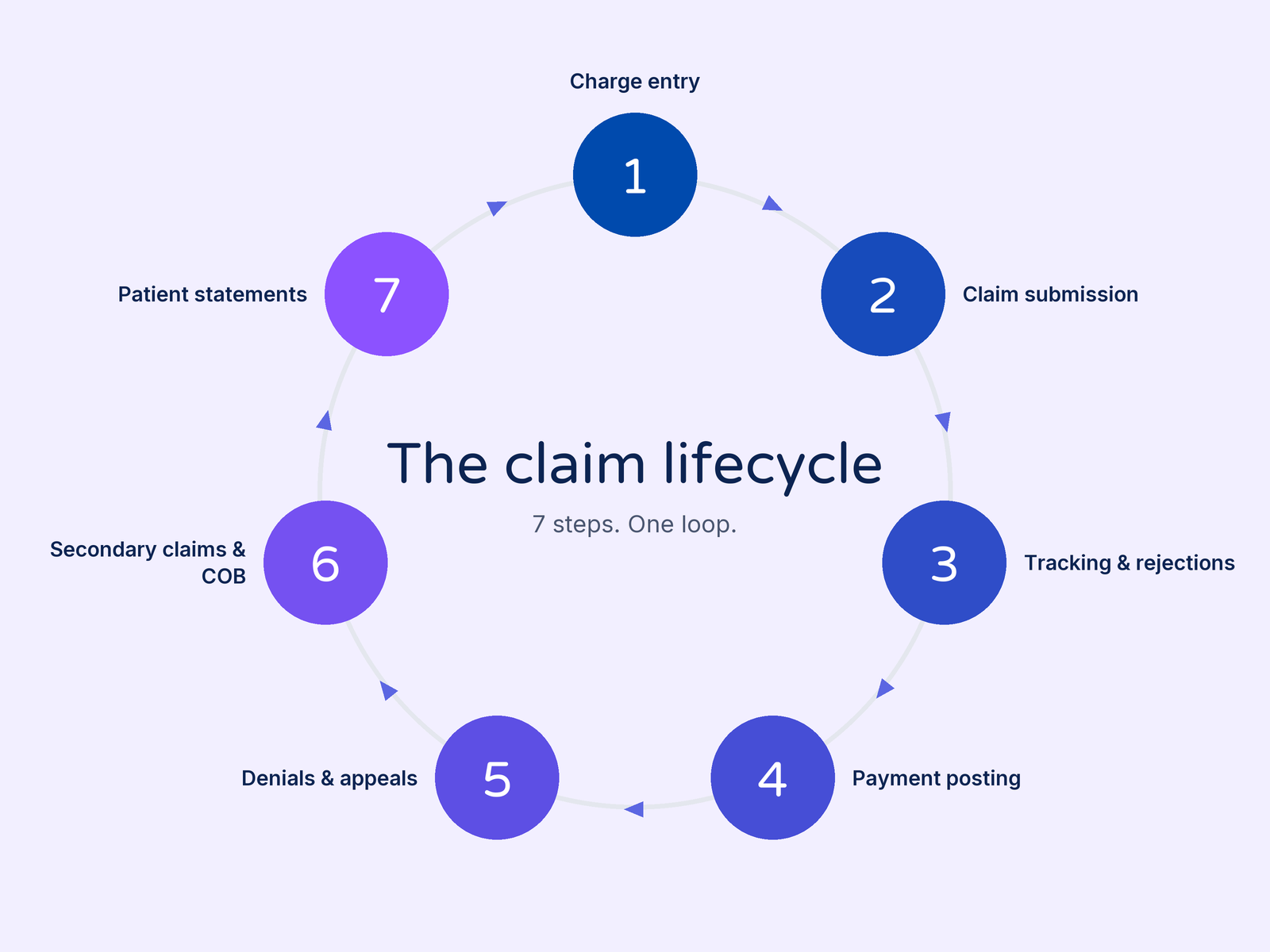
| Number | Stage | What happens | Where it breaks | Our available service |
|---|---|---|---|---|
| 1 | Charge entry | Every documented service is entered against the right patient, provider, date and place of service, with the CPT, ICD-10 and HCPCS codes and modifiers the note supports. Charges are entered daily, not in a weekly batch. | Encounters are missed, entered late, or entered under the wrong provider or location. Revenue that was earned never becomes a claim, and nobody notices, because nothing is denied. | Medical coding review |
| 2 | Claim scrubbing & submission | Each claim is checked against the payer's edits and the clearinghouse rules, then sent electronically, normally within 24 hours of the charge being entered. Paper claims go only where a payer still requires them. | Claims wait for a batch, a filing deadline passes, or a claim goes out with an error the scrubber would have caught. A claim submitted late is not slow. It is unpayable. | Part of this service |
| 3 | Tracking & rejections | Every submitted claim is tracked from acceptance at the clearinghouse to adjudication at the payer. Rejections are corrected and resent the same day, and claims with no response are chased before the filing window closes. | Clearinghouse rejections sit in a queue nobody reads. A claim the payer never received ages for 60 days before anyone asks where it is. | Part of this service |
| 4 | Payment posting | Electronic remittances and paper EOBs are posted to each claim line, contractual adjustments are applied, and anything paid short of the contract is flagged for follow-up rather than written off. | Payments are posted in bulk to the account instead of the claim, so underpayments and the denials buried in the remittance are never seen. | Payment posting |
| 5 | Denials & appeals | A denied line is traced to its cause, fixed, and resubmitted or appealed inside the payer's window. A denial that repeats is treated as a workflow problem to fix upstream, not a claim to rework every month. | Denials are resubmitted unchanged and come back unchanged. Appeal deadlines pass. The same error costs the practice again next month. | Denial management |
| 6 | Secondary claims & coordination of benefits | When a patient has two plans, the primary payer's remittance is attached and the secondary claim goes out in the correct coordination of benefits (COB) order, so the second plan pays its share instead of denying for missing primary information. | The secondary claim is never filed, or it goes out before the primary has paid, and a balance two payers would have covered is billed to the patient or written off. | Part of this service |
| 7 | Patient statements | After every payer has paid, the patient's share is billed on a fixed cadence with a clear amount due and a way to pay, and followed up before it ages. | Statements go out late, unclear, or not at all, and the practice quietly absorbs balances that patients would have paid. | Patient statements |
| Compare | In-house biller | Summit Billing Solutions |
|---|---|---|
| Cost | A salary plus benefits, software seats, clearinghouse fees and training, paid whether collections are up or down. | A percentage of collections, so the cost moves with revenue, and a quiet week costs you nothing. |
| Coverage | One person and one set of hours. Vacation, illness or a resignation stops claims going out. | A team, so claims go out every business day regardless of who is away. |
| Payer knowledge | Deep knowledge of your payers, built over years and lost the day that person leaves. | We work the same payers across many practices, so a rule change shows up early and is fixed once, for everyone. |
| Turnaround | Depends on the workload that week. Charges often wait for a batch. | Charges entered daily, claims submitted within 24 hours, rejections worked the same day. |
| Software | You choose and manage your practice management system, clearinghouse and vendors. | We work inside your existing system. You keep your software and your data; nothing migrates. |
| Control | Total. You can walk over and ask about any claim. | Less direct control, by design. A named contact and a weekly call keep it from feeling remote. |
We look at your current clean-claim rate, denial rate, aging A/R and top denying payers, and tell you what we find, whether or not you go further with us.
We get access to your practice management system and clearinghouse, agree who does what and how escalations work, and set up the reporting you want. Most practices are live within one to two weeks.
Charges are entered daily and claims submitted within 24 hours. Rejections are corrected the same day, remittances posted as they arrive, denials worked to their cause, and unpaid claims chased on a schedule, all inside your system.
A report you can read in ten minutes: what was billed, what was collected, what was denied and why, what is aging, and what we changed upstream as a result.


Your claims are worked by a team in the United States, not routed offshore.
You know who is working your account, and you hear from them every week. A familiar face, not a ticket queue.
If we are not earning the relationship, you can leave. That keeps us honest.
We are in Salem, NH, and we bill for practices nationwide, with the state-by-state payer knowledge that takes.
2%
Average claim rejection rate
24 hrs
Claims submitted within
28
Average days in A/R

I’ve been in billing for 30+ years and Summit is the best I’ve worked with. They’re knowledgeable, detailed, and persistent to get claims paid instead of writing them off. They take the burden off providers so we can focus on patients.

We billed in-house for decades, but it was time for a change. I couldn’t be happier with Summit. The transition was seamless thanks to their strong systems and clear communication. If you’re considering a switch, talk to Summit.


Most medical billing companies charge a percentage of what they collect; some charge a flat monthly fee or a per-claim rate. For a small practice, a percentage usually fits best: the company is paid when you are paid, so the incentive sits where it belongs.
Summit Billing Solutions charges between 3% and 9% of monthly collections. What moves the number is specialty, claim volume, payer mix and how clean the receivables are when we take them on, which is why we quote your exact rate after the free account review, not before. How other companies structure their fees, and what to watch for in a contract, is covered in our guide to medical billing pricing.
50A Northwestern Drive, Salem, NH 03079
603-207-3172
(866) 906-3116
info@summitbillingsolutions.com
Mon - Fri @ 9am - 5pm
Summit Billing Solutions has been one of the best decisions for my business. They’re responsive, transparent, and make billing feel organized and manageable. They truly feel like a partner, not a vendor. Highly recommend.