


Revenue cycle management (RCM) is everything a practice does to get paid, from checking coverage before a visit to collecting the last patient balance. Practices that search for a privately owned RCM company in Texas usually want a partner that will still be the same company, with the same people, a year after they sign. The label alone does not promise that. “Private” can describe a small firm run by its founder or a platform controlled by a private equity fund. In loose use, people even apply it to Texas companies owned by publicly traded hospital chains.
One of the largest names in the industry shows why the word needs a second look. On November 19, 2024, investment funds affiliated with TowerBrook Capital Partners and Clayton, Dubilier & Rice completed their acquisition of R1 RCM, valuing it at about $8.9 billion. R1’s shares stopped trading on Nasdaq the same day (R1 RCM announcement filed with the SEC, November 19, 2024). R1 is now privately owned. It is not independent.
This guide explains the three kinds of ownership you will meet and shows how to check a Texas company’s ownership in free public records. It also lists the questions and contract terms that protect your practice if the company you choose is later sold. If you are still deciding how much of the cycle to hand over, start with our comparison of medical billing and revenue cycle management.
Key Takeaways
- “Privately owned” only means a company’s shares do not trade on a public exchange. It covers owner-run firms and companies controlled by private equity funds alike.
- Two well-known North Texas RCM names show the range: Conifer Health Solutions is a subsidiary of Tenet Healthcare, a public company, and Plano-based FinThrive described itself as a Clearlake Capital portfolio company in 2024.
- The Texas Comptroller’s free account status search shows the officers, directors and members a company listed on its latest Public Information Report. The reports are annual, so confirm anything important with the company.
- Knowing Texas payers (TMHP, the STAR managed care plans and the state prompt pay rules) matters more than having a Texas street address.
- Put ownership into the contract: notice of any change of control, the right to leave without penalty if the company is sold, and a clean export of your data.
What Does “Privately Owned” Mean for an RCM Company?
A privately owned company is one whose shares are not listed on a public stock exchange. That is the whole legal meaning, and it says nothing about who controls the company. In revenue cycle management, the answer usually falls into one of three groups.
| Ownership type | Who controls it | What it can mean for your practice | What to ask |
|---|---|---|---|
| Independent, owner-operated | Founders or a small management team, with no outside investor in control | Decisions are made by people you can meet. Continuity depends on the owners, so succession matters. | Who owns the company, and what happens to our account if the owner retires or sells? |
| Private equity-backed | One or more investment funds, usually alongside management | Capital for software and growth. Funds invest with a plan to sell their stake later, so ownership can change again. | When did the current investor buy in, and is the company in a sale process? |
| Owned by a public company or health system | A parent company | Scale and resources. Priorities are set by a parent whose main business may be hospitals rather than physician practices. | Who decides pricing and service levels for practices our size? |
None of these is automatically better. A private equity-backed company can fund automation that a small firm cannot afford. An owner-run firm can be sold like any other. What matters is knowing which kind you are dealing with before you hand over your claims, your patient balances and your practice management login.
How Two Texas RCM Companies Show the Difference
North Texas is home to some of the best-known names in revenue cycle management, and two of them make the ownership groups concrete.
Conifer Health Solutions: part of a public hospital company
Conifer provides revenue cycle management and value-based care services to hospitals, health systems, physician practices, employers and other clients. Its parent is Tenet Healthcare, whose shares trade on the New York Stock Exchange. Until recently Tenet shared Conifer with a nonprofit health system, CommonSpirit Health, which held a 23.8% equity stake. Conifer redeemed that stake effective January 1, 2026, returning full ownership to Tenet (Tenet Healthcare announcement, February 2, 2026).
Conifer is a Texas RCM company, but it is not privately owned in the sense most practice owners mean. It belongs to a public company.
FinThrive: private and backed by a private equity firm
Plano-based FinThrive is primarily a revenue cycle software company, not an outsourced billing service. When it announced a refinancing in November 2024 that raised $155 million of new capital, it described itself as a portfolio company of Clearlake Capital Group (FinThrive announcement, November 18, 2024).
FinThrive is privately owned in the stock-market sense. It is also a software vendor, which is a different purchase from a billing service that works your claims for you. Search results for “RCM company” often mix the two, so check which one you are looking at.
What this means if you run a practice
Neither company is independent, and that is not a criticism: both are large, established businesses. It does show that “privately owned” and “based in Texas” are not enough on their own. Neither label finds you the kind of partner most practice owners mean when they type those words.
How to Check Who Owns a Texas RCM Company
You can confirm most of what you need with free public records and a few direct questions. Work through these five steps for every company on your shortlist.
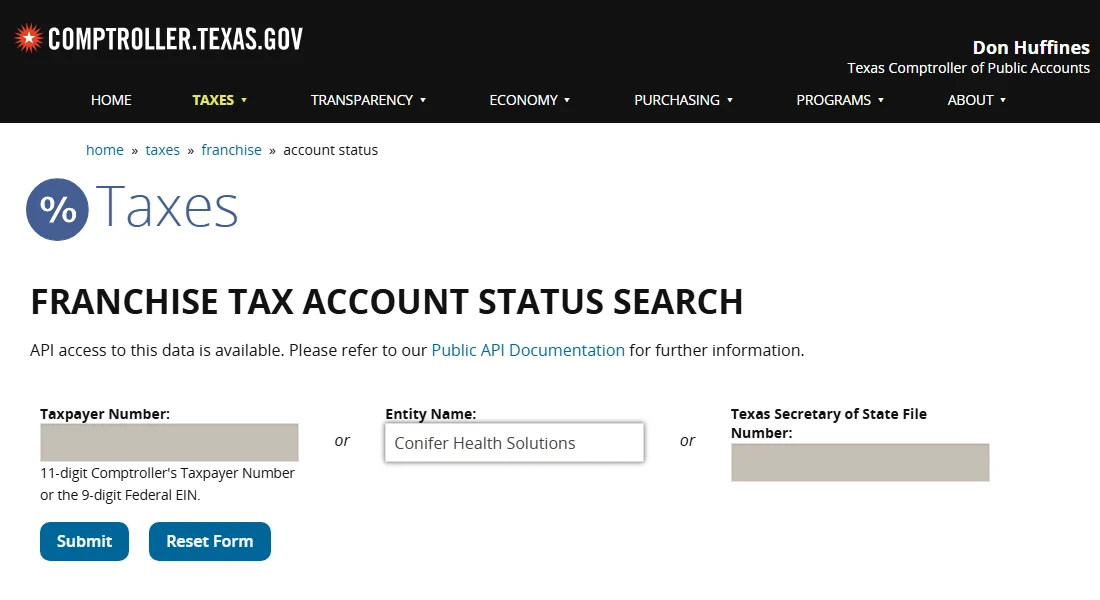
- Search the Texas Comptroller’s records. The Franchise Tax Account Status search is free. Enter the company’s name to see whether it has the right to transact business in Texas and where it was formed. The results also show its registered agent and the people and entities listed on its most recent Public Information Report. For a limited liability company, that list can include its members, which is often where ownership shows up.
- Order the full report if you need it. The Public Information Report asks for each parent company that owns 10 percent or more of the entity, along with its officers, directors and managers (Texas Comptroller). The search results page explains how to order full copies from the Comptroller’s open records section.
- Check for a public parent. If a company says it belongs to a larger group, look the parent up on the SEC’s EDGAR database. Public companies list their significant subsidiaries in their annual 10-K filings.
- Search the news. Search the company’s name with words such as “acquired”, “investment” or “portfolio company”. Private equity deals are often announced by press release.
- Ask the company in writing. Public records can be months out of date, so ask who owns the company today, whether any outside investor holds 10 percent or more, and whether ownership has changed in the last three years.
What we found when we tried it: On September 30, 2026, we searched the Comptroller’s records for Conifer Health Solutions, LLC. Its 2025 Public Information Report listed two members: Conifer Holdings, Inc. and CommonSpirit Health. Tenet’s February 2026 announcement says CommonSpirit’s stake was redeemed effective January 1, 2026. Both records are accurate for their dates, which is the lesson: a state filing is a snapshot, so use it to start the ownership conversation, not to end it.
For the rest of your vetting, our guide to finding billing companies near you covers service scope, reporting and the red flags to watch for.
Why Texas Payer Knowledge Matters More Than a Texas Address
An RCM company does not need an office in Texas to bill Texas payers well. Most claims, remittances and appeals move electronically. What it does need is to know how Texas pays. Three things set the state apart.
More patients with no insurance at all
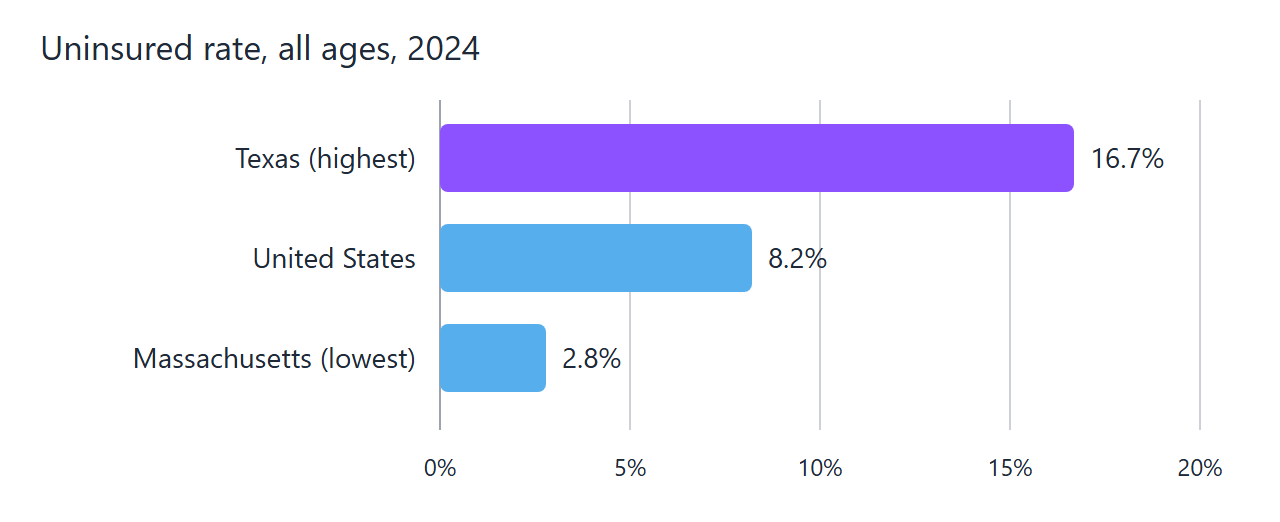
Texas had the highest uninsured rate of any state in 2024: 16.7% of residents, against a national rate of 8.2%. Among working-age adults, the Texas rate was 21.6% (U.S. Census Bureau, Health Insurance Coverage by State: 2023 and 2024, September 2025). For a practice, that means more self-pay visits and more revenue that depends on clear estimates and patient statements rather than on a payer.
Medicaid runs through managed care plans
Most people who have Medicaid in Texas get their coverage through the STAR managed care program, and STAR members get their services through health plans (Texas Health and Human Services). The Texas Medicaid & Healthcare Partnership (TMHP) supports providers with claims submission through TexMedConnect, prior authorization and enrollment help. A billing company working Texas Medicaid needs to know each plan’s rules in your service area, not just the state’s. Our Texas coverage page lists the Texas Medicaid plans and commercial payers we bill.
State prompt pay rules cover only some claims
For fully insured HMO, PPO and EPO plans issued in Texas, an insurer must pay a clean claim within 30 days if it was submitted electronically and within 45 days if it was on paper. A physician must submit the claim within 95 days of the date of service. The same rules do not apply to self-funded ERISA plans, Medicaid, Medicare Advantage or workers’ compensation (Texas Department of Insurance, Prompt Pay FAQ).
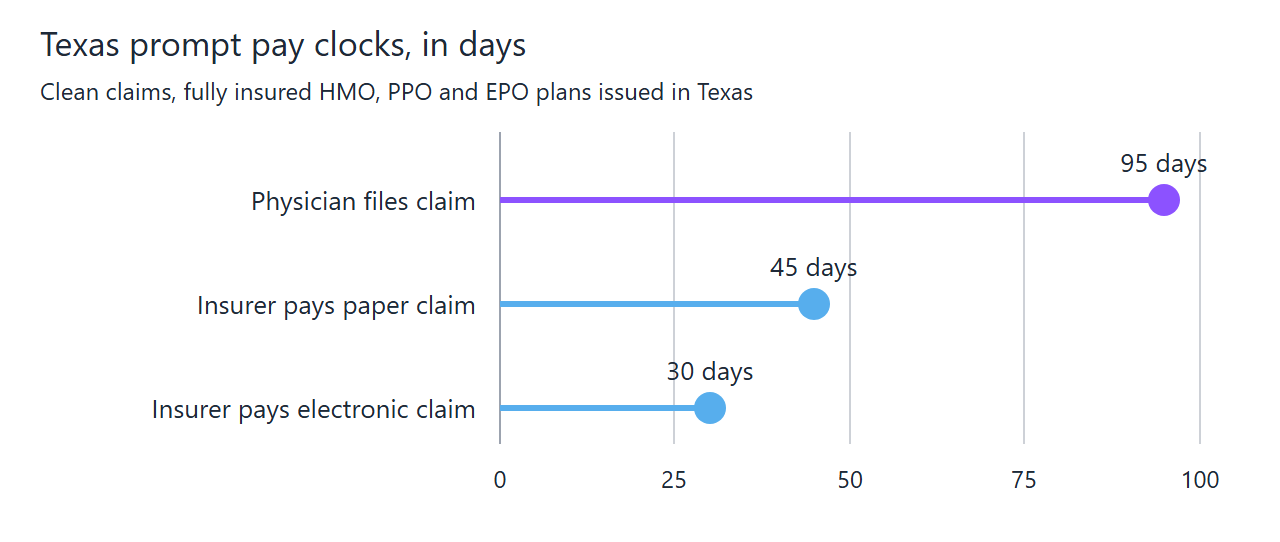
A billing company that knows which of your claims carry the state clock can spot late payments that may qualify for statutory penalties. It will also file every claim well inside the 95 days. You can test for these skills in an interview, wherever the company is based.
Questions to Ask Before You Sign
Ownership questions belong in the sales conversation, and the answers belong in the contract. Ask every company on your shortlist the same questions and compare the written answers.
- Who owns the company today? Ask for any person, fund or company that holds 10 percent or more.
- Has ownership changed in the last three years, or is a sale under way? A pending sale is not a reason to walk away, but you should know about it before you sign.
- Where is the work done? Ask whether your claims will be worked by the company’s own staff in the United States, by contractors or by offshore teams, and get the answer in writing.
- Who is our named contact, and how often do we meet? Ownership changes are easier to live with when the person who knows your account stays put.
- Will you sign a business associate agreement? HIPAA allows a practice to share patient information with a vendor only if it obtains satisfactory assurance, documented in a written contract, that the vendor will safeguard it (45 CFR 164.502(e)).
- What happens to our data if we leave? Your claims history, reports and payer correspondence should come back to you in a usable format, and the contract should say so.
Then write the protections into the agreement:
- Notice of any change of control.
- The right to end the contract without penalty if the company is sold or assigns your contract to another business.
- A reasonable notice period.
- A commitment to keep working open claims for an agreed time after termination.
Our guide to medical billing pricing covers the fee terms to check in the same contract.
Does Your RCM Company Have to Be Based in Texas?
No. A Texas office helps if you want in-person onboarding, but it does not make a company better at getting your claims paid. Test for the things that do:
- Experience with TMHP and the STAR plans in your service area.
- Familiarity with Blue Cross and Blue Shield of Texas and your other commercial payers.
- A clear answer on prompt pay deadlines.
- A willingness to work inside the practice management system you already use.
Where Summit Billing Solutions fits
Summit Billing Solutions is an independent, privately owned medical billing and revenue cycle management company based in Salem, New Hampshire. We have no private equity investor and no parent company. We work with practices in all 50 states, including Texas. There we bill Texas Medicaid through TMHP and the STAR, STAR+PLUS and STAR Kids plans, along with commercial payers such as Blue Cross and Blue Shield of Texas. Our US-based team works inside your existing software, our fee is 3% to 9% of monthly collections, and the agreement is month to month with no long-term lock-in.
Want to see what your revenue cycle is costing you?
Our free account review looks at your denials, aging A/R and top denying payers, whether or not you go further with us. You can also contact our team with questions about billing Texas payers.
How We Researched This Guide
We checked every ownership detail in this guide against a primary source on September 30, 2026: the companies’ own announcements, a filing with the U.S. Securities and Exchange Commission and the Texas Comptroller’s franchise tax records. Payer rules come from the Texas Department of Insurance, Texas Health and Human Services and TMHP, and insurance coverage figures from the U.S. Census Bureau. We did not test or rate the companies named here, and none of them paid for mention. Ownership changes, so confirm current details with any company before you sign.
Frequently Asked Questions About Privately Owned RCM Companies in Texas
1. Is a private equity-backed RCM company privately owned?
Yes. Privately owned means the company’s shares do not trade on a public exchange, so a company controlled by a private equity fund is privately owned. If you want a company run by its owners with no outside investor in control, ask for “independent” or “owner-operated” and confirm it with the checks above.
2. How can I tell if my billing company has been sold?
Check the news and the Texas Comptroller’s records once a year, and put a change-of-control notice clause in your contract so the company has to tell you. The Comptroller’s records update with each annual Public Information Report, so they can lag a sale by months.
3. Do Texas prompt pay rules apply to all my claims?
No. They apply to fully insured HMO, PPO and EPO plans issued in Texas. Self-funded ERISA plans, Medicaid, Medicare Advantage and workers’ compensation are excluded, according to the Texas Department of Insurance.
4. Can a company outside Texas bill Texas payers?
Yes. Claims, remittances and appeals are mostly handled electronically through clearinghouses and payer portals. What matters is experience with your payers and correct payer enrollment, not the company’s address.
The Bottom Line
“Privately owned” is a starting point, not an answer. Before you choose a Texas RCM partner:
- Find out which kind of private it is: owner-operated, private equity-backed or part of a larger company.
- Check the Texas Comptroller’s records, then confirm ownership with the company in writing.
- Test for Texas payer knowledge: TMHP and the STAR plans, the prompt pay clocks and a large self-pay population.
- Protect your practice in the contract with change-of-control, termination and data-export terms.
A partner that passes those checks will serve your practice well, whether its office is in Dallas or in New Hampshire.