


Private industry employers reported 2.5 million nonfatal workplace injuries and illnesses in 2024 (BLS, January 2026), and every one that needed treatment became a claim billed not to a health plan but to the employer’s workers’ compensation carrier, under the rules of the state where the worker was hurt. Those rules change everything about the claim: the claim number and date of injury on the bill, the state’s fee schedule in place of a contract, the medical reports the state requires attached to the bill, the carrier’s own clock for payment and objection, and a patient who cannot be billed for the difference. In California, “it is illegal for a physician or medical facility to bill a worker if they know the injury is or may be work related” (California DWC); in New York, Section 13-f of the Workers’ Compensation Law prohibits it (New York WCB); in Texas, “a doctor is prohibited from directly billing an injured employee for medical treatment” (Texas DWC). Summit Billing Solutions bills workers’ compensation claims for practices in all 50 states and treats each state’s rules as the payer contract, which is why the revenue cycle page lists it as a payer that runs on its own rules, and the medical billing page sends it here.
Federal employees have their own program. Under the Federal Employees’ Compensation Act, providers must enroll with the Office of Workers’ Compensation Programs to be paid, a federal fee schedule applies, and the injured worker “is not responsible for charges over the maximum allowed in the OWCP fee schedule” (US Department of Labor, OWCP). Bills go on Form OWCP-1500 or CMS-1500 (20 CFR 10.801), and under 20 CFR 10.803 no bill is paid if it is submitted more than one year beyond the end of the calendar year in which the service was provided or the claim was first accepted, whichever is later. The states are moving the same way: New York has required the CMS-1500 to be submitted electronically through a Board-approved partner since August 1, 2025. A billing team that knows these rules by state is the difference between workers’ compensation being a practice’s best payer and its oldest receivable.
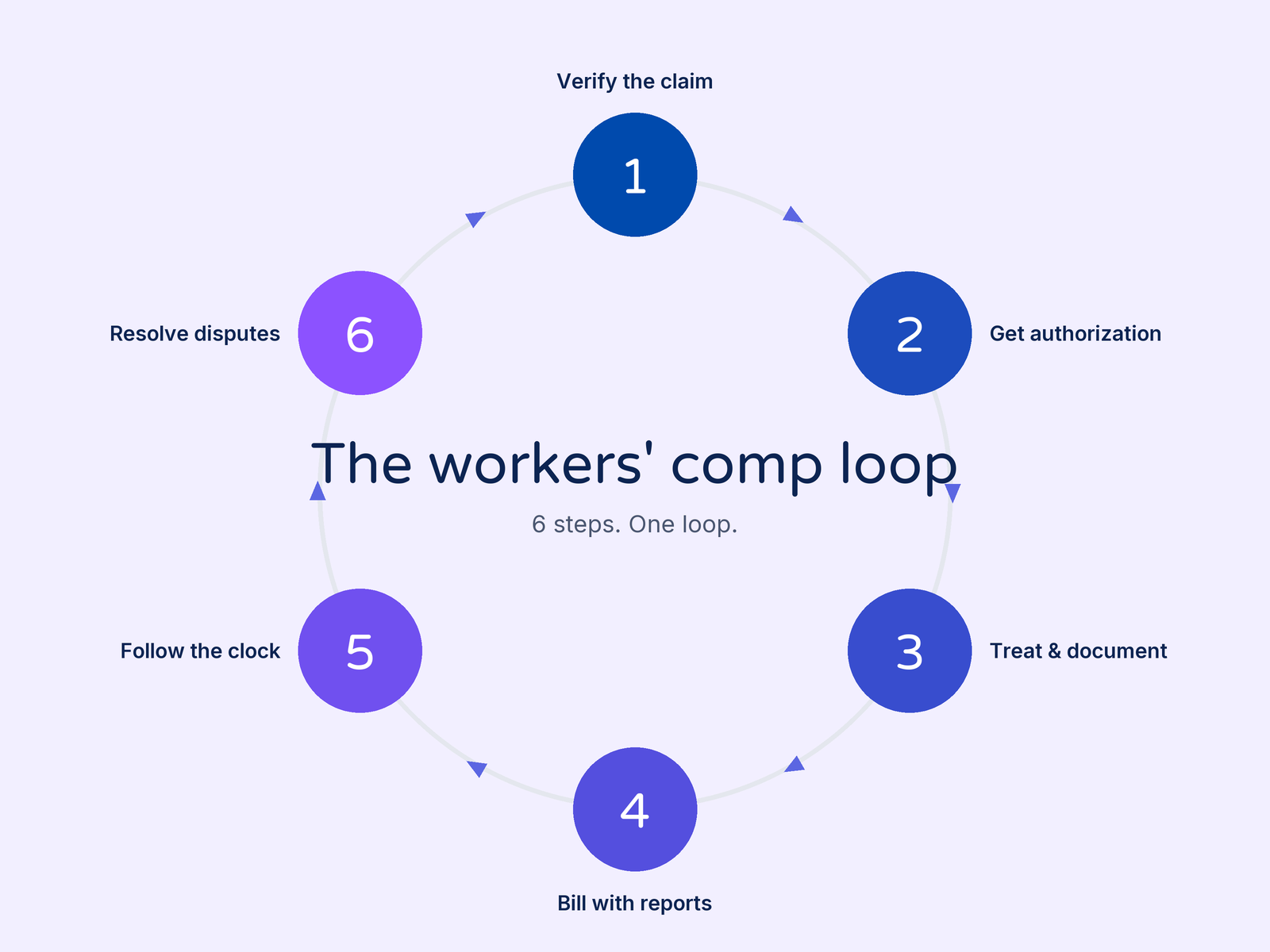
| Number | Decision | What happens | Where it goes wrong, and what we do | Related service |
|---|---|---|---|---|
| 1 | Verify the claim before the visit | Before the first visit, the claim number, the carrier or administrator, the adjuster, the date of injury, the employer and the accepted body parts or conditions are confirmed with the carrier and written to the chart, so every bill carries what the state requires. | The visit is billed to the patient's health plan, or to the carrier with no claim number, and it comes back. We verify every new workers' compensation case with the carrier and update the claim record whenever the accepted conditions change. | Eligibility verification |
| 2 | Authorization and utilization review | Most states require authorization for specified treatment: surgery, therapy beyond a set number of visits, imaging or referrals, through the carrier's utilization review, with treatment guidelines and response timelines set by the state. | Treatment goes ahead on a verbal approval that was never written down, and the bill is denied as unauthorized. We request authorization in the form the state prescribes, track the response deadline, and keep the approval with the claim. | Prior authorization |
| 3 | Coding against the state fee schedule | Each state sets its own medical fee schedule, often built on Medicare's relative values with its own conversion factors, ground rules, state-specific codes and modifiers, and its own rules for reports, records and missed appointments. The federal program has its own. | Claims are coded and priced like commercial claims, the carrier reduces them to the schedule, and nobody checks the reduction. We code to the state's ground rules, price every line to the current schedule, and dispute reductions below it. | Medical coding |
| 4 | The bill and the reports that go with it | The bill goes on the CMS-1500 or the state's form with the claim number and date of injury, and the state's required reports attached: the initial report, progress reports and the records the carrier is entitled to. New York requires the CMS-1500 electronically through a Board-approved partner. | The bill arrives without the report and sits unpaid, or the report arrives without the bill. We send both together, electronically where the state provides for it and by the carrier's route where it does not, and keep proof of receipt. | Claim submission |
| 5 | No patient balance | An injured worker cannot be billed for treatment of the work injury: California calls it illegal, New York prohibits it under Section 13-f, Texas prohibits it, and the federal program says the worker owes nothing above its schedule. The difference is the carrier's to pay or dispute. | A denied or reduced claim is statemented to the patient, which the state forbids, or written off without a dispute. We never send a workers' compensation balance to a patient statement; we dispute it with the carrier or close it under the schedule. | Patient statements |
| 6 | Deadlines, follow-up and payment | Every state sets a clock for the provider's bill, the carrier's payment or objection, and the dispute that follows. New York's denied bills must be resubmitted within 120 days of the date of care; the federal program pays no bill filed more than a year after the end of the calendar year of service. | Bills age past the state's window while the practice waits for a check that was never coming, and the balance is lost. We calendar each state's clocks from the date of service, follow every unpaid bill with the adjuster, and file the dispute the state provides. | A/R recovery |
| 7 | No-fault and auto accident claims | Twelve states and Puerto Rico have no-fault auto insurance, where the patient's own auto policy pays for injury treatment under personal injury protection, on the state's fee schedule and its own clock. New York, for example, requires the bill within 45 days of service. | The claim goes to the health plan, which denies it as an auto injury, and the no-fault deadline passes. We bill the no-fault carrier first where the state requires it, and the health plan only where it allows. New Hampshire is not a no-fault state; this work is for clients in the states that are. | Medical billing |
| Compare | Billed like commercial | Summit Billing Solutions |
|---|---|---|
| Before the visit | The patient says it happened at work; the card on file is billed. | Claim number, carrier, adjuster, date of injury and accepted conditions confirmed and written to the chart. |
| The price | The practice's usual charge, reduced by the carrier to a schedule nobody checked. | Priced to the state's current schedule and ground rules; every reduction below it disputed. |
| The bill | A CMS-1500 without the report, or a report without the bill. | Bill and required reports together, electronically where the state provides for it, with proof of receipt. |
| The patient | Statemented for the difference, which the state forbids. | Never billed for the work injury; the difference is the carrier's to pay or dispute. |
| The follow-up | Whenever someone notices; the state's window passes. | Every clock calendared from the date of service; every unpaid bill followed with the adjuster. |
| When the carrier says no | Written off. | The state's dispute route filed inside its window, with the schedule calculation and the report. |
We pull a year of your workers' compensation claims by state and carrier: billed, reduced, paid, denied and aged, with the reductions nobody disputed and the bills past a state window. You see what the workers' compensation side is worth, whether or not you go further with us.
We load each state's fee schedule, forms, report requirements and clocks for the states you treat in, agree the authorization and record-request workflow with your front desk and clinicians, set up electronic billing where the state provides for it, and connect your system. Most practices are live within two weeks.
Every new case is verified with the carrier and written to the chart. Bills go out with the required reports within 24 hours of the documentation, priced to the schedule. Reductions are checked, disputes filed, authorizations tracked, and every clock calendared from the date of service.
Workers' compensation collections by state and carrier against the schedule, reductions disputed and recovered, authorizations pending, bills past each state's window, disputed claims and liens open, and the carriers that pay late, reviewed with your named contact on the weekly call.


Your claims are worked by a team in the United States, not routed offshore.
You know who is working your account, and you hear from them every week. A familiar face, not a ticket queue.
If we are not earning the relationship, you can leave. That keeps us honest.
We are in Salem, NH, and we bill for practices nationwide, with the state-by-state payer knowledge that takes.
2%
Average claim rejection rate
24 hrs
Claims submitted within
28
Average days in A/R

I’ve been in billing for 30+ years and Summit is the best I’ve worked with. They’re knowledgeable, detailed, and persistent to get claims paid instead of writing them off. They take the burden off providers so we can focus on patients.

We billed in-house for decades, but it was time for a change. I couldn’t be happier with Summit. The transition was seamless thanks to their strong systems and clear communication. If you’re considering a switch, talk to Summit.


When Summit Billing Solutions handles your billing, workers’ compensation claims, authorizations, report handling and disputes are part of the service, inside the fee of 3% to 9% of monthly collections. A practice whose work is mostly workers’ compensation sits toward the upper end of that range, because every claim carries the verification, the reports, the schedule check and the follow-up that a commercial claim does not.
A practice that keeps its other billing in house can have workers’ compensation billing alone. That is quoted after the free account review, based on claim volume, the states you treat in, and whether no-fault or federal claims are included. Lien and dispute work is part of follow-up, not a separate fee. We do not quote a days-to-payment figure; the carriers set that, and we show you theirs. How billing companies structure their fees more generally is covered in our guide to medical billing pricing.
50A Northwestern Drive, Salem, NH 03079
603-207-3172
(866) 906-3116
info@summitbillingsolutions.com
Mon - Fri @ 9am - 5pm
Summit Billing Solutions has been one of the best decisions for my business. They’re responsive, transparent, and make billing feel organized and manageable. They truly feel like a partner, not a vendor. Highly recommend.