


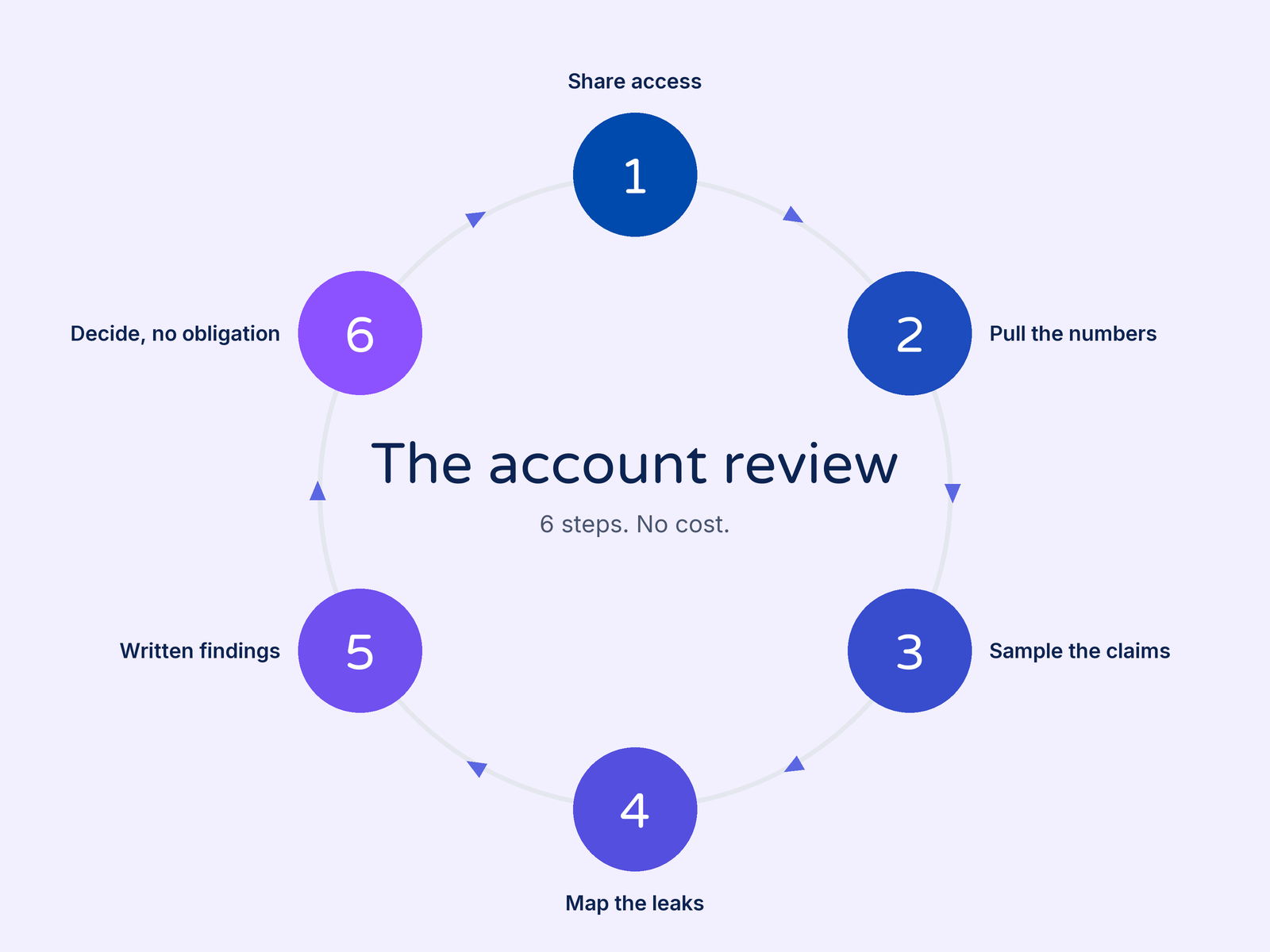
Consulting firms sell revenue cycle assessments to hospitals over a period of weeks. A small practice needs the same questions answered from its own data in days, at no cost, by the people who would do the work afterwards. That is the free account review. We pull twelve months of claims by payer, charged, allowed and paid; the aging by bucket; denials by payer and reason; remittances against your fee schedules; patient balances billed and unbilled; and the enrollment and credentialing status of every provider with every plan. We sample claims from each major payer and check them from the record to the remittance. You receive written findings with each leak quantified from your own numbers, the recoverable part marked, a plan in order of value, and your exact rate. No industry percentage stands in for your data, and, in the words of our own FAQ, we show you what we find before you commit to anything.
Leaks are ordinary, which is why the review is worth running even when nothing feels wrong. CAQH puts the medical and dental industries’ opportunity from moving manual administrative work to automated workflows at $20 billion, and the medical industry’s savings opportunity on eligibility and benefit verification alone at $11.7 billion (2024 CAQH Index). KFF found that HealthCare.gov insurers denied 20% of in-network claims in 2023 (KFF, January 2025). Medicare claims must be filed within 12 months of the date of service (CMS Medicare Claims Processing Manual, chapter 1), and CMS’s own measure of Medicare fee-for-service improper payments for fiscal year 2025 was 6.55 percent, $28.83 billion (CMS CERT). The review is where those become your numbers. It is a light audit, not the full one; when you need every claim in a period checked against the record, that is a medical billing audit, and it is priced.
| Number | What we examine | What we look at | What leakage looks like, and what we do | Related service |
|---|---|---|---|---|
| 1 | Front end: eligibility, authorization and network status | How coverage is verified before the visit, whether authorizations are secured and tracked, and whether every rendering provider is enrolled with every plan the practice bills. We read twelve months of eligibility and authorization denials by payer. | Denials for coverage that had ended, visits without an authorization, and claims paid at the out-of-network rate to a provider who was never enrolled. We quantify each from the remittances and name the front-end fix for each one. | Eligibility verification |
| 2 | Coding, charge capture and clean claims | A sample of claims per major payer, checked from the note to the claim: codes supported by the record, modifiers, missed charges, and rejections at the clearinghouse. A claim that goes out within 24 hours starts the payer clock weeks before one that waits. | Visits never billed, services documented but never charged, undercoded visit levels, and claims rejected and resubmitted late. We count the missed charges and the rejections, and say which are coding problems and which are process problems. | Medical coding |
| 3 | Payer payments: underpayments and posting | Remittances against your fee schedules for each contracted plan, the posting lag by payer, unapplied cash, and credit balances. Underpayments only show when someone compares the allowed amount with the contract, so we do. | Allowed amounts below contract posted as adjustments, and payments posted to accounts rather than claim lines, so short pays are invisible. We list the underpaid lines by payer, and the credits waiting for a refund. | Payment posting |
| 4 | Denials and appeals | Denials by payer and reason code for twelve months, how many were corrected, appealed or written off, and how long each took. HealthCare.gov insurers denied 20% of in-network claims in 2023, according to KFF; your own rate is the one that matters. | Denials written off because nobody had time, appeals filed after the plan's deadline, and the same denial recurring every month because its cause was never fixed. We quantify what is still appealable and what is lost. | Denial management |
| 5 | Aged A/R and timely filing | Every open balance by age and payer, against each payer's filing and appeal limits. Medicare claims must be filed within 12 months of the date of service; commercial limits are set by contract and are often shorter. | Balances over 90 days that nobody has touched, and claims that crossed a filing limit while they waited. We separate what can still be recovered from what is past every window, and say why for each. | A/R recovery |
| 6 | Patient balances | Patient responsibility after insurance: what was statemented, when, for how many cycles, what was paid, and what sits unbilled because the secondary never posted or the statement run was missed. | Balances never billed, statements sent before insurance had finished, and no way to pay online. We count the unbilled and the aged patient balances and describe the cycle that would collect them. | Patient statements |
| 7 | Adding it up: the revenue leakage analysis | Each finding becomes a number from your own data: denials never resubmitted, claims past filing limits, underpayments against contract, charges never billed, patient balances never statemented. Added together, that is your leakage for the year, with the recoverable part marked. | Most free assessments quote an industry percentage instead. We do not: every figure in your findings traces to a claim, a remittance or a statement you can open in your own system, and the findings are yours whether or not you go further. | Medical billing audit |
| Compare | Consulting assessment | Summit Billing Solutions |
|---|---|---|
| Who it is for | Hospitals and health systems. | Solo, small and group practices. |
| Cost | A fee, quoted by scope. | Free, with no obligation at the end. |
| Time | Weeks of interviews and data requests. | Read-only access, your last twelve months, and written findings within days. |
| Deliverable | A report with recommendations. | Written findings with every leak quantified from your own data, a plan in order of value, and your exact rate. |
| Who does the work | A consulting team that leaves when the report is delivered. | The billers who would work your account. |
| What happens next | An implementation proposal. | Onboarding, live within one to two weeks, month to month; or nothing at all, and the findings are still yours. |
Fifteen minutes with your named contact: what you bill, which systems you use, what worries you, and what you want to know. If we are not the right fit for your practice, we say so on this call.
Read-only access to your practice management system, clearinghouse and remittances, under a signed business associate agreement. We pull twelve months of claims, aging, denials, remittances against fee schedules, patient balances and enrollment status.
A sample of claims per major payer is checked from the record to the remittance. Every leak is quantified from your own numbers and written up, with the recoverable part marked, the cause named and the fix described.
We walk through the findings with you and quote your exact rate inside the 3% to 9% range. Proceed, and onboarding starts that week. Decline, and the findings are still yours to act on, with whoever you choose.


Your claims are worked by a team in the United States, not routed offshore.
You know who is working your account, and you hear from them every week. A familiar face, not a ticket queue.
If we are not earning the relationship, you can leave. That keeps us honest.
We are in Salem, NH, and we bill for practices nationwide, with the state-by-state payer knowledge that takes.
2%
Average claim rejection rate
24 hrs
Claims submitted within
28
Average days in A/R

I’ve been in billing for 30+ years and Summit is the best I’ve worked with. They’re knowledgeable, detailed, and persistent to get claims paid instead of writing them off. They take the burden off providers so we can focus on patients.

We billed in-house for decades, but it was time for a change. I couldn’t be happier with Summit. The transition was seamless thanks to their strong systems and clear communication. If you’re considering a switch, talk to Summit.


The account review is free, and it stays free if you decide not to proceed; the findings are yours. If you do proceed, Summit Billing Solutions charges a percentage of monthly collections, between 3% and 9% depending on specialty, volume, payer mix and the state of your receivables, quoted with the findings so there is nothing to negotiate later.
The agreement is month to month with no long-term lock-in, and, in the words of our own FAQ, if the results are not there, you are not tied in. A billing partner should keep your business by improving your collections, not by holding you to a contract term. How billing companies structure their fees more generally is covered in our guide to medical billing pricing.
50A Northwestern Drive, Salem, NH 03079
603-207-3172
(866) 906-3116
info@summitbillingsolutions.com
Mon - Fri @ 9am - 5pm
Summit Billing Solutions has been one of the best decisions for my business. They’re responsive, transparent, and make billing feel organized and manageable. They truly feel like a partner, not a vendor. Highly recommend.