


The request is administrative work with a clinical core. The plan’s policy decides which procedures, drugs, tests and equipment need approval; the CPT code and the diagnosis decide whether this one does; the provider’s note decides whether the plan says yes. Summit Billing Solutions handles everything around that core: the requirement check when the visit is scheduled, the documentation package, the submission by portal, phone, fax or the electronic 278 health care services review transaction, the follow-up, and the record on the claim. The clinical judgment stays with your provider, and when a plan wants a peer-to-peer conversation, we schedule it and prepare it; your provider has it.
Two numbers explain why the work is worth organising. Doing one authorization by hand costs the provider $12.88, by payer portal $8.93, and fully electronically $5.38, according to the 2024 CAQH Index (p. 56). And denials are worth challenging: HHS OIG found that among prior authorization requests denied by Medicare Advantage organizations, 13 percent met Medicare coverage rules (April 2022). The practice that tracks every request and appeals the wrong denials keeps money the practice that does not simply loses.
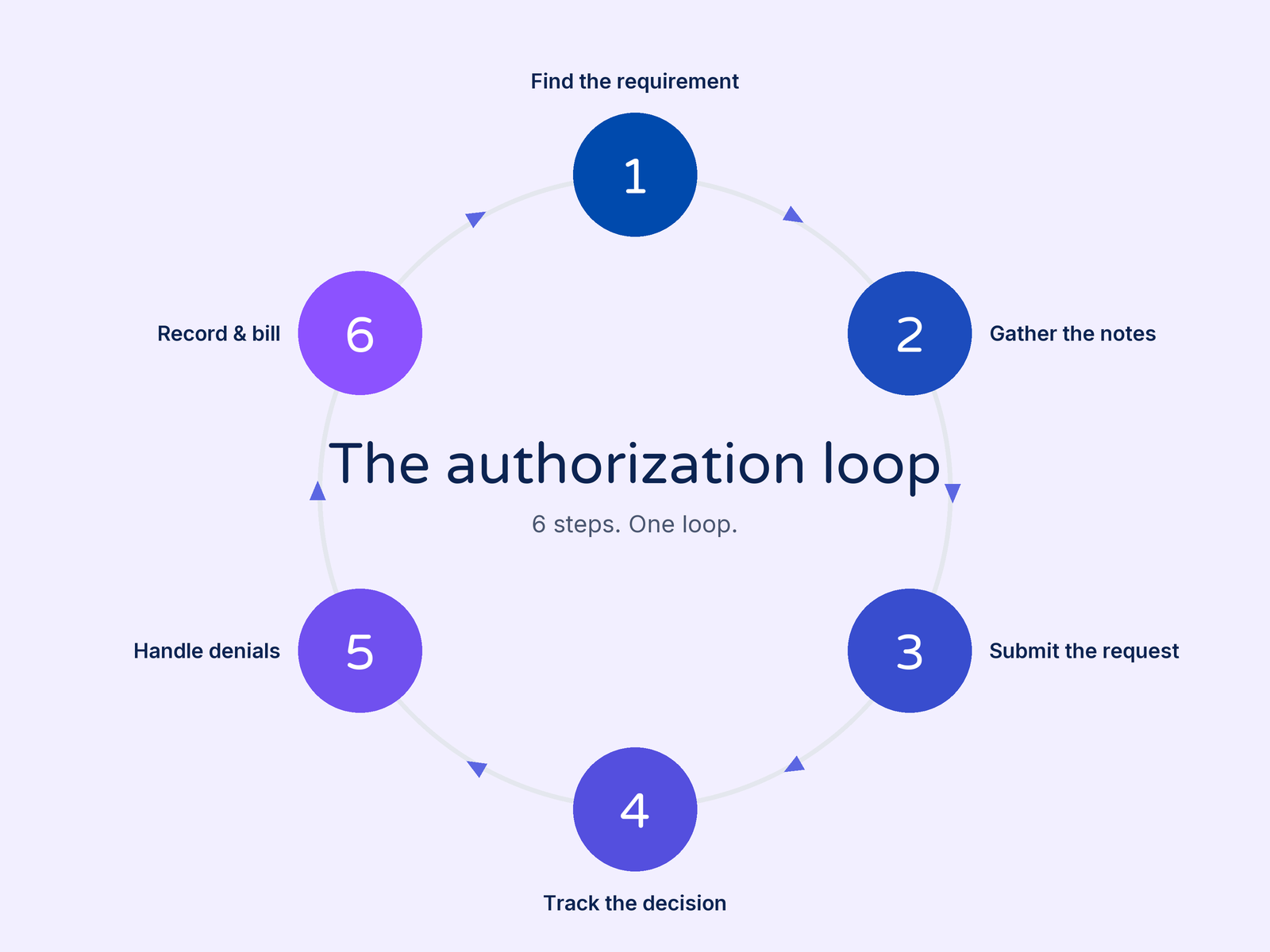
| Number | Step | What happens | Where it stalls, and what we do | Related service |
|---|---|---|---|---|
| 1 | Find the requirement | When the visit is scheduled, the planned service is checked against the patient's plan: does this CPT, for this diagnosis, under this product, need authorization, a referral, or neither. Eligibility verification is where the flag is raised. | The requirement is discovered after the service, when the denial arrives. We check every scheduled service against the payer's current policy list and open the request before the appointment is confirmed. | Eligibility verification |
| 2 | Gather the clinical documentation | The plan's criteria for that service are pulled, and the notes, prior treatment, test results and letters that answer them are assembled from the record. | A request sent thin comes back as a request for more information, and the clock restarts. We package what the plan's criteria ask for the first time, and go back to the provider only for what is missing. | Medical coding |
| 3 | Submit the request | Through the payer's channel: its portal, an electronic 278 transaction via the clearinghouse where the plan supports it, or fax and phone where it does not. The reference number, date and channel are recorded. | A request with no reference number is a request that never existed. We log every submission and confirm receipt, so a lost request is found in days, not weeks. | Medical billing |
| 4 | Track to a decision | Federal rules now set clocks for many plans: Medicare Advantage, Medicaid and CHIP plans must decide expedited requests within 72 hours and standard ones within seven calendar days. Commercial plans follow their own contracts. | The request sits in pending and the appointment date arrives first. We follow up on every open request on a schedule, escalate when a plan's own clock runs out, and tell scheduling what is approved and what is not. | CMS prior authorization rule |
| 5 | Denials and peer-to-peer | A denial now has to state a specific reason for the plans covered by the federal rule. The options are a corrected resubmission, a peer-to-peer review between the provider and the plan's physician, or a formal appeal. | The denial is accepted, or the peer-to-peer is missed because nobody scheduled it. We read the reason, schedule and prepare the peer-to-peer for your provider, and file the appeal with the criteria the plan itself published. | Denial management |
| 6 | Record and bill | The approval number, the dates it covers, the units and the services approved go on the appointment and on the claim. Expiring approvals are renewed before the next visit. | The claim goes out without the authorization number, or with a different CPT from the one approved, and is denied as unauthorized. We match the claim to the approval before it leaves, and renew approvals before they run out. | Claim submission |
| Compare | Front desk, between calls | Summit Billing Solutions |
|---|---|---|
| Finding the requirement | When someone remembers this plan wants one for that procedure. | Every scheduled service checked against the payer's current policy list at the time of booking. |
| The documentation | Whatever is handy; the plan asks for the rest later. | The plan's own criteria answered the first time, with a query to the provider only for what is missing. |
| Follow-up | When the patient calls to ask whether they are approved. | Every open request followed on a schedule, escalated when the plan's clock runs out. |
| Denials | Accepted, or resubmitted unchanged. | The reason read, the peer-to-peer scheduled and prepared, the appeal filed against the plan's published criteria. |
| On the claim | The number is in an email somewhere. | Approval number, dates, units and codes on the appointment and the claim, matched before submission. |
| Visibility | None, until the denial report. | Turnaround by payer, approvals and denials, and expiring approvals in the monthly report. |
We pull your denials for the last 90 days, show you how many were authorization denials, which payers and services they came from, and what they cost, whether or not you go further with us.
We load your payers' authorization policies by CPT, set up portal access and electronic submissions through your clearinghouse where plans support them, and agree with each provider how documentation queries and peer-to-peer requests reach them. Most practices are live within one to two weeks.
The queue comes from your schedule. Requirements are checked at booking, requests submitted with the criteria answered, every open request followed on a schedule, and approvals recorded on the appointment and the claim. Denials are read the day they arrive.
Requests submitted, approved, denied and pending, turnaround by payer against the federal clocks where they apply, appeals and peer-to-peer outcomes, and approvals expiring next month, reviewed with your named contact on the weekly call.


Your claims are worked by a team in the United States, not routed offshore.
You know who is working your account, and you hear from them every week. A familiar face, not a ticket queue.
If we are not earning the relationship, you can leave. That keeps us honest.
We are in Salem, NH, and we bill for practices nationwide, with the state-by-state payer knowledge that takes.
2%
Average claim rejection rate
24 hrs
Claims submitted within
28
Average days in A/R

I’ve been in billing for 30+ years and Summit is the best I’ve worked with. They’re knowledgeable, detailed, and persistent to get claims paid instead of writing them off. They take the burden off providers so we can focus on patients.

We billed in-house for decades, but it was time for a change. I couldn’t be happier with Summit. The transition was seamless thanks to their strong systems and clear communication. If you’re considering a switch, talk to Summit.


When Summit Billing Solutions handles your billing, authorization work is part of the service, inside the fee of 3% to 9% of monthly collections. An authorization denial is usually a balance nobody can collect, so preventing it is what the fee is for.
A practice that keeps its billing in house can have authorization work alone. That is quoted after the free account review, based on how many requests a month, how many payers, and how many of those plans accept electronic submissions, because those three things decide the effort. We do not quote an approval rate, because the plan decides approvals; we quote the work. How billing companies structure their fees more generally is covered in our guide to medical billing pricing.
50A Northwestern Drive, Salem, NH 03079
603-207-3172
(866) 906-3116
info@summitbillingsolutions.com
Mon - Fri @ 9am - 5pm
Summit Billing Solutions has been one of the best decisions for my business. They’re responsive, transparent, and make billing feel organized and manageable. They truly feel like a partner, not a vendor. Highly recommend.