


The check itself is a standard transaction. The practice sends a 270 inquiry, which X12 defines as the Eligibility, Coverage or Benefit Inquiry, and the payer answers with a 271 response. For Medicare, CMS runs that exchange in real time through its HIPAA Eligibility Transaction System. Summit Billing Solutions sends those inquiries through your clearinghouse, reads the responses, calls the payer when the response is incomplete, and writes the result into your practice management system before the patient arrives.
Doing it by hand is the expensive way. The 2024 CAQH Index puts the provider’s cost of one eligibility and benefit verification at $8.57 when done manually, $4.46 through a payer portal, and $2.00 when fully electronic (CAQH Index 2024, p. 56). The bigger cost is the check that never happens: a claim denied for eligibility weeks after the visit was lost on the day the appointment was booked.
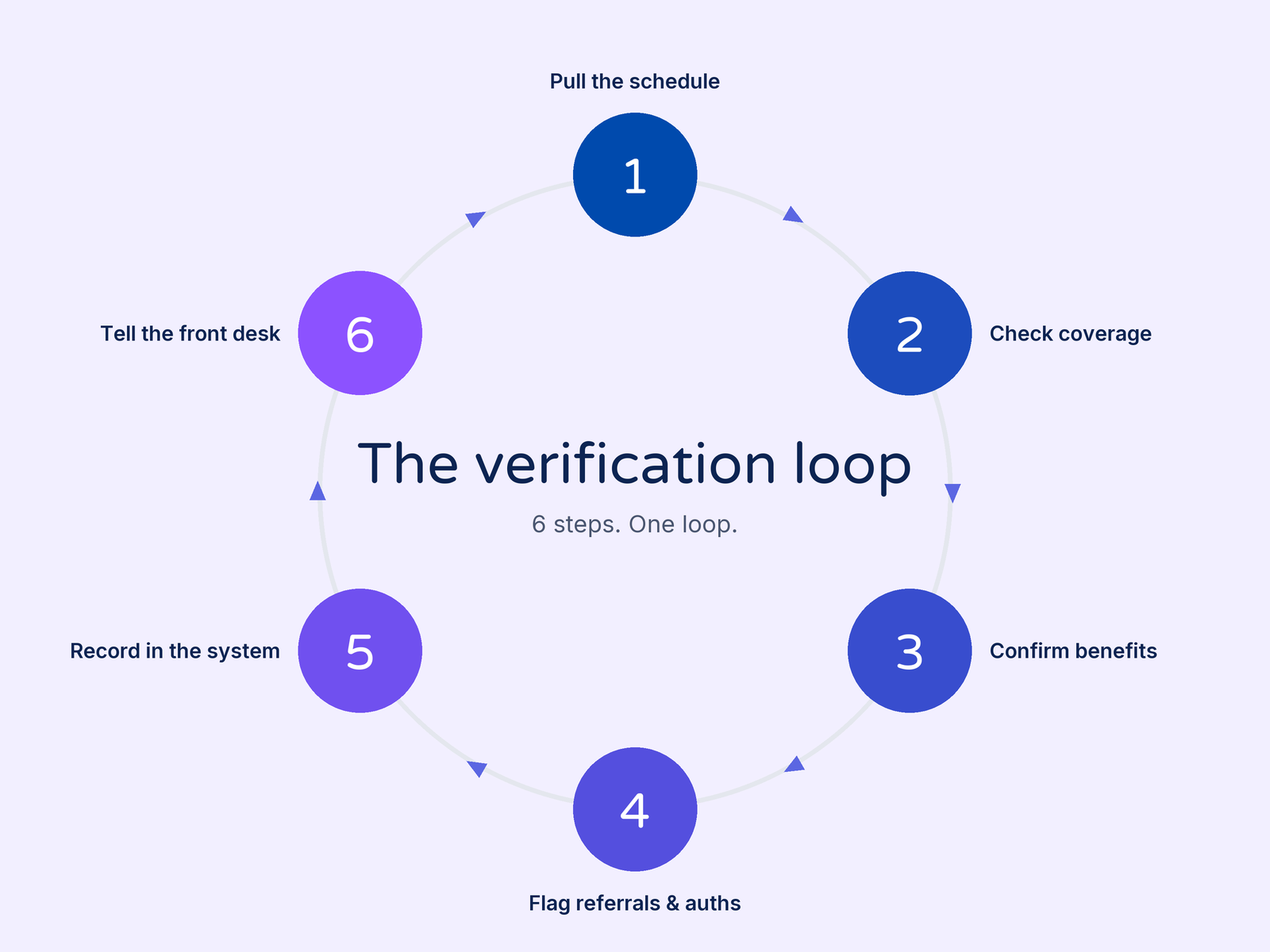
| Number | What we verify | How it is checked | What goes wrong when it is skipped | Related service |
|---|---|---|---|---|
| 1 | Coverage on the date of service | A 270 inquiry through your clearinghouse, run two to three business days before the visit and again the same day for add-ons. Medicare is checked in real time through HETS. | The plan terminated, changed at the new year, or the card is from a previous employer. The claim is denied weeks later for a reason that was knowable on the day of booking. | Denial management |
| 2 | Plan type and network status | The 271 response names the plan; we confirm the rendering provider is in network with that specific product, not just the payer, and flag out-of-network visits before the patient arrives. | A visit is billed in network to a product the provider is not enrolled with. It pays at the out-of-network rate or not at all, and the patient gets a bill nobody warned them about. | Out-of-network billing |
| 3 | Patient responsibility | Copay, coinsurance, deductible remaining and out-of-pocket maximum are read from the response and written to the appointment, so the front desk collects the right amount at check-in. | The wrong copay is collected or nothing is, and the balance becomes a patient statement that arrives a month later and is paid slowly or not at all. | Patient statements |
| 4 | Referral requirement | For HMO and POS plans we confirm a referral from the primary care provider is on file, with its number, visit count and expiry date, and chase it before the visit if it is missing. | The visit happens without a valid referral. Most plans deny it outright, and many contracts bar billing the patient for it. | Referral management |
| 5 | Authorization requirement | The response and the payer's policy are checked for services that need prior authorization. When one is needed, the request goes to the authorization team before the visit is confirmed. | A procedure is performed without the authorization it needed. The claim is denied, and prevention was the only real fix. | Prior authorization |
| 6 | Coordination of benefits | When the patient has more than one plan, we confirm which is primary and record the order, so the first claim goes to the right payer and the secondary claim follows automatically. | The claim goes to the wrong payer first and is denied for coordination of benefits, then the filing window on the correct payer keeps running. | Secondary claims & COB |
| 7 | Service-specific benefits | Visit limits, telehealth coverage, excluded services and frequency rules for the service being scheduled are read from the response or confirmed by a call when the response is silent. | The twenty-first visit of a twenty-visit benefit, or a telehealth visit the plan does not cover, is delivered and never paid. | Medical billing |
| Compare | Front desk, day of visit | Summit Billing Solutions |
|---|---|---|
| When | At check-in, with the patient standing there, if the queue allows. | Two to three business days before the visit, and again the same day for add-ons. |
| How | One payer portal at a time, or a call on hold between patients. | 270/271 through your clearinghouse for every patient, with a call only when the response is incomplete. |
| What is recorded | A checkmark, sometimes a screenshot. | Plan, network status, copay, deductible remaining, referral and authorization flags, written to the appointment. |
| Referrals and authorizations | Noticed when the denial arrives. | Flagged before the visit, with the referral chased and the authorization request started. |
| Collections at check-in | Whatever the card says. | The amount the plan says, so fewer balances become statements. |
| Visibility | None, until the denial report. | Unverified visits, eligibility denials and their causes in the monthly report. |
We pull your denials for the last 90 days and show you how many were eligibility, coordination-of-benefits or referral denials, which payers they came from, and what they cost, whether or not you go further with us.
We connect to your schedule and your clearinghouse, set up 270/271 inquiries for your payers, gather portal access for the ones that need it, and agree how results reach the front desk. Most practices are live within one to two weeks.
Every scheduled patient is verified two to three business days ahead, add-ons the same day. Results are written to the appointment in your system, and anything that needs action, a missing referral, an authorization, an out-of-network plan, is flagged to your team by name.
How many visits were verified, how many could not be, and what changed downstream: eligibility and coordination-of-benefits denials by payer and reason, month over month.


Your claims are worked by a team in the United States, not routed offshore.
You know who is working your account, and you hear from them every week. A familiar face, not a ticket queue.
If we are not earning the relationship, you can leave. That keeps us honest.
We are in Salem, NH, and we bill for practices nationwide, with the state-by-state payer knowledge that takes.
2%
Average claim rejection rate
24 hrs
Claims submitted within
28
Average days in A/R

I’ve been in billing for 30+ years and Summit is the best I’ve worked with. They’re knowledgeable, detailed, and persistent to get claims paid instead of writing them off. They take the burden off providers so we can focus on patients.

We billed in-house for decades, but it was time for a change. I couldn’t be happier with Summit. The transition was seamless thanks to their strong systems and clear communication. If you’re considering a switch, talk to Summit.


When Summit Billing Solutions handles your billing, eligibility verification is part of the service, inside the fee of 3% to 9% of monthly collections. It is the cheapest work in the whole cycle and the work that prevents the most expensive denials, so it is never an add-on.
A practice that keeps its billing in house can have verification alone. That is quoted after the free account review, based on visit volume, the number of payers and how many of them answer 270 inquiries electronically, because those three things decide the effort. How billing companies structure their fees more generally is covered in our guide to medical billing pricing.
50A Northwestern Drive, Salem, NH 03079
603-207-3172
(866) 906-3116
info@summitbillingsolutions.com
Mon - Fri @ 9am - 5pm
Summit Billing Solutions has been one of the best decisions for my business. They’re responsive, transparent, and make billing feel organized and manageable. They truly feel like a partner, not a vendor. Highly recommend.