


Mental health insurance billing services handle the insurance side of a therapy or psychiatry practice: getting clinicians in network, checking each client’s behavioral health benefits, coding sessions, sending claims, posting payments, and working denials and patient balances. A general medical biller can do much of that. What sets mental health apart is the detail. Codes are billed by the minute, a separate company often manages the behavioral health benefit, telehealth has its own rules and deadlines, and networks pay behavioral clinicians less than their medical colleagues.
That last point shapes the whole market. In a study of claims for more than 22 million people, in-network office visits with medical and surgical clinicians paid 22% more on average than office visits with behavioral health clinicians. Patients went out of network 3.5 times as often to see a behavioral health clinician (RTI International, April 2024, 2021 claims). When rates are low and the rules are fussy, every denied session costs more.
This guide explains what a mental health billing service should handle, the 2026 rules behind therapy claims and the errors that most often get them denied. It then compares billing in-house, hiring a service and joining an insurance platform. If you are a solo clinician weighing outside help for the first time, our guide to medical billing services for small practices covers the basics.
Key Takeaways
- A mental health billing service should cover credentialing, benefits checks, authorizations, coding, claims, payment posting, denials and patient balances, plus superbills and single case agreements if you see clients out of network.
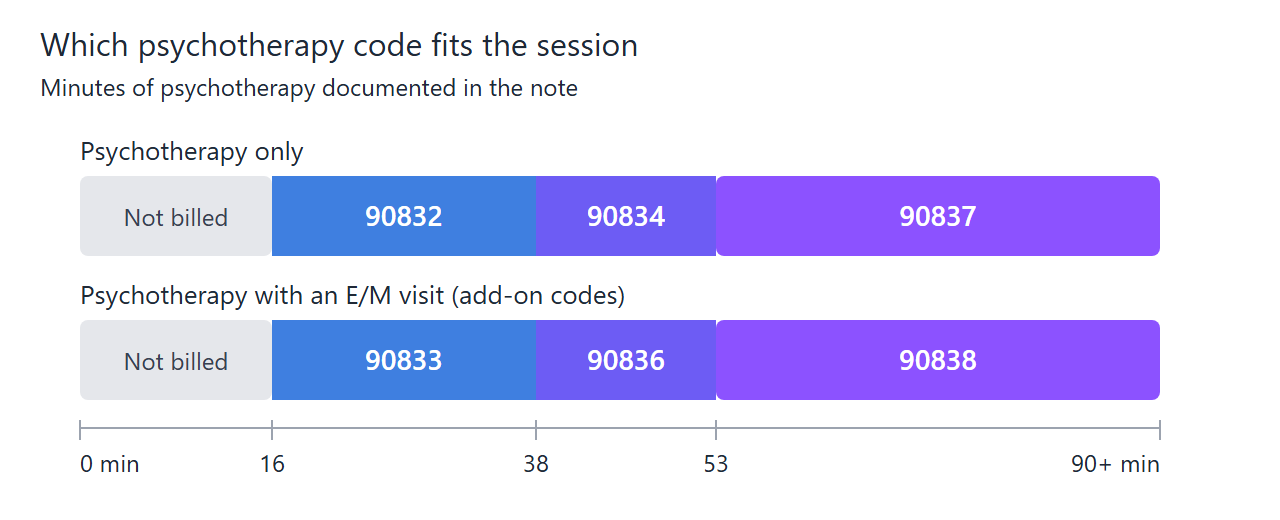
- Psychotherapy codes follow documented time: 90832 for 16 to 37 minutes, 90834 for 38 to 52 and 90837 for 53 or more. The note has to show the time.
- Since January 1, 2024, licensed marriage and family therapists and mental health counselors can bill Medicare directly, at 75% of the clinical psychologist rate.
- Medicare still pays for mental health telehealth in the patient’s home, and CMS says the in-person visit requirement takes effect only after December 31, 2027.
- The federal parity law still applies in 2026. Enforcement of most of the 2024 parity rule is paused, and the Department of Labor says it will focus on medical necessity reviews and network adequacy.
What Does a Mental Health Insurance Billing Service Do?
A full-service mental health billing company takes on every step between booking a client and collecting the last dollar of the session. Services differ in what they include, so use this list to compare them.
| Task | What it involves in a mental health practice |
|---|---|
| Credentialing and enrollment | Joining commercial plans, Medicaid plans and Medicare for each clinician, and keeping those enrollments current |
| Benefits checks | Confirming outpatient mental health benefits, copays, deductibles and visit limits, and which company manages the behavioral health benefit |
| Authorizations | Getting approval or giving notice where a plan requires it, such as for inpatient and specialty outpatient services |
| Coding | Matching each psychotherapy code to the documented time, using add-on codes correctly and reporting telehealth place of service |
| Claims | Sending each claim to the right payer and address, with edits checked before submission |
| Payment posting | Posting insurance and patient payments and checking each payment against the contracted rate |
| Denials and appeals | Correcting and resubmitting denied claims and appealing medical necessity and authorization denials |
| Patient balances | Statements, copay follow-up and good faith estimates for self-pay clients |
| Out-of-network support | Superbills, single case agreements and claims for plans you are not in network with |
Some companies sell only claim submission and leave credentialing, benefits checks and patient balances to you. That can look cheaper per claim and cost more in staff time, so ask for the full list of what is included in writing.
Why Mental Health Claims Need Specialist Billing
Psychotherapy is billed by the minute
Most psychotherapy codes are chosen by the time spent in psychotherapy, not by how complex the session was. A Medicare contractor’s billing article sets out the ranges: 90832 (or add-on 90833 with an E/M visit) for 16 to 37 minutes, 90834 (or 90836) for 38 to 52 minutes, and 90837 (or 90838) for 53 minutes or more. Psychotherapy under 16 minutes is not reported, and start and stop times or total time must be documented (First Coast Service Options, article A57520).
The rules around the core codes matter as much as the ranges:
- Add-on codes go with an E/M visit. When a psychiatrist or nurse practitioner provides medication management and psychotherapy in one visit, the psychotherapy is billed with an add-on code (90833, 90836 or 90838), not a stand-alone code. The two services must be significant and separately identifiable (WPS, article A57480).
- Interactive complexity (90785) is an add-on for sessions where a communication difficulty is present. It cannot be reported with crisis codes, or with an E/M visit when no psychotherapy is reported (same source). It should not be billed if the patient is unable to communicate by any means (A57520).
- Crisis codes (90839 and 90840) stand alone. They may not be reported with 90791, 90792 or 90832 through 90838 (A57480).
If a note does not support the time billed, a payer can reduce the code or take the payment back after an audit. Accurate time documentation is the cheapest protection a practice has.
The payer on the card may not be the payer for therapy
Many health plans hand their behavioral health benefit to a separate company, an arrangement known as a carve-out. That company can run its own network, authorizations and claims system. Optum, which manages behavioral health benefits for many health plans, tells providers that the claims payment address for a medical claim is different from the address for a behavioral health claim (Optum Provider Express). For Cigna Healthcare plans, behavioral health is administered by Evernorth Behavioral Health, which has its own provider portal for eligibility, benefits and claim status (Evernorth).
A billing service that knows these arrangements checks who manages the behavioral health benefit before the first session, not after the first denial.
More clinicians can bill Medicare since 2024
Since January 1, 2024, licensed marriage and family therapists (MFTs) and mental health counselors (MHCs) can bill Medicare Part B directly. Medicare pays them 75% of what it pays a clinical psychologist under the physician fee schedule. Addiction counselors and alcohol and drug counselors who meet the MHC requirements can enroll as MHCs (CMS). Each clinician needs a National Provider Identifier and a Medicare enrollment, usually through PECOS, before the first claim.
Telehealth has its own codes and deadlines
Medicare continues to pay for mental health services delivered by telehealth to patients in their homes. Claims use place of service 10 for telehealth in the patient’s home and 02 for telehealth anywhere else, and since 2024 Medicare pays home telehealth at the non-facility rate. The law requires an in-person visit within 6 months before the first mental health telehealth service. CMS says that requirement takes effect after December 31, 2027, and does not apply to patients who began home telehealth before January 1, 2028. Audio-only visits to the home are allowed through 2027. From 2028, behavioral health visits can still be audio-only when the patient cannot use, or does not consent to, video (CMS Telehealth FAQ, updated February 26, 2026).
Commercial and Medicaid plans set their own telehealth rules, including the place of service and modifiers they expect. A billing service should keep a payer-by-payer list and update it when policies change.
The 2026 Medicare fee schedule spared behavioral health
Medicare’s 2026 physician fee schedule raised the conversion factor to $33.4009 for most clinicians, 3.26% above 2025. It also cut work values by 2.5% for most services that are not time-based. Time-based codes, including behavioral health services, were excluded from that cut (Holland & Knight summary of the CY 2026 final rule, November 2025).
Why So Much Mental Health Care Is Out of Network
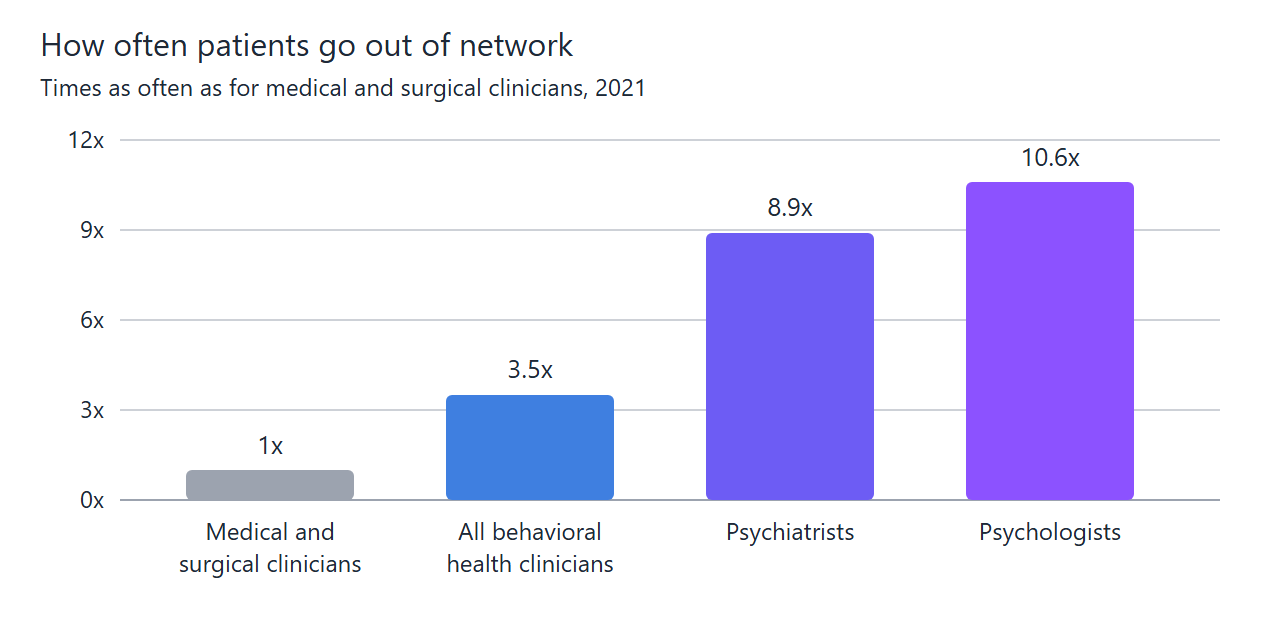
The network gap sits behind many mental health billing problems. The RTI International study, commissioned by the Mental Health Treatment and Research Institute, found that in 2021:
- patients went out of network 3.5 times as often for behavioral health clinicians as for medical and surgical clinicians, 8.9 times as often for psychiatrists and 10.6 times as often for psychologists
- in-network office visits with medical and surgical clinicians paid 22% more on average than office visits with behavioral clinicians, 48% more at the 75th percentile and 70% more at the 95th percentile
Plan directories do not always help. In a secret shopper study of 12 Medicare Advantage plans in six states, Senate Finance Committee staff found that more than 8 in 10 listed mental health providers were inaccurate or not taking new appointments. Staff could make an appointment only 18% of the time (Senate Finance Committee, May 2023).
For a practice, that means two things. First, confirm your own network status with each plan rather than trusting its directory, and keep your listings current. Second, have a process for clients whose plans you are not in: a superbill they can submit themselves, or a single case agreement when the plan has no in-network clinician who can treat them. Our out-of-network billing service handles both.
What Parity Law Means for Your Claims in 2026
The Mental Health Parity and Addiction Equity Act bars most employer health plans and health insurers that cover mental health care from limiting it more strictly than comparable medical and surgical care. The rules that put the law into practice are in flux:
- On May 15, 2025, the Departments of Labor, Health and Human Services and the Treasury paused enforcement of the new parts of the 2024 parity rule. The pause lasts while a court challenge proceeds, plus 18 months. They said the statute, as amended in 2021, still has effect and pointed plans to the 2013 rule (Department of Labor statement).
- On September 8, 2026, the Department of Labor issued Field Assistance Bulletin 2026-03. It focuses enforcement on blanket treatment exclusions, on medical necessity reviews such as prior authorization, and on network admission standards and provider reimbursement. It also says plans must make the clinical criteria behind medical necessity reviews available on request (Field Assistance Bulletin 2026-03).
Parity does not change how you code a claim, but it gives you grounds to push back. When a plan requires prior authorization for routine therapy but not for comparable medical visits, or applies stricter medical necessity reviews to therapy, a parity appeal or complaint is one route. A billing service that works denials for mental health practices should know when to raise it.
Common Mental Health Billing Errors
These are the errors to check first when therapy claims are denied or paid late:
- Billing 90837 without 53 documented minutes. Without start and stop times or total time in the note, the code cannot be supported in an audit.
- Sending the claim to the medical plan. When a separate company manages the behavioral health benefit, the medical plan’s address or payer ID is the wrong one.
- Using the wrong telehealth place of service. Medicare expects 10 for a patient at home and 02 for other locations. Commercial plans set their own rules.
- Billing for a clinician who is not yet credentialed. Sessions seen before a clinician’s enrollment takes effect can be denied or processed as out of network.
- Adding codes that cannot go together. Interactive complexity cannot be reported with crisis codes, and crisis codes cannot be reported with 90791, 90792 or 90832 through 90838.
- Missing an authorization or notification. Plans administered by Optum Behavioral Health, for example, require authorization or notification for specialty outpatient services and most inpatient services (Optum Provider Express). Our prior authorization service tracks these by payer.
- No good faith estimate for self-pay clients. Providers usually must give clients who are not using insurance a good faith estimate. It is due within 1 business day when the service is scheduled 3 to 9 business days ahead, and within 3 business days when it is scheduled further out (CMS).
In-House, Billing Service or Insurance Platform?
Therapists have three realistic ways to handle insurance, and each trades cost against control.
| Option | How it works | Fits best when | Watch for |
|---|---|---|---|
| Billing in-house | You or your staff handle credentialing, claims and follow-up in your own practice management system | You have a small caseload with few payers, or an experienced biller on staff | Time taken from clinical work, and payer rule changes nobody is tracking |
| Mental health billing service | A company works the claims under your own payer contracts, NPI and tax ID, often for a percentage of collections | You want to keep your own contracts and rates without doing the billing work | What the fee covers, contract length and how you get your data back |
| Insurance platform, such as Headway | The platform negotiates contracts with health plans, sets your session rates, handles credentialing and claims, and pays you every two weeks while keeping part of each session payment | You want to start taking insurance quickly without contracting with each plan yourself | The rates come from the platform’s contracts, so ask what happens to your network status if you leave |
Headway describes its model on its own site: it negotiates rates with health plans, keeps a percentage of session payments, and pays providers every two weeks whether or not the plan has paid it yet (Headway, June 2024). A billing service suits practices that want to own their payer contracts and negotiate their own rates as they grow. A platform suits clinicians who value speed over control.
Questions to Ask a Mental Health Billing Service
Ask every company on your shortlist the same questions and compare the written answers:
- Which behavioral health payers do you bill every week, including the Medicaid plans and behavioral health companies in my state?
- Is credentialing included, and who keeps my payer enrollments and re-credentialing current?
- How do you find out who manages a client’s behavioral health benefit before the first session?
- How do you track telehealth rules for each payer?
- What does the fee include, what counts as collections, and are there setup fees or minimums? Our guide to medical billing pricing lists the terms to check.
- What will you report each month? Ask for the denial rate, days in accounts receivable and collections by payer.
- Will you sign a business associate agreement, and how do we get our data back if we leave?
Where Summit Billing Solutions Fits
Summit Billing Solutions bills for psychiatry and mental health practices, two of the specialties we support. We handle credentialing, benefits checks, authorizations, claims, denials and patient statements, and we manage superbills and single case agreements for clinicians who are out of network by choice. Our US-based team works inside your existing software, our fee is 3% to 9% of monthly collections, and the agreement is month to month.
Want to know which therapy claims are being denied, and why?
Our free account review looks at your denials, aging A/R and top denying payers, whether or not you go further with us. You can also contact our team with a behavioral health billing question.
How We Researched This Guide
We checked every rule, date and figure in this guide against a primary or authoritative source on September 30, 2026. Those include CMS guidance, Medicare contractors’ billing articles, Department of Labor parity statements, the RTI International study, the Senate Finance Committee’s secret shopper study, and payers’ and Headway’s own provider pages. Commercial plan rules vary by plan and state, so confirm the details with each payer before changing how you bill.
Frequently Asked Questions About Mental Health Insurance Billing
1. How much do mental health billing services cost?
Many charge a percentage of the payments they collect for you. Summit’s fee is 3% to 9% of monthly collections. Compare what each service includes as well as the rate, because credentialing, patient statements and out-of-network work are sometimes priced separately.
2. What is the difference between 90834 and 90837?
Time. Under Medicare contractor guidance, 90834 covers 38 to 52 minutes of psychotherapy and 90837 covers 53 minutes or more. Document start and stop times or total time so the note supports the code.
3. Can licensed professional counselors bill Medicare?
Yes. Since January 1, 2024, counselors who meet Medicare’s mental health counselor requirements can enroll and bill Medicare directly, and Medicare pays them 75% of the clinical psychologist rate. Licensed marriage and family therapists can enroll on the same terms.
4. Can I bill insurance for teletherapy sessions?
Usually, yes. Medicare pays for mental health telehealth to patients at home, billed with place of service 10, and its in-person visit requirement does not take effect until after 2027. Commercial and Medicaid plans set their own telehealth rules, so check each plan’s policy.
5. Should I use a billing service or a platform like Headway?
Use a billing service if you want your own payer contracts and rates. A platform can get you taking insurance faster, but it negotiates the contracts and sets the rates. Some clinicians start on a platform and move to their own contracts with a billing service as the practice grows.
The Bottom Line
Mental health billing looks simple from the outside: a handful of codes and one kind of visit. The money is lost in the details. Before you decide how to bill:
- Match every psychotherapy code to documented time.
- Check who manages each client’s behavioral health benefit before the first session.
- Enroll every eligible clinician, including counselors and marriage and family therapists for Medicare.
- Keep a payer-by-payer list of telehealth rules, and plan for Medicare’s in-person requirement after 2027.
- Use parity rules in appeals when a plan limits therapy more than comparable medical care.
A billing partner that handles these every day turns fewer sessions into write-offs.