


G0463 is the HCPCS code a hospital uses to bill the facility side of an outpatient clinic visit. Its full descriptor is “Hospital outpatient clinic visit for assessment and management of a patient.” It is not a physician code, and it has no levels. One code covers every clinic visit the hospital bills under Medicare’s Outpatient Prospective Payment System (OPPS), short or long, new patient or established.
It is also the most billed service under the OPPS. CMS uses its payment group, APC 5012, as the anchor for every other OPPS payment weight (HFMA summary of the CY 2026 OPPS final rule, December 2025). That makes it one of the most consequential codes in hospital billing, and one of the easiest to get wrong. The code itself is simple. The modifiers, the location of the clinic and the matching physician claim are where the money moves.
This guide explains what G0463 covers, who bills it, how Medicare pays it in each setting in 2026, and the errors that cost hospitals and physician practices money. If you are new to how facility and professional billing fit together, our guide to POS 22 in medical billing covers the on-campus side of the same visit.
Key Takeaways
- G0463 is the hospital’s facility code for an outpatient clinic visit. Since January 1, 2014 it has replaced CPT codes 99201-99205 and 99211-99215 for OPPS payment.
- One clinic visit usually creates two claims. The hospital bills G0463 on the institutional claim. The physician bills an E/M code on the professional claim with place of service 19 or 22.
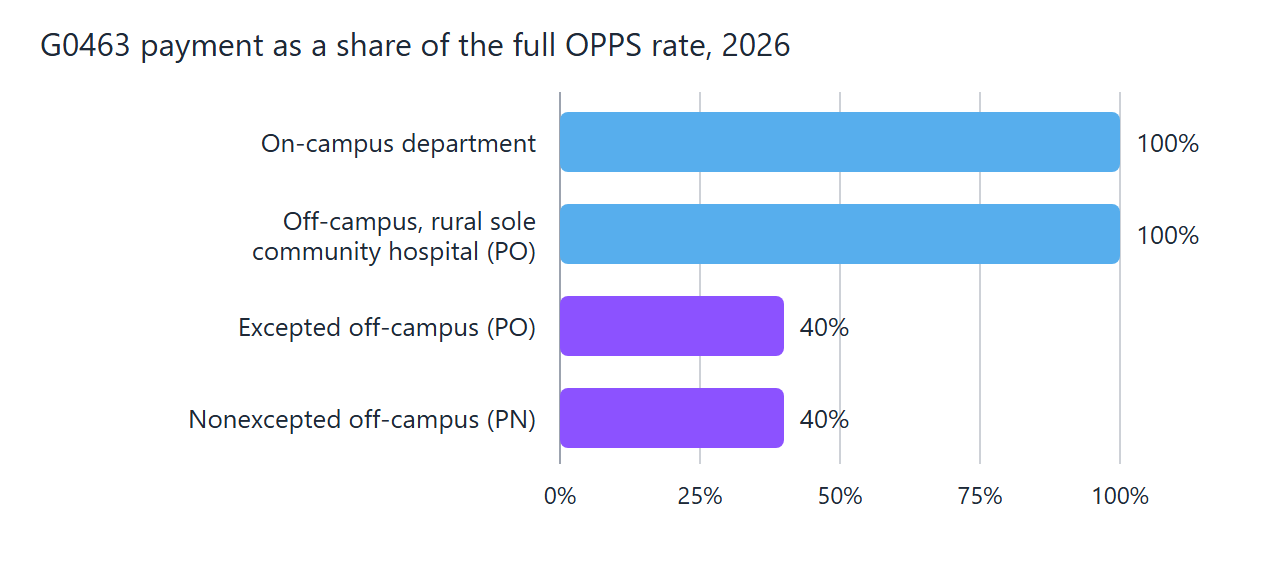
- Location drives payment. On-campus clinics get the full OPPS rate, while most off-campus departments are paid 40% of it, reported with modifier PO or PN.
- Excepted off-campus departments of rural sole community hospitals have been paid the full OPPS rate since 2023.
- CMS extended the same site-neutral approach to drug administration in 2026, has proposed adding imaging without contrast for 2027, and has asked for comments on on-campus clinic visits.
What Is G0463?
G0463 is a Level II HCPCS code, not a CPT code, although it is often searched as “CPT G0463.” CMS created it for the January 2014 OPPS update. From January 1, 2014, Medicare pays hospital clinic visits under the OPPS only through G0463. CPT codes 99201-99205 and 99211-99215 stopped being recognized for OPPS payment that day (CMS Transmittal 2845, December 27, 2013).
Three things follow from that change:
- There is only one visit level. A hospital no longer chooses between five levels, or between new and established patients, on its Medicare facility claim. The same code, and the same payment group, covers every clinic visit.
- It is only for clinic visits. Emergency department visits keep their own codes: 99281-99285 for Type A departments and G0380-G0384 for Type B departments (CMS Claims Processing Manual, chapter 4).
- It is only for hospitals. G0463 belongs on the hospital outpatient department’s claim. The physician who sees the patient does not bill it.
Who Bills G0463, and What Goes on the Physician Claim?
A visit to a hospital outpatient clinic usually produces two claims for the same encounter. The hospital bills for the room, staff and supplies. The physician or other practitioner bills for the professional service.
| Facility claim | Professional claim | |
|---|---|---|
| Who bills it | The hospital outpatient department | The physician or other practitioner |
| Claim form | Institutional claim (UB-04 / 837I) | Professional claim (CMS-1500 / 837P) |
| Visit code | G0463 | E/M code, such as 99202-99215 |
| Location reported | Revenue code 0510 (clinic), plus modifier PO or PN if off campus | Place of service 19 (off campus) or 22 (on campus) |
| Paid under | Outpatient Prospective Payment System | Physician Fee Schedule, at the facility rate |
The place of service code on the professional claim has to match where the visit happened. CMS defines place of service 19 as an off-campus hospital provider-based department and place of service 22 as a portion of the hospital’s main campus (CMS place of service code set). Place of service 11, the physician office, is wrong for a visit in a hospital clinic even when the clinic feels like an office.
That mistake is costly. The HHS Office of Inspector General found this error across the country. It estimated potential overpayments to physicians of about $33.4 million from January 2010 through September 2012, for services performed in hospital outpatient departments and surgery centers but coded with nonfacility places of service (HHS OIG report A-01-13-00506, May 2015). Overpayments like these are recouped later, usually with interest.
The two claims also mean two bills for the patient. Medicare beneficiaries usually pay 20% of the Medicare-approved amount for the doctor’s services, plus a copayment to the hospital for each outpatient service. Medicare also tells patients they may pay more in a hospital outpatient setting than for the same care in a doctor’s office (Medicare.gov). If your front desk takes those calls, a short script explaining the facility charge saves a lot of confused phone time.
How Medicare Pays G0463 in 2026
Medicare pays G0463 through APC 5012, and the rate depends on where the clinic sits and when it started billing. The CY 2026 OPPS conversion factor is $90.970 for most hospitals. CMS publishes each code’s national payment rate in OPPS Addendum B, and your Medicare administrative contractor adjusts it for your area’s wage index (HFMA summary; CMS-1834-FC).
- On-campus departments bill G0463 with no location modifier and receive the full OPPS rate. A department on the main campus, or within 250 yards of it, counts as on campus. Neither the PO nor the PN modifier applies there (CMS Claims Processing Manual, chapter 4).
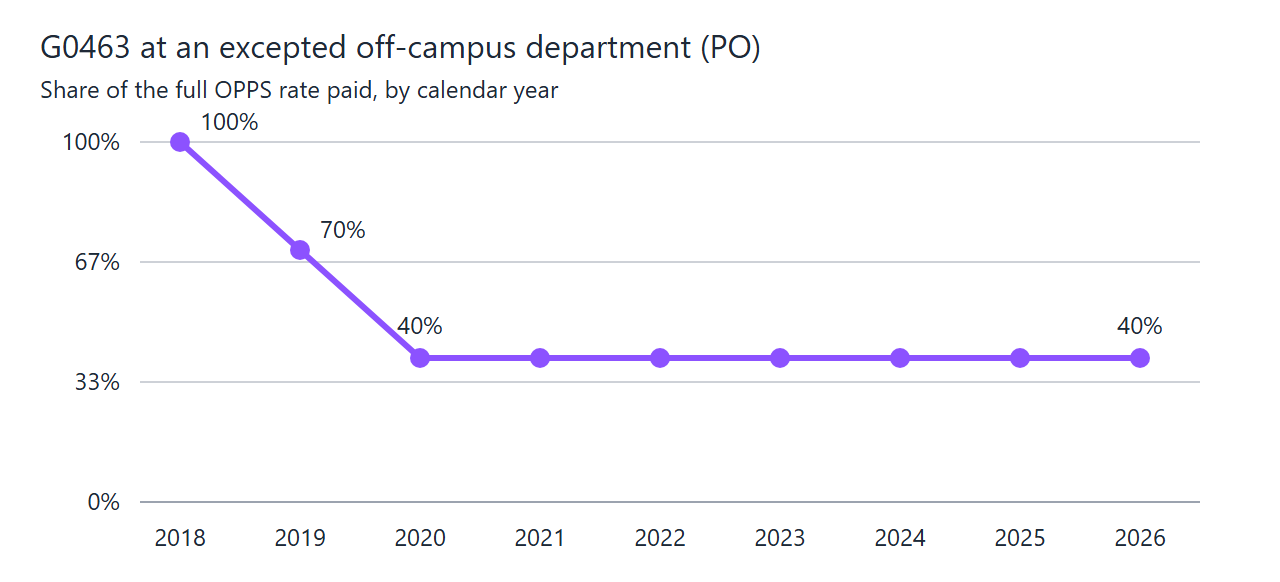
- Excepted off-campus departments bill G0463 with modifier PO. Since 2020, their clinic visits have been paid a physician fee schedule equivalent rate: 40% of the OPPS rate. A two-year phase-in paid 70% in 2019 (same source).
- Excepted off-campus departments of rural sole community hospitals still report modifier PO, but CMS has paid them the full OPPS rate since 2023 (Holland & Knight on the CY 2023 OPPS final rule, November 2022).
- Nonexcepted off-campus departments report modifier PN and are paid 40% of the OPPS rate. These are generally departments that began billing Medicare after November 2, 2015, and the rule comes from section 603 of the Bipartisan Budget Act of 2015 (HFMA summary).
The 40% rate has survived a court challenge. The American Hospital Association sued over the 2019 cut. The U.S. Court of Appeals for the D.C. Circuit upheld it in 2020, holding that “a service-specific, non-budget-neutral rate reduction falls comfortably within” CMS’s authority to control unnecessary increases in the volume of outpatient services (HFMA summary, citing 964 F.3d 1230).
Modifiers That Change How G0463 Pays
Most G0463 payment errors come from modifiers, not from the code itself.
- PO marks items and services from an excepted off-campus provider-based department. Reporting it has been mandatory since January 1, 2016.
- PN marks nonexcepted items and services from an off-campus department. CMS expects it on every nonexcepted line, including lines whose payment it does not adjust.
- Never both on one line. If a claim mixes services from an excepted and a nonexcepted department, PO goes on the excepted lines and PN on the nonexcepted lines. Neither modifier belongs on a claim from a dedicated emergency department or an on-campus department (CMS Claims Processing Manual, chapter 4, sections 20.6.11 and 20.6.12).
- Modifier 25 applies when the hospital bills a visit on the same day as a procedure or drug administration. CMS tells hospitals to add modifier 25 only when the visit is a significant, separately identifiable service (same source, drug administration billing). If the visit only covers the usual assessment that goes with the procedure, it is not billed separately. Our guide to modifier 24 vs 25 covers the professional side of the same rule.
Common G0463 Billing Errors
These are the errors we would check first on any claims that involve hospital outpatient clinic visits:
- Missing PO or PN on an off-campus claim. Without the modifier, an off-campus visit can be priced as an on-campus visit, which is an overpayment waiting to be found.
- CPT E/M codes on the Medicare facility claim. Medicare stopped recognizing 99201-99215 for OPPS payment in 2014, so the hospital’s Medicare claim needs G0463.
- G0463 on the physician’s claim. The professional claim takes an E/M code. G0463 describes only the hospital’s facility service.
- Place of service 11 on the professional claim. Office place of service on a hospital clinic visit pays the higher nonfacility rate and invites recoupment, as the OIG findings above show.
- Assuming every payer follows Medicare. Commercial and Medicare Advantage contracts vary. HealthSpring, for example, stopped denying facility claims billed with G0463 on January 1, 2026. It now pays clinic facility claims billed with revenue codes 0510-0519 or 0520-0529 (HealthSpring provider update, January 2026). Check each contract before you assume a code will pay.
A medical billing audit that samples these claims against the notes is the fastest way to find which of these errors you have, and how much they have cost.
What Is Changing Next for G0463?
The clinic visit was the first service CMS moved to site-neutral payment, and it is no longer the last. For 2026, CMS extended the same physician fee schedule equivalent payment to drug administration services in excepted off-campus departments, again exempting rural sole community hospitals. In the same rule, CMS asked for comments on expanding the policy to on-campus clinic visits, to be considered in future rulemaking (California Hospital Association summary of the CY 2026 OPPS final rule).
The CY 2027 proposed rule, released on July 2, 2026, would add imaging without contrast in excepted off-campus departments. CMS estimates that would cut Medicare Part B spending by about $260 million in the first year (CMS fact sheet). On-campus clinic visits are not part of that proposal. If CMS ever applies the 40% rate on campus, G0463 would be the code it touches first, so hospital-affiliated practices should watch each year’s final rule.
Where Summit Billing Solutions Fits
If your physicians see patients in hospital outpatient clinics, the professional claim is yours even though the facility claim is the hospital’s. Summit Billing Solutions codes and bills those professional claims for physician practices. We check the E/M level, place of service and modifiers through our medical coding services and wider revenue cycle management.
Want to know whether place of service and modifier errors are costing your practice?
Our free account review looks at your denials, aging A/R and top denying payers, whether or not you go further with us. You can also contact our team with a coding question.
How We Researched This Guide
We checked every rule, date and percentage in this guide against a primary or authoritative source on September 30, 2026. Those include CMS transmittals, the Medicare Claims Processing Manual, CMS fact sheets and the place of service code set. We also used an HHS OIG audit, Medicare.gov, a payer’s published update, and HFMA and California Hospital Association summaries of the CY 2026 OPPS final rule. We did not quote a dollar payment rate for G0463 because CMS publishes it in Addendum B, and each hospital’s rate also depends on its wage index. Confirm current rules with your Medicare administrative contractor before changing your billing.
Frequently Asked Questions About G0463
1. Is G0463 a CPT code?
No. G0463 is a Level II HCPCS code created by CMS. CPT codes are five-digit numeric codes maintained by the American Medical Association, while G codes like G0463 are maintained by CMS.
2. Can a physician bill G0463?
No. G0463 is the hospital’s facility code. The physician bills an E/M code such as 99213 on the professional claim, with place of service 19 or 22.
3. Does G0463 have levels like 99212 through 99215?
No. One code covers every hospital outpatient clinic visit on the Medicare facility claim, which is why CMS eliminated the new and established patient distinction for facility billing in 2014.
4. What revenue code goes with G0463?
Hospitals usually report G0463 with revenue code 0510, clinic. Payers can accept other clinic revenue codes; HealthSpring, for example, lists 0510-0519 and 0520-0529 for clinic facility claims.
5. Why did our off-campus clinic’s G0463 payment drop?
Most likely because the department reports modifier PO or PN. Since 2020, Medicare has paid clinic visits in most off-campus departments at 40% of the OPPS rate. Excepted off-campus departments of rural sole community hospitals are the exception and are paid the full rate.
The Bottom Line
G0463 is one code with many ways to go wrong. Before you bill a hospital outpatient clinic visit:
- Put G0463 on the hospital’s facility claim and an E/M code on the physician’s claim.
- Report place of service 19 or 22 on the professional claim, never 11.
- Add PO or PN to off-campus facility claims, and never both on one line.
- Use modifier 25 only when the visit is significant and separately identifiable from a same-day procedure.
- Check each commercial and Medicare Advantage contract, and watch each year’s OPPS rule for site-neutral changes.
Getting these right protects the facility payment, the professional payment and the patient’s trust in the bill.