

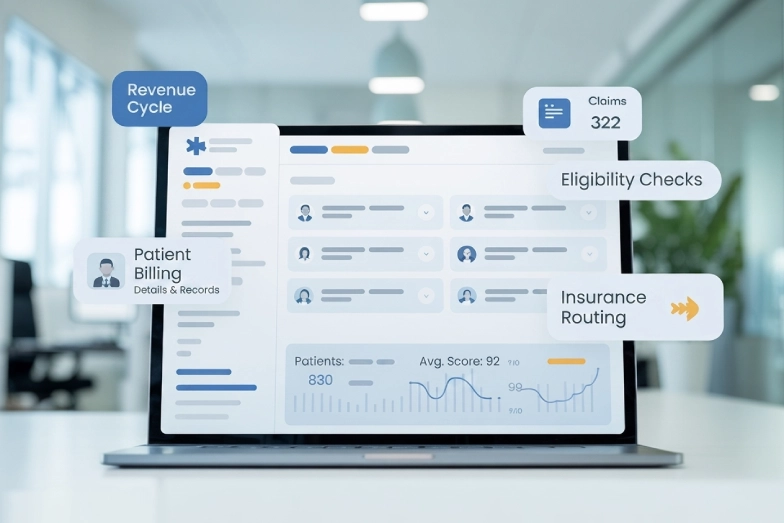
Quick Answer: What Is the Best Clearinghouse for Medical Billing?
The best clearinghouse for medical billing is the one that helps your practice submit cleaner claims, confirm eligibility faster, identify errors before payer submission, integrate with your EHR or practice management system, and give your billing team clear visibility into rejections, denials, ERAs, and claim status.
For many practices, the strongest options to compare include Availity, Waystar, Optum Change Healthcare, TriZetto Provider Solutions, Experian Health, Office Ally, Claim.MD, and AdvancedMD’s integrated clearinghouse tools. Each platform has a different strength. Some are better for large provider groups, some are better for small practices, some are better for transparent pricing, and some work best when they are already built into your medical billing software.
A clearinghouse is not just a claim submission tool. Under HIPAA Administrative Simplification, electronic healthcare transactions follow adopted standards such as ASC X12 Version 5010, and clearinghouses are part of the covered entity environment that helps standardize the flow of healthcare data between providers and payers.
The real question is not only, “Which clearinghouse is the best?” The better question is, “Which clearinghouse is the best fit for my specialty, payer mix, claim volume, EHR system, denial patterns, and billing workflow?”
That is where practices often make the wrong decision. They compare names instead of performance. They compare pricing instead of total revenue impact. They compare software features instead of asking whether claims are actually getting accepted, paid, posted, and followed up correctly.
Why Choosing the Best Clearinghouse Matters
A medical billing clearinghouse acts as the bridge between healthcare providers and insurance payers. Instead of sending claims one by one to each payer, a practice submits claims through a clearinghouse, which checks formatting, validates required data, routes claims to the correct payer, and returns acknowledgments, rejections, claim status updates, and remittance information.
Experian Health describes this process as checking each claim before it reaches the payer, scrubbing for errors and omissions, reformatting data to meet payer requirements, and transmitting the electronic claim, often the 837 file, to the correct commercial or government payer.
That matters because the first version of a claim is usually the most important version. If the claim goes out with missing information, payer-specific formatting issues, invalid subscriber details, mismatched modifiers, incorrect NPI information, or incomplete authorization data, your team may not find out until days or weeks later. By then, the revenue cycle is already delayed.
A strong clearinghouse helps reduce that risk. It gives your billing team a better chance to catch errors earlier, resubmit faster, and avoid turning preventable rejections into aging AR.
This is also why clearinghouse selection should be treated as a revenue cycle decision, not just a software decision. A cheaper clearinghouse can become expensive if it creates more manual work. A powerful clearinghouse can still be the wrong fit if your billing team does not know how to use its reports. A large clearinghouse can still create risk if your practice has no backup plan when connectivity is disrupted.
The 2024 Change Healthcare cyberattack showed how dependent many providers had become on a single claims infrastructure. Reuters reported that Change Healthcare handled approximately 50% of medical claims in the United States at the time of the disruption, affecting physicians, pharmacies, hospitals, and laboratories.
That event changed how many practices think about clearinghouses. Reliability is no longer only about uptime. It is also about redundancy, support, visibility, payer connectivity, and how quickly your practice can keep claims moving when something goes wrong.
What a Medical Billing Clearinghouse Actually Does
A clearinghouse usually helps with several core billing functions:
- Claim submission
- Claim scrubbing
- Payer routing
- Eligibility and benefits transactions
- Claim status checks
- Electronic remittance advice
- Rejection reporting
- Claim corrections and resubmissions
- Attachments, depending on payer support
- Reporting and workflow visibility
CMS lists adopted standards and operating rules for electronic healthcare transactions under HIPAA Administrative Simplification, including standardized formats used across electronic healthcare data exchange.
For a provider office, this standardization is helpful because every payer has its own rules, but your billing team still needs one organized way to submit, track, correct, and reconcile claims.
A clearinghouse can make the process easier, but it does not replace billing expertise. It can flag missing data, formatting errors, payer ID issues, or eligibility mismatches. It cannot always determine whether the documentation supports the code, whether the payer policy was applied correctly, whether a denial should be appealed, or whether your front desk workflow is creating repeat eligibility problems.
That is why the best clearinghouse is only one part of a healthy revenue cycle.
Best Medical Billing Clearinghouses to Compare
Below is a practical comparison of leading clearinghouse options. This is not a universal ranking because the best choice depends on your practice size, specialty, payer mix, billing software, and operational needs.
| Clearinghouse | Best Fit | Notable Strength | Watch For |
|---|---|---|---|
| Availity | Practices needing broad payer connectivity and eligibility workflows | National-scale transaction connectivity across eligibility, authorizations, claims, payments, and related workflows | Pricing and feature access may vary based on setup and payer needs |
| Waystar | Groups that want advanced claims management and automation | AI-enabled claim management, automation, analytics, and workflow tools | May be more platform than a very small practice needs |
| Optum Change Healthcare | Organizations needing large-scale network reach | Historically one of the largest claim networks in the U.S. | Practices should consider backup routing after past industry disruption |
| TriZetto Provider Solutions | Practices focused on payer acceptance and RCM support | TriZetto reports a 98% average payer acceptance rate for clients | Confirm EHR integration, support model, and specialty fit |
| Experian Health | Organizations wanting claims management plus revenue cycle analytics | ClaimSource performs edits, error checking, outbound formatting, and payer submission | May be best for practices that need broader RCM tooling |
| Office Ally | Cost-sensitive small practices and independent billers | Public pricing information and payer list tools are available | Fees can vary by transaction type, payer, attachments, and non-par rules |
| Claim.MD | Small to mid-sized practices wanting transparent pricing | Public pricing tiers, real-time validation, claim tracking, ERA, and eligibility features | Confirm payer coverage and EHR compatibility before switching |
| AdvancedMD Clearinghouse | Practices already using or considering AdvancedMD | Integrated clearinghouse tools connect with claims workflows and many carriers | Strongest fit is usually within the AdvancedMD ecosystem |
Availity says its clearinghouse solution provides national-scale transaction connectivity and processing across eligibility, authorization, claims, payments, and related administrative workflows. Waystar describes its Claim Manager as part of a unified healthcare payments platform using automation, AI capabilities, and data to streamline workflows and reduce cost to collect. TriZetto Provider Solutions reports a 98% average payer acceptance rate for its clients and promotes claims management solutions focused on clean claims.
Experian Health’s ClaimSource product performs customizable edits and error checking before submission, formats outbound claims, and submits claims to payers. Office Ally publishes payer list tools and pricing details for transaction types such as eligibility, attachments, claim submission, acknowledgments, and claim status. Claim.MD publishes pricing tiers and describes tools for claim creation, upload, validation, tracking, ERAs, eligibility, and real-time correction workflows.
Is Availity Considered a Clearinghouse?
Yes. Availity is considered a healthcare clearinghouse and transaction network. Its official clearinghouse page describes the Availity Clearinghouse Solution as a national-scale transaction connectivity and processing solution for eligibility, authorization, claims, payments, and related workflows.
Availity is often known by providers because many payer portals, eligibility checks, and authorization workflows touch the Availity ecosystem. For practices that work with multiple commercial payers, Availity may already be part of the administrative workflow even if the practice does not think of it first as a claims clearinghouse.
The key question is whether Availity is the right clearinghouse for your claim submission needs, not whether it qualifies as one. A practice should confirm:
- Does it connect with your specific EHR or practice management system?
- Does it support your highest-volume payers?
- Does it handle the transactions you need, such as 837 claims, 835 ERAs, 270/271 eligibility, 276/277 claim status, and attachments where applicable?
- Does your team understand how to work rejections inside the platform?
- Does it provide reporting that helps prevent repeat errors?
For some practices, Availity is a strong fit. For others, it may be one piece of a larger billing workflow.
What Are the Largest Medical Billing Clearinghouses?
The largest and most recognized clearinghouse networks usually include Availity, Optum Change Healthcare, Waystar, TriZetto Provider Solutions, Experian Health, and other national RCM technology vendors. However, “largest” is not always the same as “best.”
A large clearinghouse may offer broad payer connectivity and mature infrastructure. That can be valuable for multi-specialty groups, hospitals, and billing companies that need to manage many payers across many providers. But a smaller practice may care more about pricing transparency, ease of use, direct support, EHR integration, and how quickly rejections can be corrected.
Optum Change Healthcare has historically been one of the most significant players in the claims transaction space, with Reuters reporting that it handled about half of U.S. medical claims at the time of the 2024 cyberattack. Availity also positions itself as a leading healthcare intelligence network connecting payers, providers, and healthcare IT vendors nationwide.
Large networks matter, but they should not be your only selection criteria. A clearinghouse that connects to 2,000 payers is not automatically better for your practice if your top 12 payers create 90% of your revenue and the clearinghouse does not handle those payer workflows well.
The Best Clearinghouse Depends on Your Practice Type
A solo therapist, a dermatology group, an urgent care center, and a multi-location physician practice do not need the exact same clearinghouse setup.
A small physician office may prioritize simplicity. They need eligibility checks, clean claim submission, easy rejection correction, affordable pricing, and responsive support. Claim.MD, Office Ally, or an integrated clearinghouse inside their billing software may be enough.
A growing specialty practice may need better reporting, payer-specific edits, ERA workflows, denial visibility, and stronger EHR integration. Waystar, TriZetto, Experian Health, Availity, or AdvancedMD may make more sense depending on the practice’s software stack.
A large group or enterprise organization may need advanced automation, multi-site reporting, high transaction volume support, payer analytics, denial trend visibility, and more formal implementation support. In that case, national platforms like Waystar, Optum Change Healthcare, Availity, Experian Health, or TriZetto may be more realistic options.
A medical billing company may need flexibility across many specialties and billing systems. They may prioritize payer coverage, batch upload workflows, rejection queues, reporting, ERA management, client-level segmentation, and support response times.
This is why there is no single best clearinghouse for every provider. The right choice depends on how your revenue cycle actually works.
What Features Should You Look For?
The best clearinghouse for medical billing should help your practice improve speed, accuracy, visibility, and control. Here are the features that matter most.
1. Strong Claim Scrubbing
Claim scrubbing should catch obvious errors before claims reach the payer. This includes missing member IDs, invalid payer IDs, incomplete demographics, date issues, NPI problems, taxonomy mismatches, required modifiers, and payer-specific formatting issues.
Experian Health notes that clearinghouses help check claims before payer submission, scrub for errors and omissions, and format data for payer requirements.
Good claim scrubbing does not eliminate every denial, but it can reduce preventable rejections. That alone can improve cash flow because your team spends less time fixing claims that should never have left the system.
2. Payer Connectivity That Matches Your Revenue
Do not choose a clearinghouse based only on the total number of payers it advertises. Choose based on whether it supports your actual payer mix.
Before signing, list your top payers by claim volume and collections. Then confirm whether the clearinghouse supports professional claims, institutional claims if needed, eligibility, ERA, secondary claims, claim status, and attachments for those payers.
Claim.MD and Office Ally both provide payer list tools that let users check payer IDs and supported transaction types.
3. EHR and Practice Management Integration
The clearinghouse should work smoothly with the system your team already uses. If your EHR or practice management system requires workarounds, duplicate data entry, file exports, or manual uploads, the clearinghouse may create more work than it saves.
TriZetto says its solution offers connectivity with 650 EHR and practice management systems. AdvancedMD promotes an integrated clearinghouse that automatically scrubs claims, submits them through a single portal, and tracks them with an integrated claim adjudication log.
Integration matters because billing errors often happen at handoff points. If your front desk, clinical documentation, charge entry, clearinghouse, ERA posting, and denial management workflows do not connect cleanly, claims can fall through the cracks.
4. Rejection Visibility and Fast Correction
A clearinghouse should make rejections easy to find, understand, correct, and resubmit. If your team has to dig through long reports, unclear codes, or multiple portals, claims will sit too long.
Claim.MD describes workflows where failed payer-specific edits can be corrected, rejected claims can be edited and resubmitted in real time, and support tickets can include transaction history.
This type of visibility is important because clearinghouse rejections are usually easier to fix than payer denials. The faster your team works them, the faster the claim can get back into the revenue cycle.
5. Eligibility and Benefits Verification
Eligibility verification is one of the most important front-end billing functions. If the patient’s coverage is inactive, the wrong payer is billed, the plan requires authorization, or the deductible information is not reviewed, the claim may be delayed or denied.
Availity promotes eligibility and coverage workflows for providers, including verification of patient eligibility and coverage information. Office Ally also lists real-time eligibility and coverage details as part of its product pricing page.
A strong clearinghouse should support eligibility checks, but your practice still needs a process for using the information correctly before the visit.
6. ERA and Payment Posting Support
Electronic remittance advice helps your team understand how a payer adjudicated a claim. It supports faster payment posting, better denial tracking, and cleaner patient balance workflows.
If your clearinghouse supports ERA but your billing workflow does not post and reconcile it correctly, you may still have inaccurate AR. The clearinghouse can deliver the data, but your team needs to manage the outcome.
7. Transparent Pricing
Pricing can vary by vendor, payer, transaction type, feature package, implementation, claim volume, and integrations. Practices should look beyond the monthly subscription and ask about:
- Claim submission fees
- Eligibility transaction fees
- ERA fees
- Attachment fees
- Setup fees
- Provider enrollment fees
- Payer enrollment fees
- Non-par payer fees
- Support fees
- Contract terms
Claim.MD publishes plans such as Basic, Small Volume, and Unlimited, with listed monthly pricing and included transaction volumes. Office Ally publishes pricing for several transaction categories and notes certain fee changes effective June 1, 2026.
The lowest monthly price is not always the lowest total cost. If a low-cost option causes more manual work, slower posting, or missed rejections, the real cost may show up in AR.
Need Help Choosing the Right Clearinghouse?
Summit Billing Solutions helps practices review billing workflows, payer mix, claim issues, and clearinghouse performance so you can make smarter revenue cycle decisions without guessing.
Which Clearinghouse Offers the Fastest Claim Processing?
No clearinghouse can honestly guarantee that every claim will be paid faster because payer adjudication, provider enrollment, eligibility, coding, documentation, authorization, and payer policy all affect payment speed.
A clearinghouse can speed up the part of the process it controls: claim validation, formatting, routing, acknowledgments, rejections, and resubmission workflows.
The fastest option for your practice is usually the one that does four things well:
- Finds errors before payer submission
- Returns rejection information quickly
- Makes corrections simple
- Connects cleanly with your billing system and payers
Waystar positions its Claim Manager around cleaner claims, fewer denials, automation, and faster revenue cycle workflows. Claim.MD promotes fast EDI transactions, real-time validation, claim tracking, and claim correction workflows.
For practical purposes, practices should measure speed using internal KPIs:
- Claim submission lag
- Clearinghouse rejection rate
- Average time to correct rejected claims
- First-pass acceptance rate
- Days in AR
- Percentage of claims over 30, 60, and 90 days
- ERA posting lag
- Denial rate by payer and reason
The best clearinghouse is the one that improves these numbers in your actual environment.
How to Select the Ideal Clearinghouse for a Small Physician Office
Small physician offices usually do not need the most complex platform. They need a clearinghouse that is affordable, easy to use, connected to the right payers, and simple for staff to manage.
Here is a practical selection process:
Step 1: Identify Your Top Payers
Pull the last 6 to 12 months of claims or collections. Identify the payers that drive most of your revenue. Your clearinghouse must work well with those payers first.
Step 2: Confirm Your EHR or Billing Software Compatibility
Ask your software vendor which clearinghouses are supported. If your system already has a preferred clearinghouse integration, that may reduce implementation work.
Step 3: Compare Transaction Support
Make sure the clearinghouse supports the transactions your office needs, such as claims, eligibility, ERA, claim status, secondary claims, and attachments.
Step 4: Test Rejection Workflows
Ask for a demo of how rejections appear, how corrections are made, and how claims are resubmitted. The rejection workflow should be clear enough for your billing team to use daily.
Step 5: Ask About Enrollment Requirements
Some payers require enrollment before electronic claims or ERAs can flow through the clearinghouse. This can affect your go-live timeline.
Step 6: Review Total Cost
Do not only compare the monthly fee. Ask about transaction fees, payer fees, attachment fees, setup fees, and support fees.
Step 7: Create a Backup Plan
Ask what happens if the clearinghouse or a payer connection goes down. Your practice should know whether alternative claim routing is available.
This is especially important after the healthcare industry saw how a major claims network disruption could affect cash flow across thousands of organizations.
Medical Billing Software vs. Clearinghouse: What Is the Difference?
Medical billing software helps your practice manage billing tasks. A clearinghouse helps transmit and validate electronic claim transactions between providers and payers.
Medical billing software may include charge entry, patient accounts, claim creation, payment posting, reporting, denial management, scheduling, and practice management features. A clearinghouse usually focuses on electronic transactions, payer routing, claim validation, acknowledgments, ERAs, and claim status workflows.
Some platforms combine both. AdvancedMD, for example, promotes medical billing software with claims management, clearinghouse, and collections functionality. AdvancedMD also announced in 2025 that it became a multi-clearinghouse platform through a partnership with Waystar, giving providers an alternative to Change Healthcare.
When people ask, “What is the most used medical billing software?” they are often mixing two questions:
- What EHR or practice management system do most providers use?
- What clearinghouse do those systems use to submit claims?
In ambulatory EHR market share, Definitive Healthcare reported that Epic had the highest ambulatory EHR market share, followed by eClinicalWorks and athenahealth. But that does not automatically answer which clearinghouse is best for your practice. A practice can use one EHR, a separate practice management system, and a different clearinghouse connection.
The important point is compatibility. The best clearinghouse for your practice should fit your billing software, not force your team into unnecessary extra steps.
How to Compare Clearinghouse Pricing
Clearinghouse pricing can be simple or complicated depending on the vendor. Some publish transparent pricing. Others use custom quotes based on volume, provider count, transaction types, and platform features.
For small practices, transparent pricing can be attractive because it makes budgeting easier. Claim.MD publicly lists plan options such as Basic, Small Volume, and Unlimited, with monthly pricing and included claims, ERA, and eligibility features depending on the plan. Office Ally also publishes pricing information for specific transaction categories and payer-related services.
However, pricing should be judged against revenue cycle impact. A clearinghouse that costs more but reduces rejections, speeds up corrections, improves eligibility workflows, and supports cleaner ERA posting may be more valuable than a cheaper platform.
Ask these questions before choosing:
- What is included in the base monthly fee?
- Are claims billed per claim, per provider, per tax ID, or per transaction?
- Are eligibility checks included or billed separately?
- Are ERAs included?
- Are attachments included?
- Are payer enrollments included?
- Are there implementation fees?
- Are there support fees?
- Are there contract minimums?
- What happens if claim volume changes?
The goal is not to find the cheapest clearinghouse. The goal is to find the clearinghouse that gives your practice the cleanest workflow for the best total value.
Clearinghouse Reviews: Where Should You Look?
Practices looking for reviews of the best medical billing clearinghouses should look beyond general star ratings. Public reviews can be helpful, but they often do not explain payer mix, claim volume, specialty, implementation quality, support experience, or the billing team’s skill level.
Good places to compare clearinghouses include:
- KLAS Research for healthcare technology decision support
- Vendor demos and references
- EHR vendor integration lists
- Payer connectivity lists
- Billing company feedback
- Specialty-specific billing communities
- Internal KPI comparisons before and after implementation
KLAS describes its role as helping healthcare providers make informed technology decisions through healthcare IT insights and feedback from healthcare professionals. KLAS also lists claims management and clearinghouse software categories that include vendors such as athenahealth, Availity, Cognizant, Experian Health, FinThrive, Inovalon, Office Ally, Optum, Quadax, and Waystar.
When reading reviews, pay attention to patterns. One bad review may be the result of poor implementation or a mismatch. Repeated complaints about support delays, payer enrollments, missing ERAs, confusing rejection reports, or integration problems should be taken seriously.
Best Clearinghouse by Practice Need
Here is a simple way to think about fit:
Best for Broad Payer Workflows: Availity
Availity is often a strong option when practices need eligibility, claims, authorization, payment, and payer-provider workflows across a large network. Its value is often tied to payer connectivity and administrative workflow coverage.
Best for Advanced Claim Management: Waystar
Waystar is a strong option for organizations that want advanced claim management, automation, analytics, and a more robust healthcare payments platform. It may be especially useful for practices that need more than simple claim submission.
Best for Payer Acceptance Focus: TriZetto Provider Solutions
TriZetto Provider Solutions promotes claims management solutions and reports a 98% average payer acceptance rate for clients. This makes it a platform worth comparing for practices focused on clean claim workflows.
Best for Claims Management and RCM Analytics: Experian Health
Experian Health’s ClaimSource focuses on automated claims management, claim editing, error checking, outbound formatting, and payer submission. This may appeal to organizations that want clearinghouse functionality tied to broader revenue cycle tools.
Best for Transparent Small Practice Pricing: Claim.MD
Claim.MD is worth comparing for practices that want public pricing, real-time validation, eligibility, ERA support, and a clear claims workflow. Its published pricing makes it easier for small practices to estimate costs before a demo.
Best for Budget-Conscious Practices: Office Ally
Office Ally may appeal to practices that want an affordable clearinghouse option with public payer list tools and transaction-level pricing details. Practices should carefully review payer participation, attachment fees, eligibility fees, and non-par payer rules before choosing.
Best for Practices Already Using AdvancedMD: AdvancedMD
AdvancedMD’s clearinghouse tools are strongest when the practice is already using or considering AdvancedMD’s broader medical billing and practice management ecosystem. Its integrated workflow can reduce the need for disconnected systems.
When Outsourcing Billing May Be Better Than Switching Clearinghouses
Sometimes the clearinghouse is not the real problem.
A practice may switch clearinghouses because claims are aging, denials are increasing, or payments are slowing down. But the root issue may be front-end registration, eligibility checks, provider enrollment, coding accuracy, documentation, authorization tracking, charge lag, ERA posting, or denial follow-up.
Before switching, ask:
- Are claims being submitted within 24 to 48 hours?
- Are eligibility checks completed before the visit?
- Are authorizations verified before services are rendered?
- Are rejected claims worked daily?
- Are denials categorized by reason and payer?
- Are ERAs posted correctly?
- Are patient balances transferred accurately?
- Are provider enrollment issues causing avoidable denials?
- Are coding patterns triggering payer scrutiny?
- Is anyone tracking first-pass acceptance rate?
If the answer to these questions is unclear, a new clearinghouse may not fix the problem. A stronger billing process may.
That is where a medical billing services company can help. Summit Billing Solutions can evaluate whether the issue is your clearinghouse, your billing workflow, your payer setup, your documentation process, or your follow-up system.
Want Cleaner Claims Without the Guesswork?
Summit Billing Solutions helps healthcare practices improve claim submission, denial follow-up, payment posting, and revenue cycle workflows so your team can focus more on patient care.
Final Verdict: What Is the Best Clearinghouse for Medical Billing?
The best clearinghouse for medical billing is the one that fits your practice’s workflow and improves measurable revenue cycle outcomes.
For many practices, Availity, Waystar, Optum Change Healthcare, TriZetto Provider Solutions, Experian Health, Office Ally, Claim.MD, and AdvancedMD are all worth comparing. The right choice depends on your payer mix, claim volume, specialty, EHR integration, reporting needs, support expectations, and budget.
If you are a small practice, do not overbuy. A simple, affordable clearinghouse with strong payer coverage and easy rejection management may be enough.
If you are a growing specialty group, prioritize claim edits, payer-specific rules, ERA workflows, denial reporting, and EHR integration.
If you are a large organization, evaluate redundancy, automation, analytics, implementation support, and enterprise-level scalability.
Most importantly, remember this: a clearinghouse can help you submit claims, but it cannot replace a disciplined billing process. Cleaner claims come from the right combination of technology, front-end accuracy, coding quality, claim follow-up, denial management, and payment posting.
That is why the best revenue cycle strategy is not simply choosing the best clearinghouse. It is choosing the best clearinghouse and making sure your billing workflow is strong enough to use it properly.
FAQs
1. What is the best clearinghouse for medical billing?
The best clearinghouse for medical billing depends on your practice’s payer mix, EHR system, specialty, claim volume, support needs, and budget. Common options to compare include Availity, Waystar, Optum Change Healthcare, TriZetto Provider Solutions, Experian Health, Office Ally, Claim.MD, and AdvancedMD. The best choice is the one that improves claim acceptance, reduces rejections, supports your payers, and fits your billing workflow.
2. Is Availity considered a clearinghouse?
Yes. Availity is considered a healthcare clearinghouse and transaction network. Availity describes its clearinghouse solution as providing national-scale transaction connectivity and processing across eligibility, authorization, claims, payments, and related administrative workflows.
3. Which clearinghouse offers the fastest claim processing?
The fastest clearinghouse for your practice is the one that validates claims quickly, catches errors before payer submission, returns rejection information clearly, and allows fast correction and resubmission. No clearinghouse controls every part of payer adjudication, so practices should measure speed through KPIs such as first-pass acceptance rate, rejection correction time, days in AR, and denial rate.
4. What should a small practice look for in a clearinghouse?
A small practice should look for payer coverage, simple EHR integration, easy claim correction, eligibility verification, ERA support, transparent pricing, responsive support, and clear rejection reporting. The best option is not always the largest platform. It is the one your team can use consistently without creating extra manual work.
5. Where do medical billers make the most money?
Medical billing and coding pay varies by role, experience, certification, employer type, and location. The U.S. Bureau of Labor Statistics groups many medical billing and coding roles under medical records specialists, with a median annual wage of $50,250 in May 2024 and projected employment growth of 7% from 2024 to 2034.
References for External Linking
- CMS: HIPAA Administrative Simplification adopted standards and operating rules. (Centers for Medicare & Medicaid Services)
- CMS: HIPAA covered entities, including health plans, clearinghouses, and certain providers. (Centers for Medicare & Medicaid Services)
- CAQH: 2025 CAQH Index on electronic transactions and administrative savings. (caqh.org)
- Availity: Clearinghouse and trading partner network. (Availity)
- Waystar: Claims clearinghouse and claim management platform. (Waystar)
- TriZetto Provider Solutions: Claims management and payer acceptance information. (TriZetto Provider Solutions)
- Experian Health: Choosing a medical claims clearinghouse. (Experian)
- Claim.MD: Pricing and provider clearinghouse services. (claim.md)
- Office Ally: Pricing and payer list resources. (cms.officeally.com)
- BLS: Medical records specialists pay and job outlook. (Bureau of Labor Statistics)