


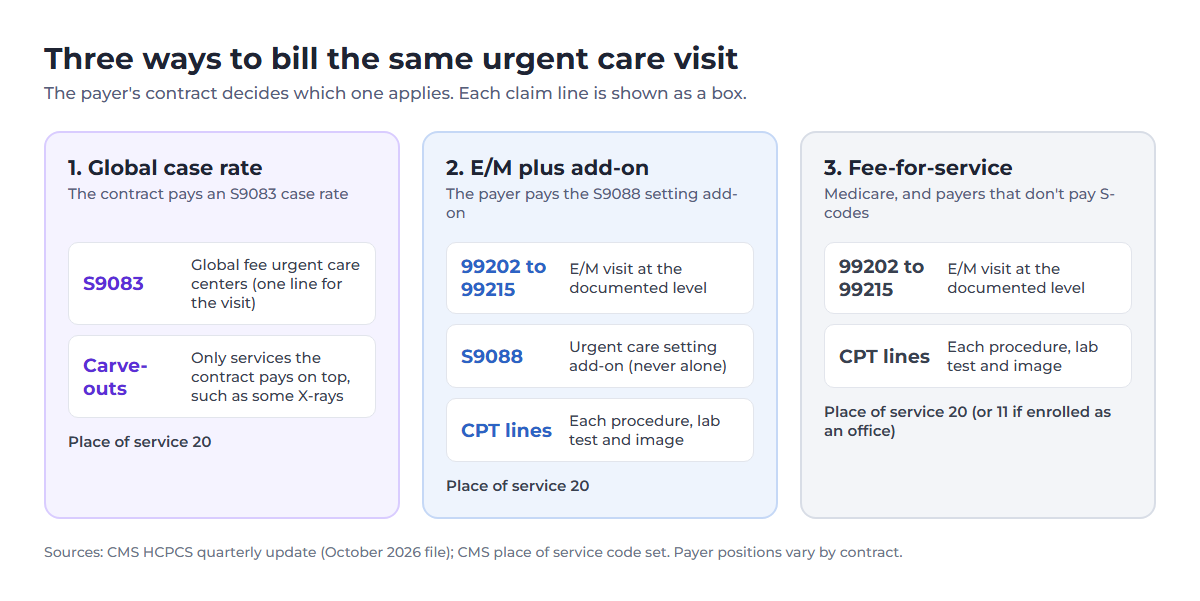
S9083 is the code for a global fee at an urgent care center. Its official description in the CMS HCPCS file is “Global fee urgent care centers”: one case-rate charge that stands for the whole visit, billed only when a payer’s contract pays it that way. People search for it as the “S9083 CPT code”, but it isn’t a CPT code. It’s a HCPCS Level II S-code, and Medicare doesn’t pay it.
Key Takeaways
- S9083 means “Global fee urgent care centers” and S9088 means “Services provided in an urgent care center (list in addition to code for service)”. CMS’s October 2026 HCPCS file gives both coverage code I, “Not payable by Medicare” (CMS HCPCS quarterly update).
- Payers disagree. Blue Cross and Blue Shield of Minnesota treats both codes as informational only, while Ambetter made both payable on August 1, 2026, but only with place of service 20.
- Bill S9083 only when the payer’s contract or published policy asks for it. Everywhere else, bill the E/M visit (99202 to 99215) and each procedure, test and image on its own line.
Why S-codes trip up urgent care billing teams
S-codes are temporary national codes that private payers and Medicaid programs use for services that have no other national code. They sit inside the same HCPCS Level II file CMS publishes every quarter, which is why billing software accepts them without complaint. Acceptance by the software says nothing about payment, though. CMS’s own HCPCS coding procedures say that the existence of a code “does not, of itself, determine coverage or non-coverage” (CMS HCPCS Level II coding procedures).
That’s the trap. An urgent care center can send S9083 to five payers and get five different answers: paid at a case rate, denied as informational, denied for the wrong place of service, paid only with itemized lines, or rejected because the plan is Medicare.
What Is Procedure Code S9083?
S9083 is the HCPCS Level II code for a global fee at an urgent care center. It replaces the line-by-line bill with one charge for the visit, and the payer pays the case rate written into its contract with the center.
Here’s how CMS lists the two urgent care S-codes in its October 2026 HCPCS file:
| Code | Long description (CMS) | Short description | Medicare coverage code |
|---|---|---|---|
| S9083 | Global fee urgent care centers | Urgent care center global | I: not payable by Medicare |
| S9088 | Services provided in an urgent care center (list in addition to code for service) | Services provided in urgent | I: not payable by Medicare |
Source: CMS HCPCS quarterly update, October 2026 alpha-numeric file and its record layout.
What “global fee” means on the claim
A global fee is a case rate. The visit, the exam and whatever the contract bundles in are paid as one amount, whatever the visit’s E/M level would have been. Contracts differ on what sits inside that rate. Some bundle in-house tests and simple procedures; others pay certain procedures, X-rays or supplies on top. The contract, not the code, decides.
S9083 vs E/M codes
On a standard claim, an urgent care visit is an office or outpatient E/M code (99202 to 99215), plus a separate line for each procedure, lab test or image. S9083 replaces that E/M line with the case rate. So in a payer arrangement built on S9083, billing S9083 and an E/M code for the same visit pays for the visit twice, and it’s one of the most common reasons S9083 claims are denied.
What Is the CPT Code for Global Urgent Care?
There’s no CPT code for a global urgent care visit. CPT is the American Medical Association’s code set, and it has no case-rate code for urgent care. When people ask for the “CPT code for global urgent care”, the code they’re after is HCPCS S9083.
Why people call S9083 a CPT code
Billing systems usually show CPT and HCPCS codes in the same procedure field, and many payer fee schedules list them together. That’s why searches like “s9083 cpt code” and “cpt s9083 description” are so common. The distinction matters for one reason: Medicare pays from CPT codes and national HCPCS codes such as G codes, and never from S-codes.
When payers want E/M codes instead
A payer that doesn’t pay S9083 expects the visit billed fee-for-service: the E/M code, place of service 20 and every billable service listed. Blue Cross and Blue Shield of Minnesota, for example, tells clinic-based urgent care centers to bill a professional claim (837P) with place of service 20, and hospital-based urgent care to bill an institutional claim (837I) with revenue code 0456 (Blue Cross MN reimbursement policy, General Coding 011).
What Is Diagnosis Code S9088?
S9088 isn’t a diagnosis code. It’s a HCPCS procedure code, “Services provided in an urgent care center (list in addition to code for service)”. Diagnosis codes come from ICD-10-CM, and none of them look like S9088. The confusion comes from ICD-10-CM injury codes, which also start with S (S00 to S99), so “S9088” looks like a diagnosis at a glance.
How S9088 is billed
The descriptor says it: list it in addition to the code for the service. S9088 is an add-on that tells the payer the visit happened in an urgent care center. It never stands alone. Ambetter’s 2026 provider notice describes it as “used only in addition to an E/M or procedure code” (Ambetter Health provider notice).
S9083 vs S9088 at a glance
The two codes answer different questions. S9083 says “pay this visit at the case rate”. S9088 says “this service happened in an urgent care center, so pay the setting add-on if the contract has one”.
| S9083 | S9088 | |
|---|---|---|
| What it reports | One case rate for the whole visit | The urgent care setting, as an add-on |
| Billed alone? | Yes, as the visit line | No, only with an E/M or procedure code |
| Billed with an E/M code? | Usually not; it replaces the E/M | Yes, that’s its purpose |
| Medicare | Not payable | Not payable |
| Who decides | The payer contract | The payer contract |
Don’t stack them by habit. A claim with S9083, S9088 and an E/M code for one visit asks the payer to pay for the visit three ways.
Which payers pay S9083 and S9088?
No national rule decides it. Each payer’s policy and each contract does. These published policies show how far apart payers are:
| Payer | Position on S9083 and S9088 | Source |
|---|---|---|
| Medicare | Not payable (HCPCS coverage code I). Bill the E/M and services. | CMS HCPCS file, Oct 2026 |
| Blue Cross and Blue Shield of Minnesota (commercial) | Both codes “informational only and not eligible for reimbursement”, because they describe where the service was given, not the service. Last reviewed 07/22/2025. | Policy General Coding 011 |
| Ambetter Health (marketplace plans) | Both payable from 08/01/2026 when billed with place of service 20. Other places of service are denied. | Ambetter provider notice, 2026 |
| UnitedHealthcare and Oxford, New Jersey commercial | Stopped accepting S9083 on 01/01/2018. Centers itemize every service with CPT codes and are still paid the contracted case rate. | Experity, 2017 |
The UnitedHealthcare change shows something worth knowing before a contract renewal: a payer can drop the code and keep the case rate. The center still receives one contracted amount per visit, but the claim has to list every service, so the payer gets visit-level detail it never saw under S9083. If your contract mentions a case rate, ask how the payer wants it billed, not just what it pays.
Why some payers reject S9083 and S9088
Payers that refuse the codes usually give one of three reasons.
- The code doesn’t describe the care. Blue Cross MN’s policy says the codes “represent where the service was rendered, not the service itself” (Blue Cross MN). A global code hides what happened at the visit.
- Medicare rules. S-codes aren’t payable by Medicare. Medicare Advantage plans set their own claim policies, so check each plan’s rules rather than assuming either way.
- The wrong place of service. Payers that do pay the codes tie them to urgent care. Ambetter denies them on any place of service other than 20.
Place of service 20 is CMS’s code for an urgent care facility: a location, distinct from a hospital emergency room, an office or a clinic, whose purpose is to diagnose and treat illness or injury for unscheduled, ambulatory patients seeking immediate medical attention (CMS place of service code set). Check how each payer has your center set up. If you’re credentialed as a physician office, claims with place of service 20 can be rejected, and the credentialing record may need to change before the codes can work.
Build a payer billing matrix
The fix is a one-page matrix that front desk, coders and billers all work from. Keep one row per payer and plan type:
| Question | Where to find the answer |
|---|---|
| Does this payer pay S9083 as a case rate? | Your contract’s fee schedule or rate exhibit |
| Does it pay S9088 as an add-on? | The payer’s reimbursement policy or provider manual |
| Which place of service does it expect: 20 or 11? | Your credentialing and enrollment record with the payer |
| What is inside the case rate, and what is paid on top? | The contract’s bundling or carve-out language |
| Does it want itemized CPT lines with S9083? | The payer’s claim instructions or provider relations |
| Is the plan Medicare or Medicare Advantage? | Eligibility check at registration |
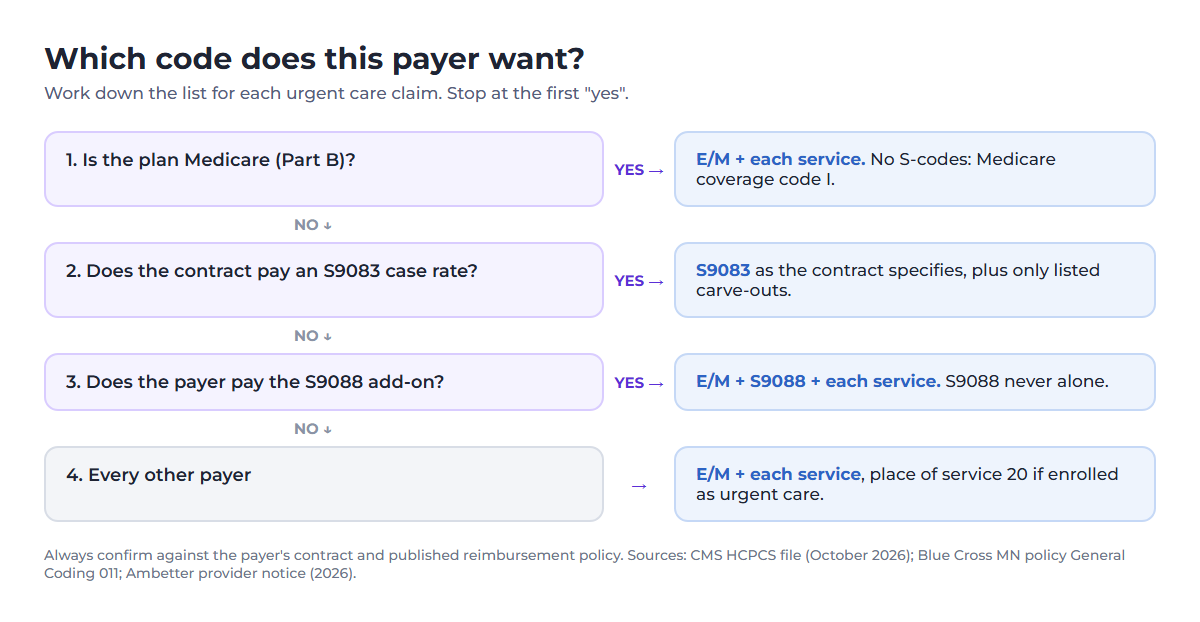
Update it whenever a payer bulletin lands. Ambetter’s August 2026 change is the kind of notice that turns a denial into a payment, but only for centers that see it in time.
Can You Use R Codes as Primary Diagnosis?
Yes, when the provider hasn’t confirmed a diagnosis. The FY2027 ICD-10-CM Official Guidelines say codes for symptoms and signs “are acceptable for reporting purposes when a related definitive diagnosis has not been established (confirmed) by the provider” (Section I.C.18.a). For outpatient visits, Section IV.G adds that the first-listed diagnosis “may be a symptom” when no diagnosis has been established (ICD-10-CM Official Guidelines, FY2027).
When an R-code is the wrong choice
R-codes cause denials when the note supports something more specific. Two rules from the same guidelines matter most in urgent care:
- Don’t code an uncertain diagnosis in outpatient care. “Probable”, “suspected”, “rule out” and “working diagnosis” aren’t coded. Code the symptom, sign or abnormal result instead (Section IV.H).
- Don’t add symptoms that come with the diagnosis. If the provider confirms strep pharyngitis, sore throat isn’t coded separately. A symptom that isn’t routinely part of the diagnosis can be added after it (Section I.C.18.b).
Sequencing that holds up
- A confirmed diagnosis is listed first.
- A symptom is listed first only when nothing has been confirmed, such as chest pain with a normal ECG and no cause found.
- A test result that confirms a condition at the same visit, such as a positive rapid test, supports coding the condition.
Some payers also run edits that deny certain R-codes as the primary diagnosis. Those are payer rules layered on top of the guidelines, so they belong in the matrix too. A coding review catches mismatches before the claim goes out.
Is S9083 a device or a model number?
No. In healthcare, S9083 is a billing code, not a product. The same string also turns up as a part number in unrelated product catalogs, which is why searches like “s9083 model” or “s9083 smart home” return odd results. Adding “HCPCS” or “urgent care” to the search filters them out. You can’t buy a billing code, and it has nothing to do with any device.
Three urgent care claims, billed three ways
These examples show how the same visit changes with the payer. They’re illustrations, not contract terms:
A sore throat with a rapid strep test. For a payer with an S9083 case rate that includes in-house tests, the claim is S9083 with place of service 20 and the diagnosis. For a fee-for-service payer, it’s the E/M level the documentation supports, the rapid test on its own line and the diagnosis linked to both.
A fall with a wrist X-ray. Imaging is often paid outside the case rate, but not always. Check the contract’s carve-out list, and link the X-ray line to the injury diagnosis, not just to “pain”.
A laceration repair with an E/M visit. On a fee-for-service claim, an E/M billed with a procedure on the same day needs modifier 25, and only when the documentation shows a significant, separately identifiable evaluation. Our modifier 25 guide covers that rule. Under a case rate, the repair may be inside the global fee.
Common S9083 denials and how to fix them
Most S9083 denials trace back to one of these. A denial management team can sort your remits by cause and show which one is costing the most:
- Billed to Medicare. Rebill with the E/M code and itemized services.
- S9083 plus an E/M code for one visit. Remove the duplicate visit line, following the contract.
- S9088 billed alone. Add the E/M or procedure code it belongs to.
- Wrong place of service. Use 20 if the payer has you enrolled as urgent care, and fix the enrollment if it doesn’t.
- “Informational” denial on a payer that doesn’t pay S-codes. Rebill fee-for-service and update the matrix so it doesn’t happen again.
- A symptom code listed first when the note confirms a diagnosis. Correct the sequencing and resubmit.
Frequently Asked Questions About S9083
1. What is procedure code S9083?
S9083 is the HCPCS Level II code “Global fee urgent care centers”. It bills an urgent care visit as one case rate, and it’s used only when a payer’s contract pays it that way.
2. What is the CPT code for global urgent care?
There isn’t one. CPT has no global urgent care code. The code people mean is HCPCS S9083, which is an S-code, not a CPT code.
3. What is diagnosis code S9088?
S9088 isn’t a diagnosis code. It’s a HCPCS add-on code, “Services provided in an urgent care center (list in addition to code for service)”, billed with an E/M or procedure code when the payer pays it.
4. Does Medicare pay S9083?
No. CMS’s HCPCS file gives S9083 and S9088 coverage code I, “Not payable by Medicare”. Bill Medicare urgent care visits with the E/M code and each service, using place of service 20.
5. Can S9083 be billed with an E/M code on the same date?
Usually not. S9083 replaces the E/M line in a case-rate arrangement, so billing both for one visit is a common denial. Follow the payer’s contract if it says otherwise.
6. Can you use R codes as primary diagnosis?
Yes, when the provider hasn’t confirmed a diagnosis. ICD-10-CM allows a symptom code first in outpatient care in that case. When the note confirms a condition, code the condition first.
Get your urgent care claims checked
Want to know which of your payers pay S9083, and which are quietly denying it?
Summit Billing Solutions builds the payer matrix for urgent care centers and works the denials behind it. A free account review shows where your claims are getting held up. See our urgent care billing services for what’s included.